
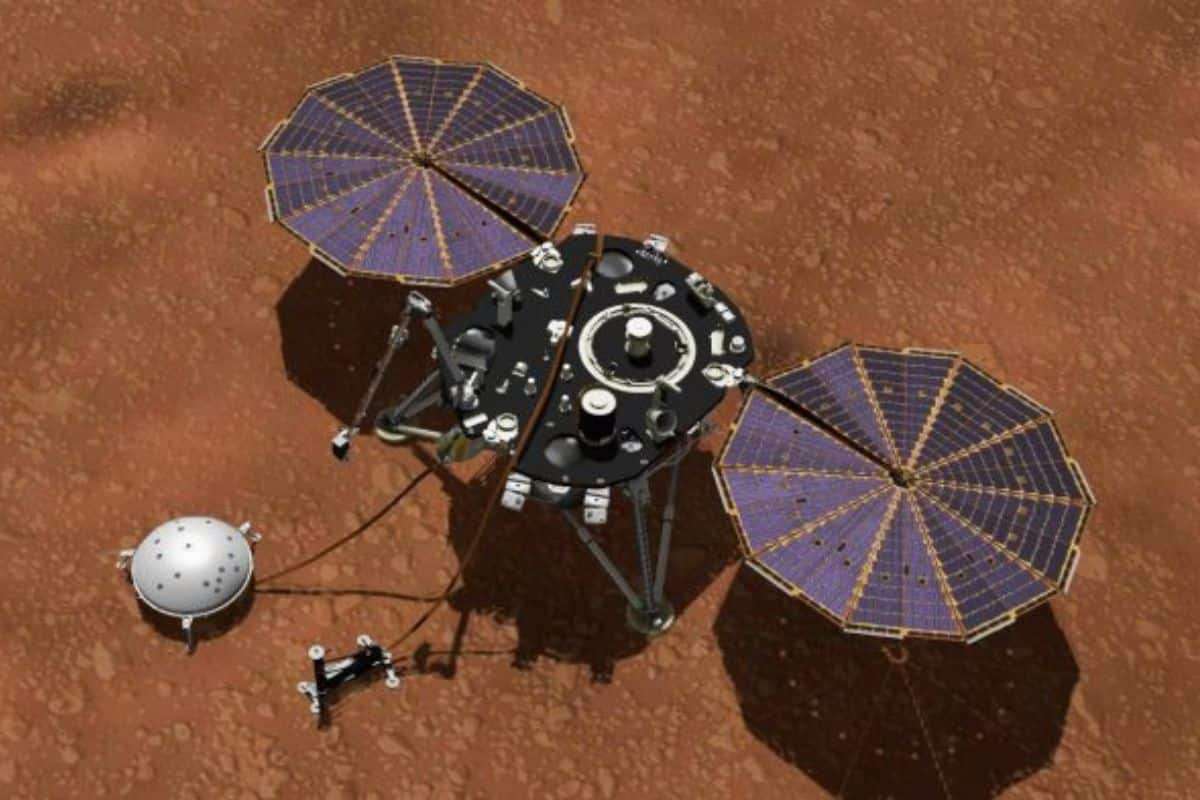
Innovative seismic analysis utilizing data from NASA’s InSight mission has unveiled indications that liquid water may still persist under the Martian surface, sparking renewed prospects for existing microbial life on Mars.
The breakthrough comes from researchers Ikuo Katayama at Hiroshima University and Yuya Akamatsu from the Research Institute for Marine Geodynamics, who examined seismic readings gathered by the SEIS instrument.
InSight’s Window Into Mars’ Subsurface Structure
Their research, published under the title “Seismic discontinuity in the Martian crust possibly caused by water-filled cracks” in Geology, sheds light on the complex interior of Mars and its capacity to harbor life.
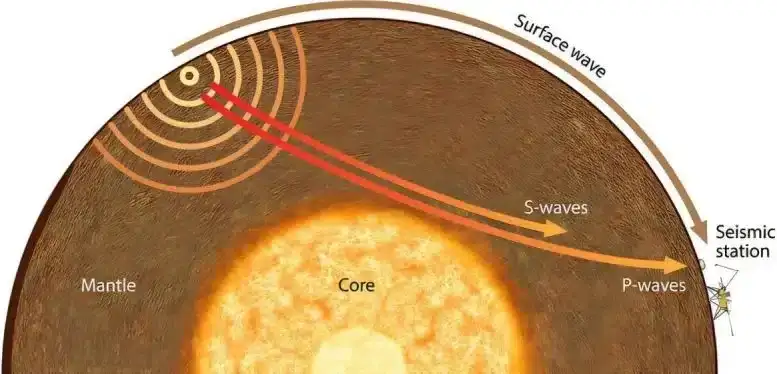
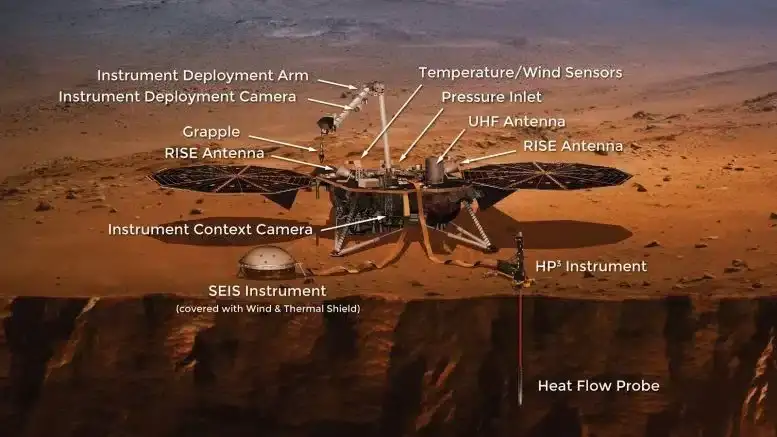
The InSight lander, which touched down on Mars in 2018, was equipped with the SEIS (Seismic Experiment for Interior Structure) seismometer, strategically placed on Martian ground. SEIS captures different seismic waves—P-waves, S-waves, and surface waves—which originate from natural sources like Marsquakes and impacts. The travel paths of these waves provide insight into Mars’ subsurface composition.

Data recorded near 10 and 20 kilometers beneath the surface revealed variations in wave speeds. While earlier interpretations linked these patterns to porosity or compositional shifts, Katayama and Akamatsu propose an alternative: “The presence of liquid water would imply the potential for microbial life,” Katayama emphasizes.
Water-Filled Fractures Instead of Empty Voids
S-waves cannot travel through liquids, while the velocity of P-waves depends on the density of the medium they cross. The team interpreted shifts in these wave characteristics as evidence for a boundary separating dry rock from cracks filled with liquid water.
To validate their theory, they performed controlled laboratory experiments with diabase samples from Rydaholm, Sweden, resembling Martian crust. These samples were tested under varied states—dry, wet, and frozen—while seismic wave propagation was analyzed using piezoelectric sensors.
The laboratory results closely matched the seismic signatures detected on Mars when the diabase was saturated with water. Katayama noted, “Many investigations have highlighted historic water presence on Mars, but our data supports liquid water currently existing beneath its surface.”
Consequences for Exploration and Mars’ Habitability
Should liquid water be confirmed underground, it would transform our understanding of Mars’ habitability by revealing stable, protected niches where microbial life could thrive, shielded from extreme radiation and frigid surface conditions.
Prior studies focused on frozen water or briny solutions near the polar regions, but this seismic evidence advocates for a deeper reservoir of stable liquid water insulated beneath Mars’ crust.
A Strengthened Argument for Life Beyond Earth
Insights from InSight’s seismic readings bolster the growing hypothesis that Mars remains geologically—and possibly biologically—active. If supported further, Katayama and Akamatsu's model may influence the design of future missions aimed at drilling into the subsurface to detect signs of life.
While definitive proof requires direct investigation, current evidence of liquid water beneath Mars’ surface encourages ongoing exploration beneath the crust, mirroring how life persists in extreme underground habitats on Earth.
- Categories:
- News





0 comments
Sign in to Comment