
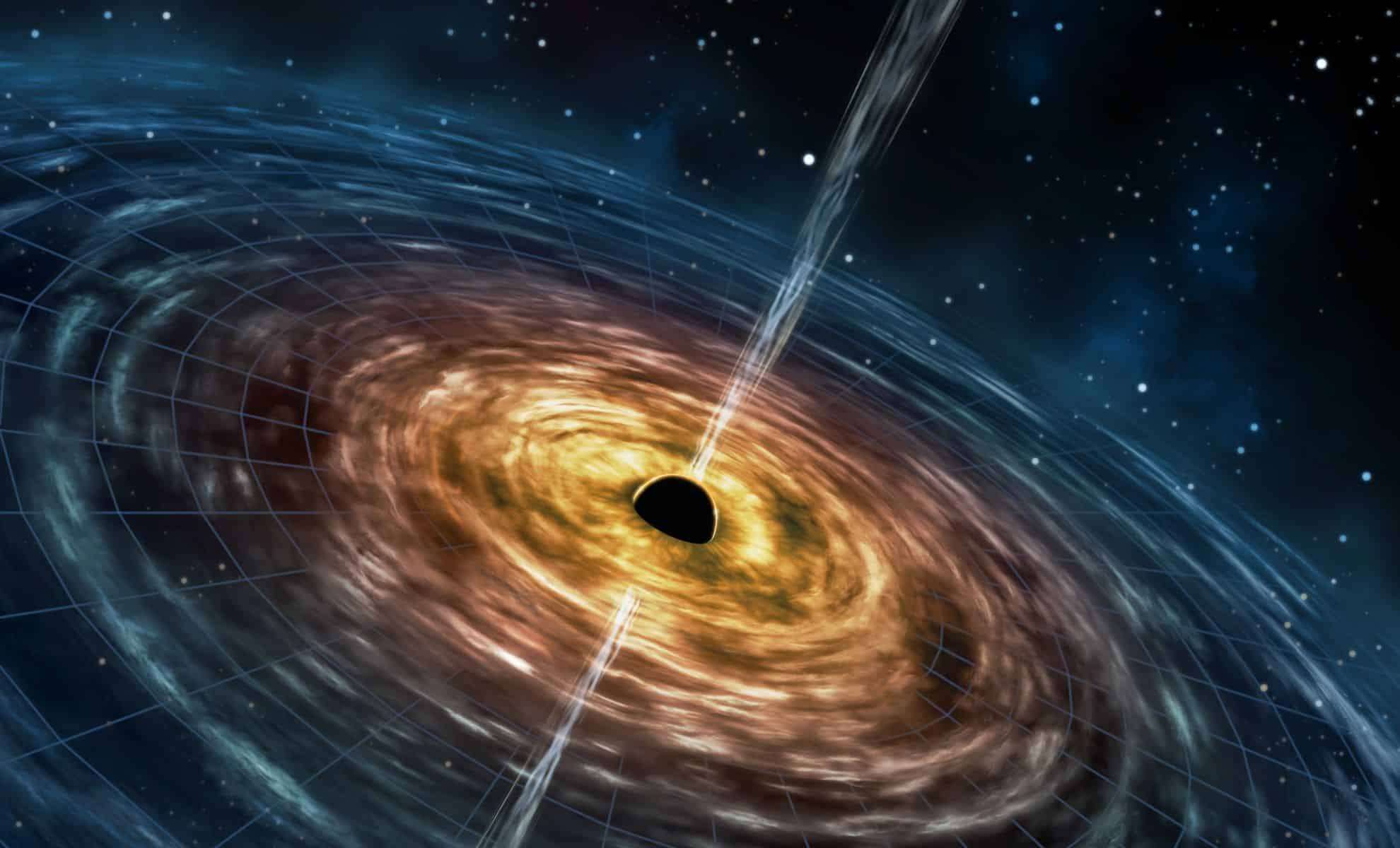
Dutch researchers have unveiled findings that dramatically reduce the anticipated timeframe for the universe's demise. Their pioneering study, featured in the Journal of Cosmology and Astroparticle Physics, estimates that the universe might conclude in roughly 10⁷⁸ years, a significant decrease from earlier forecasts that predicted a universe lifespan stretching to 10¹¹⁰⁰ years. This discovery builds on a related study investigating cosmic decay mechanisms driven by Hawking radiation.
The team—Heino Falcke, Michael Wondrak, and Walter van Suijlekom—all members of Radboud University in Nijmegen, have presented fresh perspectives on Hawking radiation, a phenomenon first proposed by physicist Stephen Hawking in 1975. Their models reveal that cosmic bodies, including white dwarfs, neutron stars, and even human bodies, might experience a gradual "evaporation" within unexpectedly brief time spans. Though theoretical at this stage, these insights deepen our understanding of the universe’s distant future.
The Shorter Lifespan of White Dwarfs and Its Cosmic Implications
The researchers' primary finding indicates that white dwarf stars, once considered among the universe’s most long-lasting objects, could disappear far sooner than previously assumed. Their projections suggest that these stellar remnants, thought to persist for about 10¹¹⁰⁰ years, actually degrade within 10⁷⁸ years via a process resembling Hawking radiation. This adjustment challenges longstanding cosmological models and brings the ultimate fate of the cosmos closer into view.

Lead author Heino Falcke commented on this revised timeline: “The universe’s final conclusion approaches sooner than past estimates, yet it still spans an immense duration.” This update highlights subtle quantum processes that lead to the slow disappearance of cosmic structures previously regarded as virtually permanent.
Hawking Radiation's Crucial Role in Cosmic Evaporation
The mechanism known as Hawking radiation, initially theorized to explain black holes steadily losing mass, underpins this new vision of universal decay. According to the study, both neutron stars and black holes undergo evaporation through similar effects. Their calculations estimate that these bodies will fade away over roughly 10⁶⁷ years, a timeframe that intriguingly places neutron stars and black holes on comparable decay schedules despite their differing properties.
Surprisingly, black holes do not evaporate faster than neutron stars because, lacking a physical surface, they reabsorb part of the radiation they emit, which slows their decay. As co-author Michael Wondrak explains, “Black holes have no surface; they reabsorb some of their own radiation which inhibits the process.”
Estimating the Evaporation of Everyday Objects: Humans and the Moon
The team extended their approach by estimating how long objects like the moon and a human body would require to vanish through a similar radiation-driven evaporation. They found both would take on the order of 10⁹⁰ years to fully dissipate via this theoretical phenomenon. Naturally, other natural processes would realistically erase these objects much faster.
Mathematics professor and co-author Walter van Suijlekom emphasized the importance of examining such extreme cases: “By asking these kinds of questions and looking at extreme cases, we want to better understand the theory, and perhaps one day, we will unravel the mystery of Hawking radiation.” This reflects the larger ambition of the research team to deepen our grasp on fundamental physics by exploring the universe’s most extreme scenarios.
- Categories:
- News










0 comments
Sign in to Comment