
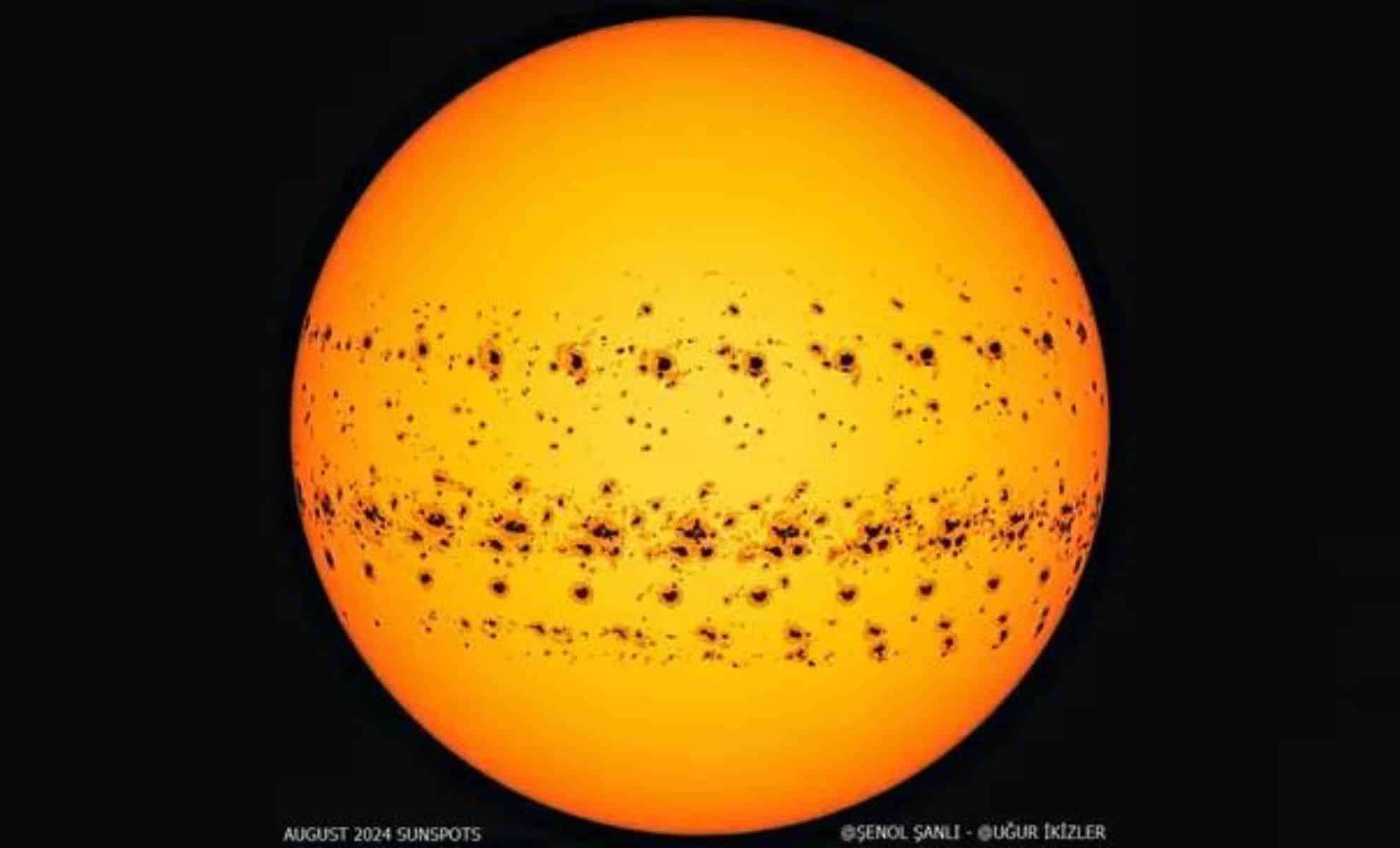
In August 2024, the Sun exhibited its highest sunspot count in over two decades, averaging 215.5 spots per day, Live Science reports.
This surge surpassed earlier projections, indicating that Solar Cycle 25 is not only stronger but has reached its peak sooner than anticipated. The record of 337 sunspots observed on August 8 represents the most sunspots recorded in a single day since 2001, suggesting that the solar maximum phase is currently underway.
Understanding Sunspots and the Solar Cycle
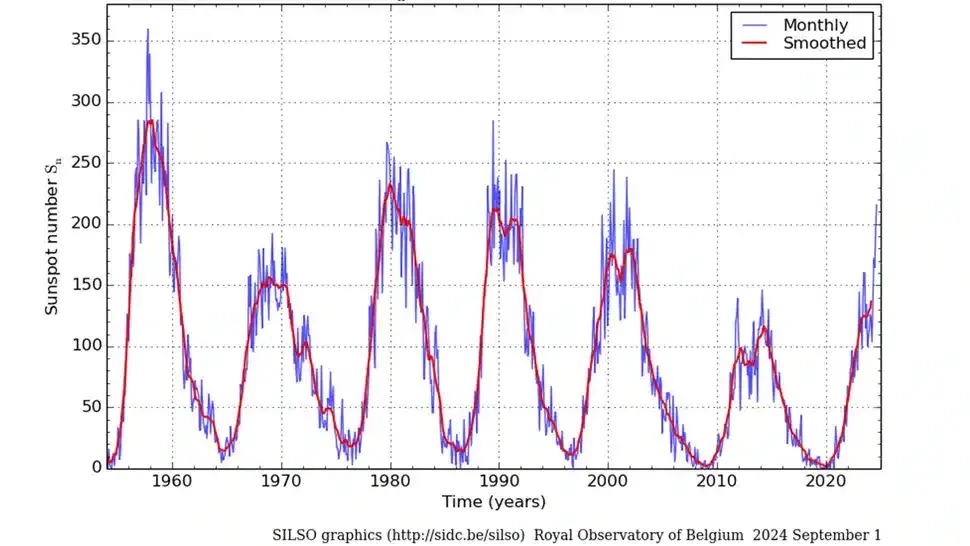
Sunspots are darker, cooler areas on the Sun's surface formed by disruptions in its magnetic field, serving as markers of solar activity levels. The Sun follows an approximately 11-year cycle oscillating between low activity periods, known as solar minimums, and high activity phases, or solar maximums, characterized by increased sunspot numbers. Solar Cycle 25 commenced in 2020, with initial models forecasting a peak similar in strength to the relatively weak Solar Cycle 24 that culminated in 2014. However, by early 2022, the rapid rise in sunspots challenged these expectations, signaling a more vigorous cycle than predicted.

During solar minimum, sunspots largely disappear, as observed in late 2019 just before the onset of Solar Cycle 25. As the Sun's magnetic field warps and intensifies, sunspot numbers climb until reaching solar maximum, marked by heightened solar flare activity and frequent coronal mass ejections (CMEs).
The August 2024 daily peak of 337 sunspots, the highest in over 20 years, has led researchers to conclude that Solar Cycle 25 is approaching or already at its maximum phase, characterized by an impending reversal of the Sun's magnetic polarity. This unexpected performance has compelled experts to update their solar activity models.
Stronger Than Expected Solar Maximum
Experts initially anticipated a subdued solar maximum for Solar Cycle 25, comparable to the relatively weak peak of Solar Cycle 24 in 2014, known as the lowest in nearly a century. The Space Weather Prediction Center (SWPC) had projected an average of 107.8 sunspots daily for August 2024. Instead, the actual figure nearly doubled to 215.5, signaling a robust and escalating phase of solar activity that has persisted since 2022, leading to revised forecasts of a more active solar cycle.
Updated SWPC projections now place the solar peak around mid-2024, arriving ahead of schedule with unexpectedly high intensity. Continually exceeding sunspot estimates reflects a more dynamic and energetic Sun, with expectations that the current cycle might grow even stronger before waning.
The heightened activity implies increased chances of disruptive solar flares and CMEs. Such events can interfere with satellite operations, GPS accuracy, and radio communications, while CMEs may spark geomagnetic storms capable of damaging power grids and critical infrastructure.
Effects of Solar Peak on Earth's Environment
The ongoing solar maximum has already produced notable effects on Earth. In May 2024, a powerful geomagnetic storm—the most intense in 21 years—caused striking auroras and potential satellite disturbances. Shortly after, the Sun unleashed an X8.7-class solar flare, the strongest such event since 2017, underscoring the escalating solar risks.
Geomagnetic storms, triggered by solar flares or CMEs, not only produce vivid auroras at unusual latitudes but also threaten modern technology. These storms result from solar particles impacting Earth’s magnetic field, generating electrical currents that can overload power systems. The historic Carrington Event of 1859—still the most powerful recorded geomagnetic storm—disrupted telegraph networks worldwide and produced auroras visible near the Caribbean. If a similar storm hit today, the consequences for electrical grids and communications infrastructure could be severe.
Scientists remain vigilant, tracking sunspot activity closely to anticipate the solar maximum's peak and its potential terrestrial impacts in the months ahead.
Outlook for the Intensified Solar Maximum
The unexpectedly rapid escalation in sunspots represents a major deviation from earlier Solar Cycle 25 forecasts, which predicted a modest peak. As sunspot counts rise, researchers continue to refine their solar models to better capture the Sun’s evolving behavior. Solar maximums generally last between one and two years, indicating the current elevated activity could persist before the Sun gradually transitions to a quieter phase.
This heightened solar output carries broad implications. As the Sun emits more frequent solar flares and CMEs, Earth's technological systems face increased vulnerability to geomagnetic disturbances. Protecting satellites, power grids, and communication networks requires ongoing observation and preparedness.
Ultimately, the record-breaking sunspot activity highlights a robust solar maximum, defying initial expectations for Solar Cycle 25. This serves as a compelling reminder of the Sun’s complex, dynamic nature and the importance of continued research into its influence on our planet.
- Categories:
- Astronomy ,
- News









0 comments
Sign in to Comment