
For a long time, scientists have viewed the universe as a vast and uniform space where properties remain consistent throughout. But emerging evidence now hints that this may not be entirely accurate. A groundbreaking study points toward the universe having an uneven distribution, revealing a potential cosmic irregularity that could fundamentally alter our grasp of the cosmos. Published in Reviews of Modern Physics, these insights are driving experts to reconsider established cosmological theories.
An Unanticipated Cosmic Imbalance
The article in Reviews of Modern Physics explores new evidence suggesting that the universe’s large-scale structure may not be as uniform as previously assumed. Traditional models have long relied on the idea that the universe is isotropic, exhibiting the same characteristics in every direction. Yet, recent analyses of cosmic microwave background (CMB) radiation—the thermal remnant from the Big Bang—have indicated anomalies inconsistent with this principle. This “Cosmic Dipole Anomaly” proposes that the cosmos could be directional, a notion that challenges prior cosmological expectations.
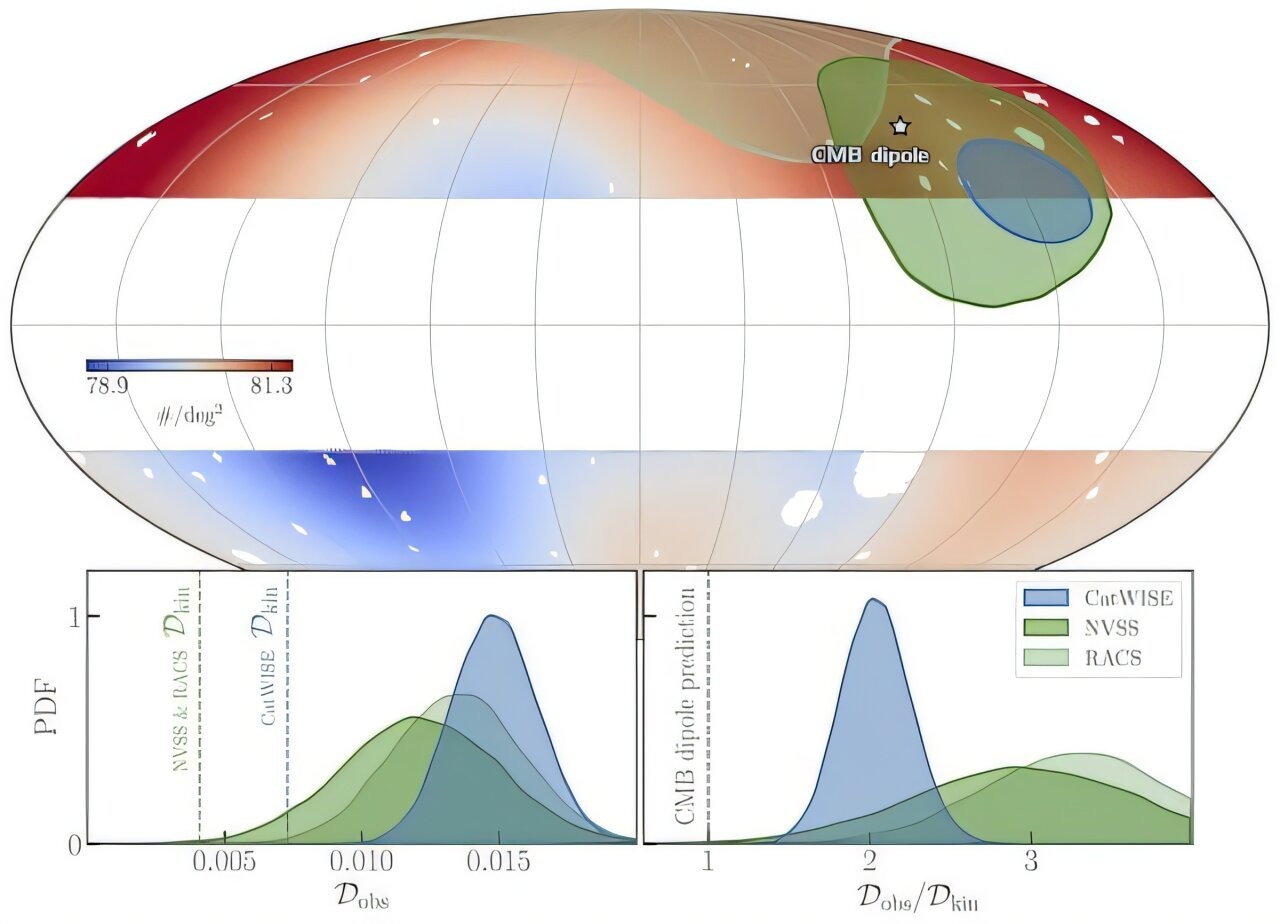
Initial detection of this anomaly came from subtle temperature variations within the CMB that correlate with the movement of our solar system against the backdrop of the broader universe. Such directional dependence suggests our galaxy might be traveling through a specific alignment in space unanticipated by standard cosmological frameworks. This discovery raises compelling new questions about the universe’s fundamental nature.

Illuminating Early Universe Conditions Through the CMB
Cosmic Microwave Background (CMB) radiation serves as a critical relic from roughly 380,000 years after the Big Bang, offering invaluable insights into the universe’s infancy. For decades, cosmologists have leveraged the CMB’s primarily uniform temperature map, marked only by minor fluctuations, to infer the primordial distribution of cosmic matter.
However, the observed “Cosmic Dipole Anomaly” reveals that temperature variations are skewed in a particular direction, suggesting that the universe might not be isotropic on the grandest scales. This directional bias might indicate unknown influences affecting matter arrangement or even the fabric of space-time itself.
What It Means if the Cosmos Is Directional
Confirmation of the “Cosmic Dipole Anomaly” would have significant consequences for cosmological theories. It suggests that the universe’s large-scale structure could have distinct orientations rather than being uniform in every direction. Such a revelation may lead to revisions of cosmic inflation models, a theory describing the rapid expansion of the universe immediately after the Big Bang and laying the groundwork for cosmic structure formation.
An uneven cosmos also invites scrutiny into the roles of dark energy and dark matter. Dark energy, attributed with accelerating universal expansion, might contribute to or be influenced by these asymmetries. Similarly, the uneven dispersal of dark matter, which composes much of the universe’s unseen mass, could cause unexpected effects within the CMB.
Reevaluating Cosmology: Possible New Physics
The potential discovery of cosmic asymmetry opens the door for new physics beyond current models. The widely accepted Lambda Cold Dark Matter (ΛCDM) model presupposes a universe that is both isotropic and homogeneous. The “Cosmic Dipole Anomaly” calls this foundational assumption into question, suggesting gaps in our understanding.
This anomaly might indicate unknown forces or particles influencing space or point to early-universe phenomena yet to be understood. Some researchers speculate that interactions between dark matter and normal matter could be involved. Others propose more exotic explanations, such as the influence of extra dimensions or other phenomena absent from standard theory.
A Fresh Look at the Big Bang
The implications of the “Cosmic Dipole Anomaly” extend to our conceptualization of the Big Bang itself. Traditionally, this event has been viewed as a uniform beginning of the universe. However, the observed asymmetry could imply that the Big Bang was more complex, involving uneven distributions of matter from the outset.
Such findings could prompt cosmologists to update models describing early cosmic expansion and matter distribution, including adjustments to the theory of cosmic inflation. This perspective envisions a universe whose primordial structure was directionally biased, influencing the growth and arrangement of cosmic structures seen today.
- Categories:
- Astronomy








0 comments
Sign in to Comment