

NASA’s New Horizons probe has delivered unprecedented insights into the profound darkness permeating the cosmos, indicating the universe contains fewer galaxies than previously believed.
Operating from a vantage point far past the inner Solar System, this mission has achieved the most precise measurement to date of the cosmic optical background (COB)—the faint diffuse glow produced by all light-emitting sources across the universe.
Unraveling the Mysteries of Cosmic Darkness
Astronomers have long grappled with Olber’s paradox: the question of why the night sky remains dark if the universe is infinite and filled with stars. Efforts to understand this paradox focus on quantifying the COB, which sums the light emitted by stars, galaxies, and other celestial bodies throughout cosmic time.

Measurements taken from within the inner Solar System face significant challenges due to zodiacal dust—tiny particles that scatter sunlight and create a hazy veil that masks the faint glow from distant galaxies. New Horizons, now over 7.3 billion kilometers from Earth, has ventured beyond this dust haze, granting scientists an unprecedented opportunity to capture clearer readings of the universe’s faint light. As co-investigator Tod Lauer noted, “Repeated attempts from inner solar system locations are impeded by sunlight scattering off interplanetary dust, creating a fog-like brightness that conceals the distant universe’s subtle illumination.”
Reevaluating Galaxy Numbers in Light of New Data
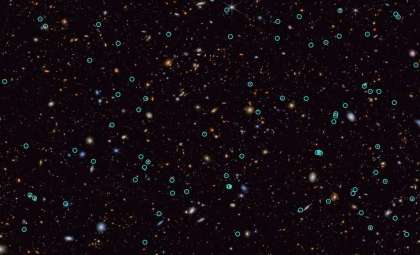
New Horizons’ observations challenge prior assumptions by showing that nearly all visible light detected is accounted for by galaxies already known, with no substantial light contributions from unknown or hidden sources. This conclusion contrasts with previous studies, which suggested the universe might host up to 2 trillion galaxies based on extrapolations from deep-field images captured by the Hubble Space Telescope.
Instead, the New Horizons data points to a lower total galaxy count—around 200 billion—a figure that corresponds with older theoretical models but with reduced uncertainty. The study’s lead author, Marc Postman of the Space Telescope Science Institute, emphasized, “Our observations now tightly constrain how dark space truly is. The overwhelming majority of visible cosmic light originates in galaxies, and there is no indication of substantial emission from unknown sources.”
This new perspective has significant consequences for our cosmic map, implying a less densely populated universe and potentially different large-scale galaxy distributions than earlier models anticipated.
Broader Cosmological Impact and Future Investigations
Beyond refining galaxy counts, these findings strengthen cosmological models by confirming that the COB arises almost entirely from galactic light. This coherence supports our current understanding of the universe’s architecture and composition, suggesting no hidden reservoirs of light exist on a grand scale.
Originally designed for exploring Pluto and the Kuiper Belt, New Horizons continues to prove invaluable in broader astronomical research. Principal investigator Alan Stern commented, “This important cosmological measurement is uniquely achievable with a distant spacecraft like New Horizons.”
The revised lower estimate of galaxy numbers could also influence theories about dark matter distribution, galaxy formation rates, and cosmic evolution, potentially sparking a reassessment of early universe models.
Understanding Our Dark, Expansive Universe
The latest New Horizons findings enrich our picture of the universe’s vast darkness. By measuring the COB with unmatched accuracy, researchers have refined our estimate of the universe's galaxy population and reaffirmed that the known galaxies account for nearly all visible cosmic light. As Lauer summarized, “The simplest explanation is that all cosmic optical background light arises from galaxies; beyond those, space is truly dark.”
These insights will underpin future cosmic research, demonstrating that despite New Horizons’ origins in Solar System exploration, it continues to illuminate the mysteries of the wider universe from the edge of the solar neighborhood.
- Categories:
- Astronomy ,
- News ,
- Space ,
- Nasa






0 comments
Sign in to Comment