

Saturn’s moon Titan stands out as a unique celestial body in our Solar System, known for its abundant surface liquids and Earth-like geological features that continue to captivate researchers.
Recent investigations using radar data from the Cassini-Huygens spacecraft have shed light on the mysterious lakes and seas composed of liquid hydrocarbons on Titan. These insights, obtained through bistatic radar techniques, have deepened our understanding of the surface textures and chemical makeup of Titan’s northern hydrocarbon seas.
Debates Over Wave Activity on Titan’s Surface
The surface of Titan is decorated with pools of methane and ethane, creating a terrain somewhat reminiscent of Earth’s primordial landscape. The dynamics of these liquid reservoirs, particularly regarding wave formation and size, has been a subject of debate among planetary scientists. Some findings suggested that waves on Titan might be energetic enough to reshape shorelines.

Conversely, alternative analyses of Cassini’s radar observations argue that the waves across Titan’s hydrocarbon seas are very subtle, often only a few millimeters high. This contradiction prompts further inquiry into the mechanisms governing surface activity on Titan’s liquid bodies.
“Radar data obtained by Cassini over Titan’s polar seas, analyzed by the team led by Dr. Valerio Poggiali from Cornell University, indicated that surface roughness on Kraken, Ligeia, and Punga Mare ranges only a few millimeters.” This suggests that although Titan harbors liquid expanses, the presence of substantial waves is limited.
Advancements Through Cassini’s Bistatic Radar Technique
In a pioneering investigation, Valerio Poggiali and colleagues at Cornell University applied Cassini’s bistatic radar experiments to gain a refined understanding of the texture and composition of Titan’s seas.
Unlike conventional monostatic radar, which receives reflected signals by the same spacecraft, bistatic radar directs the signals toward Earth, offering richer and more nuanced data. This method allowed researchers to better separate surface roughness effects from compositional influences, resulting in a clearer characterization of Titan’s liquid terrains.
The focus was on Titan’s three largest hydrocarbon seas: Kraken Mare, Ligeia Mare, and Punga Mare. The analysis confirmed predominantly placid surfaces, with wave heights rarely exceeding 3.3 millimeters. Slightly increased roughness, reaching around 5.2 millimeters, was observed near shorelines and river inlets, which could indicate subtle tidal flows. Poggiali remarked, “Bistatic radar offers a more complete dataset that is sensitive to both the chemical properties and the roughness of the surface.”
Revealing the Chemical Makeup of Titan’s Hydrocarbon Lakes
The study unveiled important variations in Titan’s hydrocarbon seas’ composition depending on geographic location and proximity to feeding channels. Notably, the southern region of Kraken Mare demonstrated the highest dielectric constants, pointing to distinct surface materials.
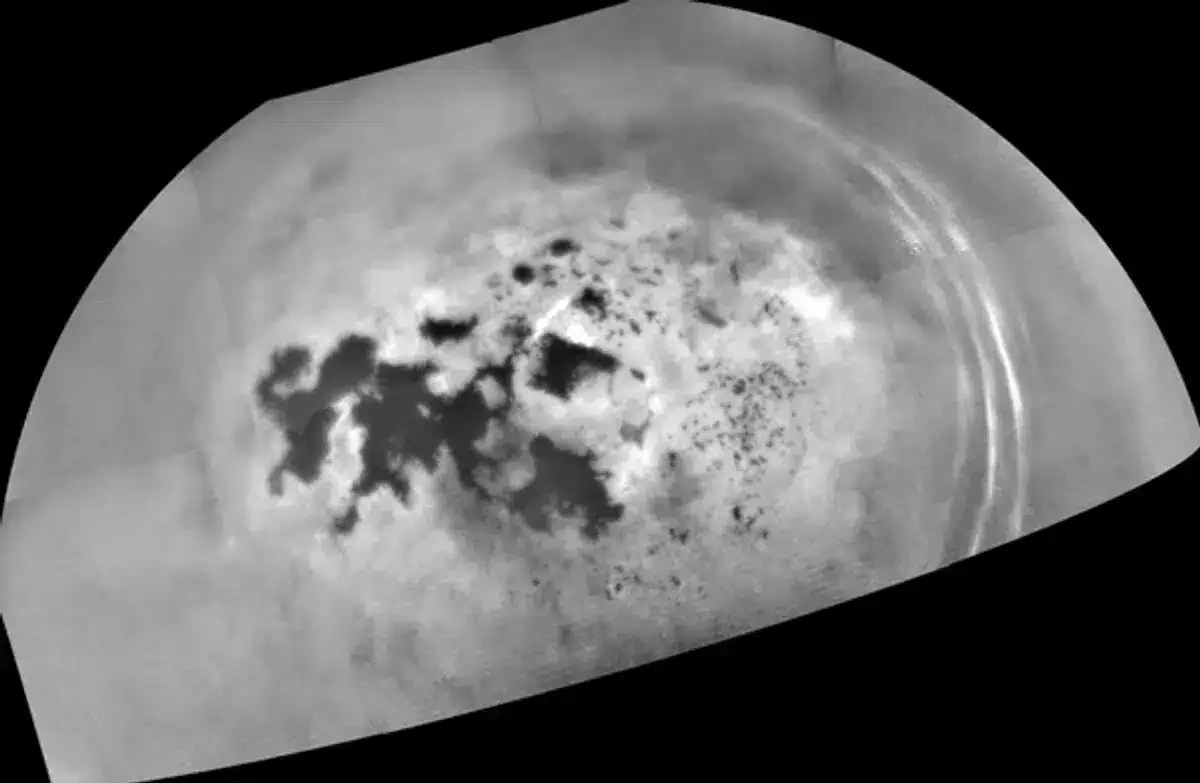
The research indicates that Titan’s tributaries consist predominantly of methane, which blend into ethane-rich seas, a process analogous to freshwater rivers merging with salty oceans on Earth. Poggiali explained, “The rivers sustaining the seas are mainly pure methane before mixing with the ethane-rich liquid bodies, similar to how on Earth fresh water joins salty seas.”
These observations harmonize with atmospheric models that suggest Titan experiences mostly methane precipitation, alongside minor ethane and other hydrocarbon traces. Co-author and astronomy professor Philip Nicholson stated, “This aligns well with meteorological predictions for Titan, where rain is expected to be nearly pure methane with some ethane and additional hydrocarbons.”
Looking Ahead: Missions and Investigations
The revelations derived from Cassini’s radar research mark a foundational step toward unraveling Titan’s complex environment. The upcoming Dragonfly mission promises to explore this intriguing moon in greater detail, focusing on its weather systems, surface liquids, and the potential for chemical precursors to life. Poggiali emphasized the treasure trove of data left to explore, stating, “A vast amount of data remains to be analyzed, promising further breakthroughs. This is just the initial progress.”
The continued study of Cassini’s extensive archives is crucial for advancing our comprehension of Titan’s Earth-like attributes. Deeper analysis is expected to reveal more about the moon’s dynamic systems, offering valuable parallels to early Earth conditions. This ongoing research underscores the necessity for innovative spacecraft missions to probe the solar system’s enigmatic worlds.
By investigating the behavior and characteristics of Titan’s liquid seas, scientists aim to better understand geological and atmospheric processes potentially similar to those shaping our own planet's ancient past. The new conclusions from Cassini’s radar data provide a vital foundation to support future explorations of this captivating moon.
- Categories:
- Astronomy ,
- News ,
- Space ,
- Aircraft






0 comments
Sign in to Comment