

For many years, experts attributed Mars’s distinctive red coloration primarily to hematite, an iron oxide typically formed in dry conditions. Yet, recent research introduces a different mineral as the principal agent behind the rusty tones that define the Martian landscape.
This breakthrough not only clarifies the cause of Mars’s striking appearance but also implies the Red Planet may have once endured cooler and wetter climates than scientists previously assumed.
Introducing Ferrihydrite
Ferrihydrite is an iron oxide mineral rich in water, forming only where cool liquid water is present. Differing from hematite, which arises under dry and oxygen-rich conditions, ferrihydrite’s emergence signals that ancient Mars harbored sufficient water to sustain and preserve such minerals. This challenges earlier beliefs that the planet’s red dust resulted mainly from dry oxidation processes.

BBC Sky Night Magazine reports ferrihydrite as a poorly crystalline iron oxide-hydroxide, a characteristic that aids researchers in discerning how and when Mars’s dusty surface formed, according to Briony Horgan, a planetary science professor at Purdue University.
The mineral’s ability to remain stable despite Mars's current cold, arid environment means it could have persisted on the surface since those wetter epochs.
Methods Behind Detecting Ferrihydrite on Mars
Scientists combined data from various sources—including orbital observations from Mars Express and Mars Reconnaissance Orbiter—along with images from rovers and Earth-based mineral simulations. Matching the spectral patterns of Martian dust, they identified a combination of ferrihydrite, basalt, and sulfate as the likeliest explanation for Mars’s red hue.
Lab experiments reinforced these findings by showing ferrihydrite’s stability under conditions akin to today’s Martian surface, in contrast to hematite, whose spectral properties do not align as well with observations. This strongly suggests that ferrihydrite largely accounts for the planet’s rusty shade.
Implications for Mars’s Ancient Climate
The identification of ferrihydrite on Mars offers vital clues about the planet’s environmental history. Because ferrihydrite forms under cool, wet, and oxidative conditions, it points to past Martian climates that were markedly different from today’s dry and barren state. The study suggests these minerals originated during times when liquid water existed before Mars became the hyper-arid world we observe now.
“Evidence of ferrihydrite has also been found in lakebed sediments at Gale crater, explored by the Curiosity rover. Ultimately, obtaining Martian dust samples for laboratory analysis on Earth would be the best way to definitively unravel this mystery,” said Horgan.
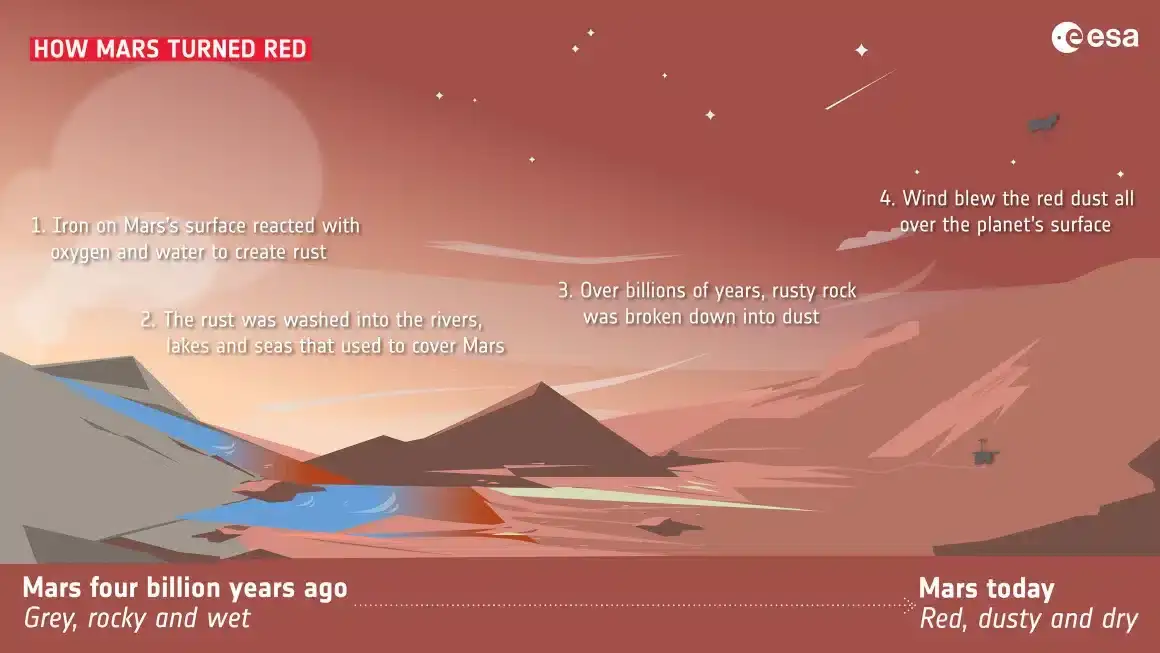
This insight overturns earlier assumptions that Mars’s surface redness came solely from dry iron oxidation. Instead, the presence of ferrihydrite underscores the significant influence water had on shaping the planet’s surface chemistry and preserving a record of its watery past. These findings provide essential context for upcoming missions aiming to uncover signs of past life on Mars.
- Categories:
- Space











0 comments
Sign in to Comment