

The origins of the famed Tyrannosaurus rex have been a subject of intense debate among paleontologists. While fossils predominantly appear in North America, questions remained whether this region was the actual birthplace or if the species' ancestors migrated from a different continent.
A recent investigation spearheaded by paleoecologist Cassius Morrison at University College London has provided fresh insights, proposing that T. rex’s earliest predecessors might have journeyed from Asia through the prehistoric Bering land connection.
Mapping the Continental Journey of Tyrannosaurus rex
Utilizing a combination of fossil evidence, dinosaur phylogenies, and Late Cretaceous climatic and geographic data, the international research team reconstructed possible migration patterns. Morrison notes, “While numerous T. rex fossils have been discovered in North America, our data imply that the ancestors of T. rex might still be awaiting discovery in Asia,”

These findings are consistent with prior research indicating a closer kinship between T. rex and Asian tyrannosaurids like Tarbosaurus, rather than with other North American relatives such as Daspletosaurus.
In early 2024, a separate group announced the discovery of a fossil of Tyrannosaurus mcraeensis from New Mexico dating roughly six million years before T. rex. This sparked claims that massive tyrannosaurs originated in North America. Yet, Morrison and colleagues dispute this due to the limited fossil samples and uncertainties in dating techniques.
The Untold Story Of Dinosaur Predators Taking Over
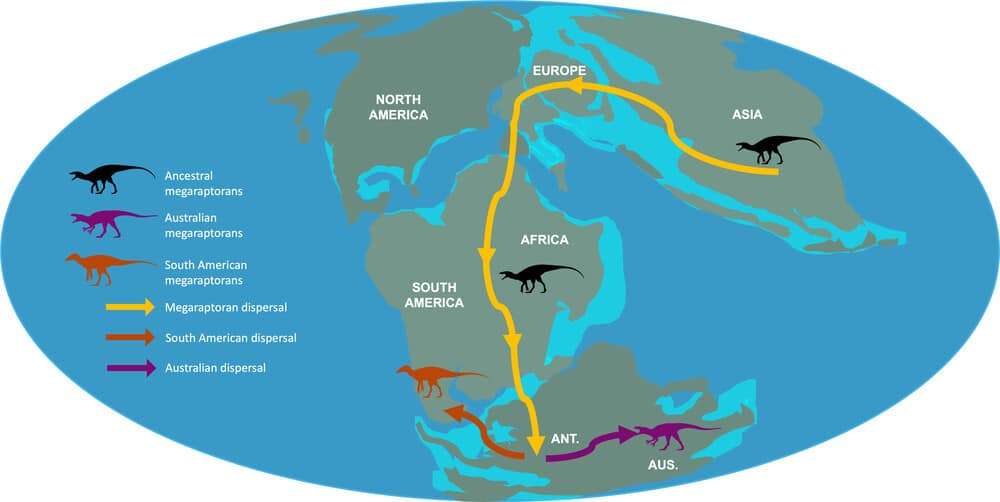
Evidence of smaller tyrannosaur ancestors suggests migration over the Beringian land bridge connecting Asia and North America. The study also traces the evolutionary history of other predatory dinosaurs, including megaraptors, which first appeared in Asia about 120 million years ago.
These carnivorous dinosaurs subsequently dispersed to regions such as Europe and the southern supercontinent Gondwana. Paleontologist Mauro Aranciaga Rolando from the Bernardino Rivadavia Natural Sciences Museum in Argentina remarks that megaraptors were “a component of a widely distributed and varied dinosaur fauna” early in their evolutionary history.
As tectonic plates shifted, megaraptors developed specialized niches. In Asia, tyrannosaurs eventually supplanted them, whereas in Australia and Patagonia, megaraptors evolved into dominant apex predators within their ecosystems.
How Tyrannosaurs and Megaraptors Became Giants Amid Changing Climates
The research indicates that roughly 92 million years ago, both megaraptors and tyrannosaurids reached immense sizes as the planet's climate cooled. However, no direct correlation was found linking climate shifts to this gigantism.
Rather, these theropods appear to have thrived in cooler environments, allowing them to occupy the apex predator role left open following the disappearance of large carcharodontosaurid theropods around 90 million years ago.
Charlie Scherer, a paleontologist and co-author from UCL, adds, “Their large size likely developed to fill the ecological void created by the extinction of giant carcharodontosaurid theropods roughly 90 million years ago. This event removed the competition barrier that previously limited tyrannosaurid growth.”
- Categories:
- News







0 comments
Sign in to Comment