

Researchers have identified an intriguing exoplanet named TOI-5734 b, situated approximately 106 light-years from our solar system. Utilizing data from the Transiting Exoplanet Survey Satellite (TESS) along with the HARPS-N spectrograph, this find broadens our perspective on the variety of planets orbiting other stars. Presented in a February 2026 publication hosted on arXiv, the exoplanet belongs to the sub-Neptune classification and offers essential insights into the development and atmospheric dynamics of planets beyond our solar neighborhood.
A Significant Addition to Exoplanet Discoveries: TOI-5734 b
The identification of TOI-5734 b represents a key advancement in exoplanet research, particularly for those in the sub-Neptune size range. An international collaboration used data from the TESS mission and the HARPS-N spectrograph to reveal this hot, rocky world orbiting a youthful star. Positioned roughly 106 light-years away in the constellation Lyra, this planet exemplifies how advanced observational tools are helping scientists explore remote planetary systems. The corresponding research, available on arXiv, reports that TOI-5734 b has a radius about twice that of Earth, highlighting its considerable scale.
Orbiting its star, TOI-5734, a young K3-K4 dwarf, every 6.18 days, TOI-5734 b possesses a mass approximately nine times Earth's and a radius measuring 2.1 Earth radii. Categorized as a hot sub-Neptune, the planet likely maintains a substantial gaseous envelope. The discovery team, led by Simone Filomeno from the Astronomical Observatory of Rome, Italy, combined observations from three TESS sectors with spectral data from the HARPS-N instrument at the Galileo National Telescope. The scientists observed that,

“In this paper, we present the detection and characterization of the transiting young planetary system TOI-5734 (TIC 9989136).”
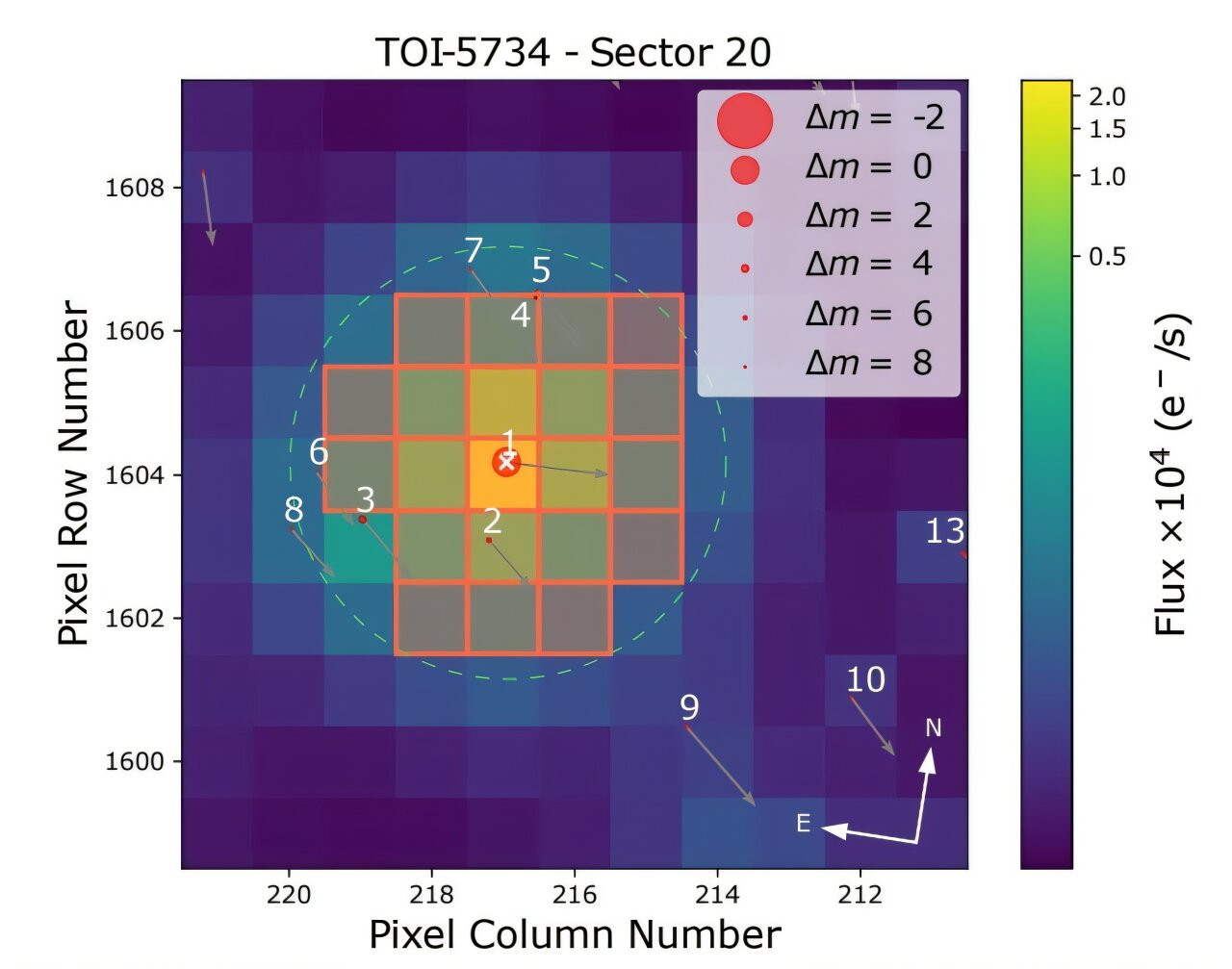
TOI-5734: The Star Hosting the Newly Found Planet
TOI-5734, the star around which TOI-5734 b orbits, is a relatively cool, young dwarf star. With a mass around 0.72 times that of the Sun and a radius near 0.64 solar radii, this star is considerably smaller than our own. Despite its size, it provides rich data that shed light on the planetary formation and evolution processes. The star’s surface temperature is estimated at roughly 4,750 K, consistent with stars of its spectral class. TOI-5734 is relatively young, with an age estimated in the range of a few billion years.
The detection of TOI-5734 b was made possible by TESS observations conducted in 2022, which revealed a transit signal in the star’s light curve. According to the research, the analysis incorporated data from three TESS observation sectors alongside spectroscopic measurements from the HARPS-N spectrograph at the Galileo National Telescope, enabling confirmation and detailed characterization of the planet.
The Dimensions and Mass of TOI-5734 b
TOI-5734 b is notable due to its substantial size and mass, making it a compelling subject for ongoing investigation. With a radius close to 2.1 times Earth’s and a mass about 9.1 times that of Earth, it fits the classification range of super-Earths or sub-Neptunes. Its density is somewhat lower than Earth’s, indicating that its composition might not be solely rocky. The planet’s orbit is tight, completing a revolution every 6.18 days at about 0.06 AU from its star. This proximity results in extremely high surface temperatures, with equilibrium temperatures near 688 Kelvin.
This combination of scale, mass, and closeness to its host star makes TOI-5734 b a valuable target for studying planetary conditions under intense stellar radiation. Its radius places it near the “radius valley” — a noted gap in exoplanet sizes between 1.5 and 2.0 Earth radii—making it particularly significant for researchers exploring planetary formation and atmospheric loss.
Composition and Prospective Evolution of TOI-5734 b
An intriguing feature of TOI-5734 b concerns its probable chemical makeup. The study suggests it is primarily a rocky planet that has undergone substantial atmospheric erosion. The researchers propose that its initial atmosphere has nearly completely dissipated, though they consider the possibility it may contain considerable water content. The planet’s close orbit and elevated temperatures have likely driven off lighter gases, and it is expected that its original atmosphere will be lost entirely within the next 300 million years.
The authors also propose that TOI-5734 b likely formed further from its star before migrating inward, a process common among close-in exoplanets, especially those near their stars’ habitable zones. Its current location near the radius gap points to a complex history of formation and evolutionary changes over its lifetime.
- Categories:
- News













0 comments
Sign in to Comment