
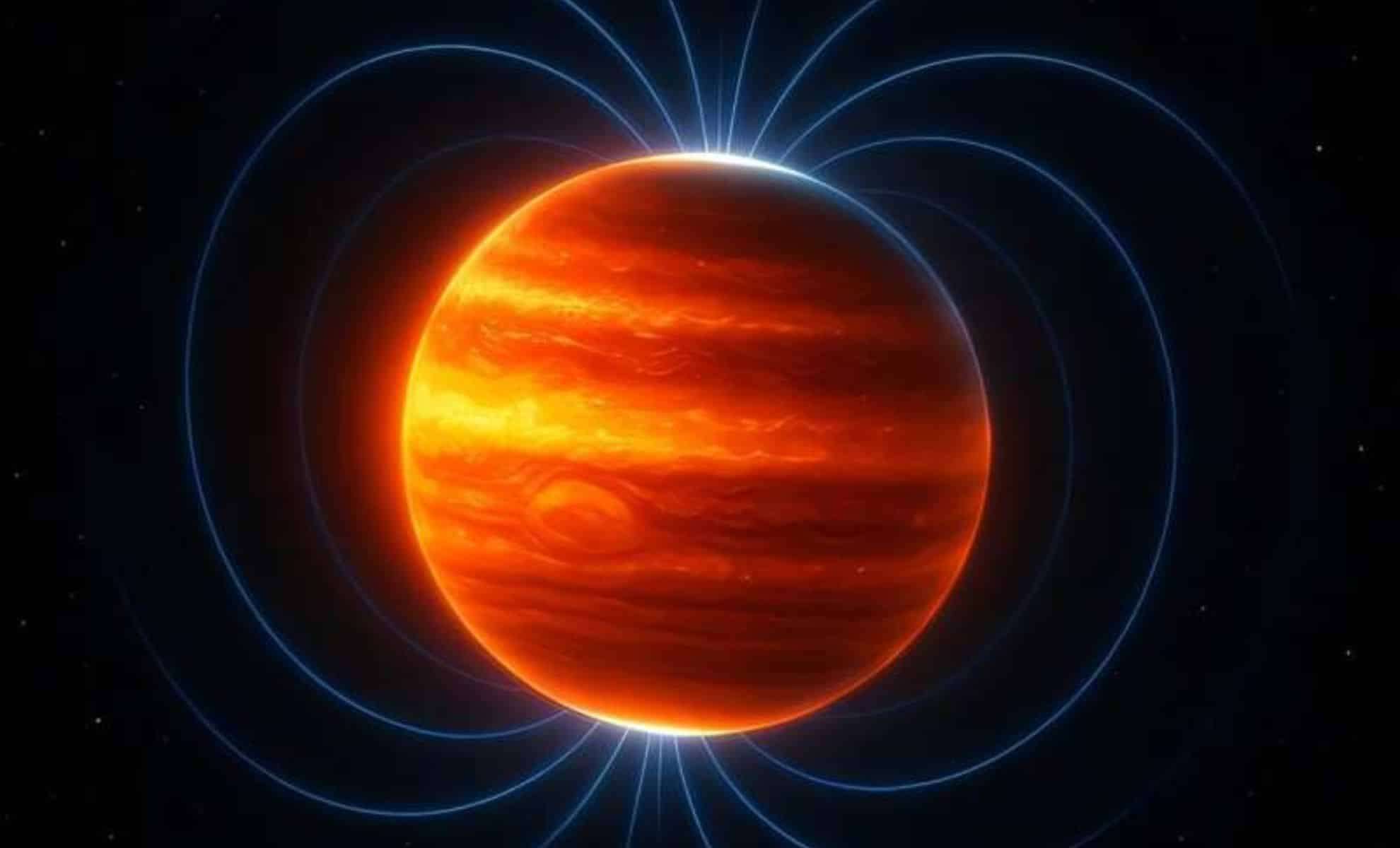
Recent research has uncovered compelling evidence that Jupiter was nearly double its current size in its infancy and possessed a magnetic field far exceeding today’s strength by about 50 times. Spearheaded by Konstantin Batygin from Caltech and Fred C. Adams at the University of Michigan, this study sheds new light on the formative epochs of our solar system. Published in Nature Astronomy, the work reconstructs Jupiter’s early physical characteristics roughly 3.8 million years after the solar system began. These revelations challenge longstanding beliefs and offer fresh insights into how the dominant planet influenced the layout of our cosmic neighborhood.
Tracing Jupiter’s Formative Size Through Its Lesser-Known Satellites
To estimate Jupiter’s primordial dimensions, Batygin and Adams examined the orbital paths of the planet’s smaller moons, Amalthea and Thebe. These satellites orbit even closer to Jupiter than the major Galilean moons and exhibit subtle orbital inclinations. By scrutinizing these inclinations and employing conservation laws of angular momentum, the team inferred that Jupiter’s early radius was about twice its current measurement. This means Jupiter once had a volume surpassing 2,000 times that of Earth, highlighting a vastly more extended and active phase during the solar system’s nascent period. Batygin notes the importance of this work: "Our ultimate goal is to understand where we come from, and pinning down the early phases of planet formation is essential to solving the puzzle. This brings us closer to understanding how not only Jupiter but the entire solar system took shape.”
A Magnetic Field of Extraordinary Magnitude
Even more striking is the finding that Jupiter’s ancient magnetic field was about 50 times more powerful than it is in the present day. Such a robust magnetic intensity would have significantly influenced the protoplanetary disk—the rotating cloud of gas and dust that birthed the planets—affecting charged particle behavior and material distribution. This magnetic strength likely played a key role in shaping the orbits and compositions of bodies within the young solar system. Adams reflects on the discovery: "It’s astonishing that even after 4.5 billion years, enough clues remain to let us reconstruct Jupiter’s physical state at the dawn of its existence." Understanding Jupiter’s magnetic evolution is crucial for refining planetary formation models and recognizing the planet’s gravitational influence on the solar system’s structure.

Innovative Techniques Overcoming Past Limitations
Conventional models of how planets form often rely on uncertain assumptions about elements like gas opacity, material accumulation rates, or core building. However, Batygin and Adams bypassed these uncertainties by focusing on directly measurable factors such as moon orbits and the conservation of Jupiter’s angular momentum. Their approach offers a clearer, less assumption-dependent perspective on Jupiter’s early characteristics. This work sets precise boundaries on the giant planet’s size, rotation, and magnetism as the protoplanetary nebula vanished, essentially preserving the blueprint for the solar system’s formative architecture. The precision of this method enhances our understanding of gas giant formation processes, particularly lending support to the core accretion theory.
- Categories:
- News









0 comments
Sign in to Comment