

A global collaboration of astronomers has unveiled three new hot Jupiter exoplanets orbiting distant K-type dwarf stars. Utilizing data from NASA’s Transiting Exoplanet Survey Satellite (TESS), this exciting discovery expands the inventory of known exoplanets. Published in June 2025, these findings provide valuable new perspectives on the characteristics and behavior of this intriguing category of extrasolar planets.
Enhancing the Exoplanet Collection Through TESS Observations
Since its 2018 launch, NASA’s TESS mission has been instrumental in locating numerous exoplanets by monitoring the periodic dimming of bright stars caused by orbiting planets. The newly detected hot Jupiters—named TOI-2969 b, TOI-2989 b, and TOI-5300 b—add to over 7,600 planets and candidates already found by TESS. This find is especially important as it focuses on a lesser-studied group of exoplanets orbiting K dwarf stars, which are cooler than our Sun and offer a unique stellar environment that influences the properties of their planets.
Details on the Newly Found Hot Jupiters
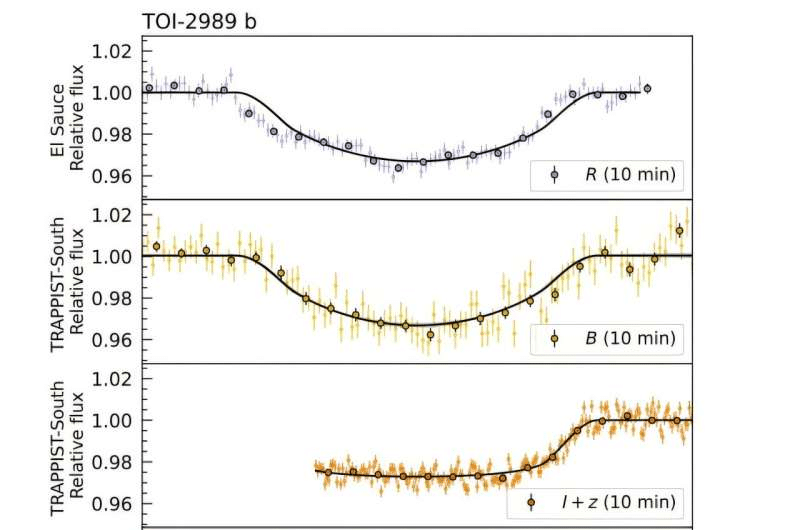
Hot Jupiters are gas giants comparable in size to Jupiter but orbit very close to their stars, resulting in high surface temperatures. Among the trio, TOI-2989 b is the heaviest, boasting about three times Jupiter’s mass and a radius 1.12 times that of Jupiter. It completes an orbit every 3.12 days at 0.038 AU, with an estimated temperature near 1,000 K. Its density, measured at 2.7 g/cm3, points to a dense atmosphere rich in heavier elements. As the team states, “In this paper, we confirm and characterize three hot Jupiters transiting mid-K dwarfs, contributing mass measurements to this still relatively unexplored population.”

The Importance of These Gas Giants for Planetary Science
Studying hot Jupiters offers crucial clues about planet formation and atmospheric evolution under extreme conditions. For instance, TOI-2969 b is about 10% larger and 16% heavier than Jupiter, with an orbit lasting just 1.82 days and an equilibrium temperature of approximately 1,186 K, categorizing it as an ultra-hot Jupiter. These discoveries provide much-needed data on how giant planets endure in harsh stellar environments. Their significant densities and heavy element content also challenge existing theories of planetary architecture.
Examining the Smallest New Hot Jupiter: TOI-5300 b
The smallest of the group, TOI-5300 b, has a radius of 0.88 times Jupiter’s and a mass of 0.6 Jupiter masses, with a density of 1.1 g/cm3. It orbits every 2.26 days at 0.029 AU, maintaining an equilibrium temperature near 1,043 K. This smaller gas giant aids in broadening the understanding of hot Jupiter diversity in terms of size and composition, highlighting just how varied these planets can be.
Why K Dwarf Stars Matter for Exoplanet Research
K dwarf stars, cooler and less luminous than the Sun, are key targets for exoplanet studies due to their smaller size and different stellar characteristics. These factors allow planets to orbit closer and remain in potentially habitable zones. Discovering hot Jupiters around K dwarfs is particularly noteworthy since these stars have been less frequently studied than their Sun-like counterparts. By analyzing these systems, astronomers can improve models related to planetary atmospheres, stellar radiation effects, and magnetic activity. The authors emphasize, “In this paper, we confirm and characterize three hot Jupiters transiting mid-K dwarfs, contributing mass measurements to this still relatively unexplored population.”
- Categories:
- News










0 comments
Sign in to Comment