
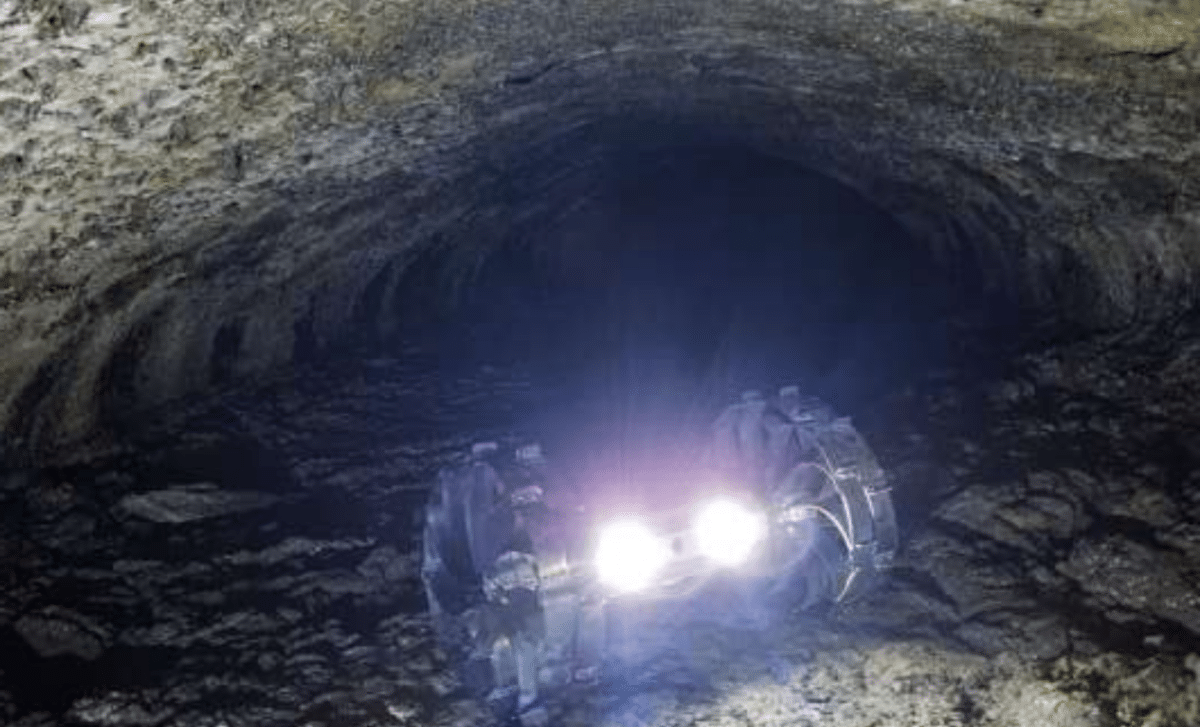
Scientists at the Korea Advanced Institute of Science and Technology (KAIST) alongside the Unmanned Exploration Laboratory (UEL) have introduced an innovative airless wheel inspired by origami and Leonardo da Vinci’s bridge concept, as detailed in a Science Robotics publication. This cutting-edge wheel design offers remarkable adaptability, enabling compact rovers to traverse the Moon’s most challenging landscapes, such as steep craters and subterranean lava tubes.
Revolutionary Airless Wheel Design Enhances Lunar Surface Navigation
In a significant advancement for extraterrestrial exploration, a team from KAIST and UEL unveiled a unique airless wheel capable of conquering the Moon’s rugged terrain. Described in Science Robotics, this innovation addresses the difficulties faced by rovers when negotiating uneven lunar surfaces.
Accessing the Moon’s mysterious lava tubes and crater pits—key locations for potential human habitation—is a top priority. These subsurface caves provide protection from harmful cosmic rays and extreme temperature swings. Unfortunately, their steep and treacherous surroundings have rendered traditional rovers ineffective at entry and exploration.

Although larger rovers often struggle with such obstacles, the deployment of smaller, swarm-based rovers presents a lower-risk alternative. Yet, the limited size of their wheels can restrict mobility and prevent successful traversal over steep entrances.
To address this, the researchers engineered a deployable wheel utilizing flexible materials influenced by origami principles. This airless wheel can expand dramatically from a compact 230 mm up to 500 mm in diameter, allowing small rovers to stay low-profile during transport and then scale steep terrain once on the lunar surface.
Structural Innovation: Combining Flexibility and Resilience for Lunar Challenges
The breakthrough hinges on marrying pliable materials with a clever structural framework inspired by the Da Vinci bridge. Instead of fixed joints or hinges, the wheel employs an elastic metal frame combined with tensioned fabric elements. This design ensures durability and eliminates mechanical vulnerabilities commonly caused by cold welding or abrasive lunar dust.
Engineered to endure the Moon’s extreme temperature swings—often exceeding 300 degrees Celsius during a single lunar day—the wheel underwent exhaustive testing with lunar soil analogues. Impressively, it survived impacts simulating falls as high as 100 meters in lunar gravity, demonstrating exceptional toughness.
Moreover, this design dramatically reduces issues linked with traditional wheels, such as punctures, dust-induced mechanical failures, and cold welding effects. Offering reliable performance without air-filled tires or complex moving parts, this wheel represents a vital step forward in traversing the Moon’s most dangerous and unpredictable terrains.
Implications for Upcoming Lunar Expeditions
This technological advancement holds great promise for upcoming lunar missions. Professor Dae-Young Lee of KAIST emphasized how this wheel system could establish their team at the forefront of space exploration technology, enhancing efforts to deploy agile small rovers capable of delving into hidden lunar regions.
Planetary scientists and engineers, including Dr. Chae Kyung Sim from KASI and Dr. Jongtae Jang from KARI, underscore the wheel’s importance for exploring lunar pits, which serve as valuable geological archives. These underground sites not only provide potential refuge for future human bases but also hold critical insights into the Moon’s formation and evolution. By overcoming traditional mobility barriers, this wheel innovation is a crucial enabler for probing the Moon’s most enigmatic and extreme environments.
- Categories:
- Space






0 comments
Sign in to Comment