

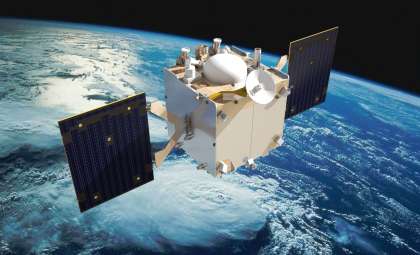
On September 23, 2025, NASA’s OSIRIS-APEX spacecraft took spectacular images of Earth during a close flyby, utilizing a gravity-assist maneuver to accelerate its trajectory toward asteroid Apophis. These remarkable photos represent a significant checkpoint in the mission, verifying the spacecraft’s health and steady progress toward its expected 2029 asteroid rendezvous, a target that has intrigued scientists for years.
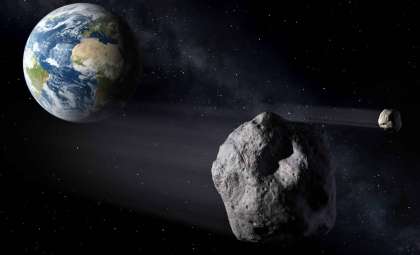
OSIRIS-APEX builds upon the achievements of NASA’s OSIRIS-REx mission, which successfully returned samples from asteroid Bennu in 2023. This new mission focuses on Apophis, a rocky, metal-rich asteroid. Once thought to be a major threat to Earth, Apophis is now regarded as a prime subject for studying asteroid dynamics, especially how these objects respond to gravitational forces from planets.
OSIRIS-APEX: Exploring a Different Kind of Asteroid
In a recent NASA statement, the OSIRIS-APEX mission is highlighted as a successor to OSIRIS-REx, which returned with samples from the carbon-rich asteroid Bennu. The objective for OSIRIS-APEX centers on Apophis, whose stony and metal-rich nature contrasts markedly with Bennu. Since its discovery, Apophis has been closely observed due to its intriguing properties and history.


Previously considered a potential hazard because of its path predictions, scientists now recognize Apophis as a valuable opportunity to deepen knowledge about asteroid origins and behavior. Mission teams emphasize that OSIRIS-APEX will be the first spacecraft to observe directly how an asteroid reacts to Earth’s gravitational influence during its close passage in 2029.
The Earth Flyby: A Vital Boost for the Journey
The spacecraft’s September 2025 close pass by Earth was an essential step, leveraging the planet’s gravity to increase velocity and adjust its flight path toward Apophis. Such gravity-assist maneuvers are a strategic standard in space exploration to preserve fuel and optimize mission routes.
During the flyby, OSIRIS-APEX came within 2,136 miles of Earth, capturing breathtaking imagery while confirming the functionality of its main instruments, including MapCam and StowCam. These tools captured detailed photos and will be vital for examining Apophis when the spacecraft arrives.
“When it was first discovered in 2004, there was concern that it would impact the Earth in 2029 during its close approach. That risk was retired after subsequent observations”, explained Planetary sciences assistant professor, Dani DellaGiustina. “But it will be the closest an asteroid of this size has gotten in the 50 or so years asteroids have been closely tracked, or for the next 100 years of asteroids we have discovered so far.”
Looking Ahead: Detailed Study of Apophis in 2029
As OSIRIS-APEX approaches Apophis in 2029, it will begin an extensive survey of the asteroid. According to a University of Arizona report, the spacecraft plans to spend around 18 months mapping Apophis’s surface and analyzing its composition. It will take high-resolution images and examine the asteroid’s responses to Earth’s gravity during its close encounter.
One of the mission’s most intriguing objectives is to hover near Apophis’s surface and fire thrusters downward to stir up dust from beneath. This will expose fresh material beneath the asteroid’s surface, offering new insights into its makeup and history, and shedding light on the evolution of asteroids in our solar system.
- Categories:
- Space








0 comments
Sign in to Comment