
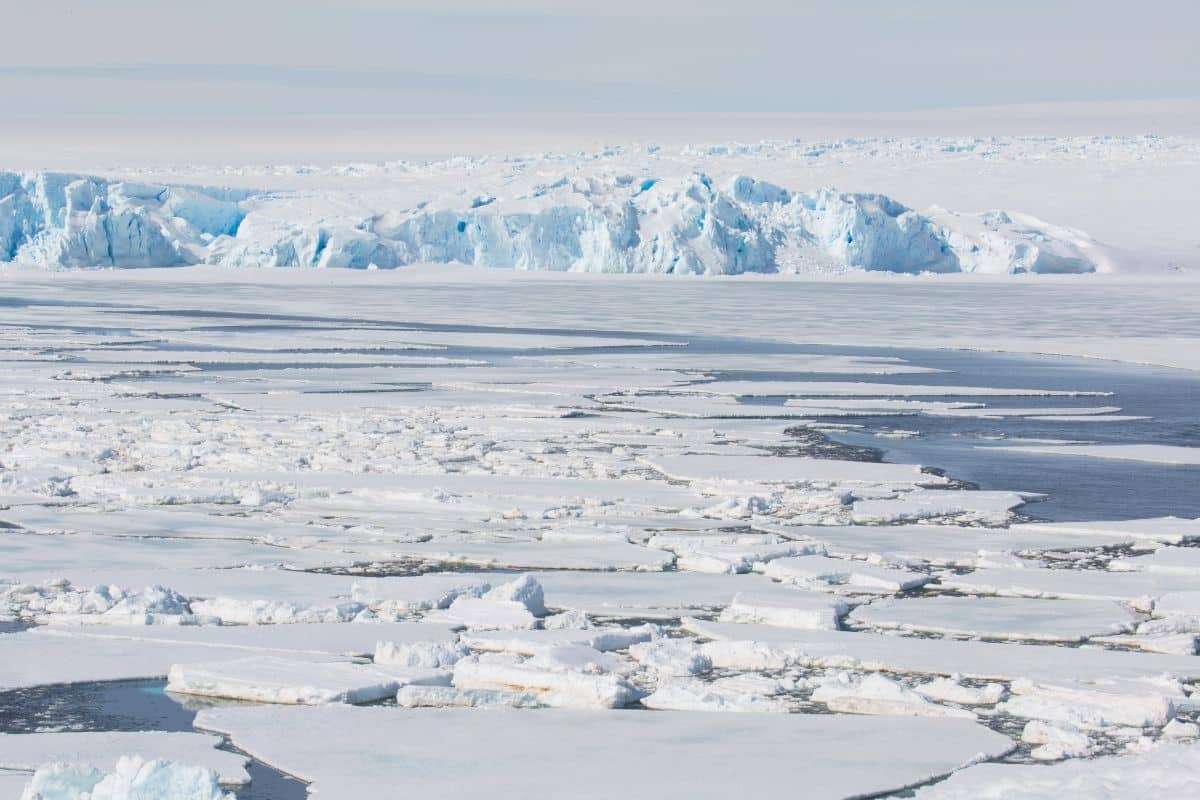
Throughout most of Earth's timeline, icy conditions were uncommon. However, modern humans emerged during a notably frigid interval in Earth’s history. As global warming intensifies, the disappearance of polar ice caps and rising global temperatures are steering our planet toward a much warmer environment—a state it has experienced for the vast majority of its 4.5-billion-year existence. The crucial question is: can humanity endure a future without ice?
Earth’s Unusual Ice Age
Though we are witnessing unprecedented heat waves today, Earth remains comparatively cool relative to its ancient past. Across the last 540 million years, known as the Phanerozoic Eon, the planet has alternated between ‘‘icehouse’’ phases dominated by glaciers and ‘‘greenhouse’’ periods marked by warmer global climates.
Periods covered by extensive ice, like the current era, represent only about 13 percent of this span. For the remaining majority, Earth bore far hotter climates with minimal ice at the poles.

The principal factor driving these climatic shifts? Atmospheric carbon dioxide (CO₂). Geological records reveal a strong connection between CO₂ concentrations and planetary temperatures. Elevated CO₂ levels correspond to warm, largely ice-free epochs, whereas reduced levels align with cold, glaciated intervals.
So, what caused Earth to enter an icehouse phase? Scientists suggest a unique interplay of factors—declining volcanic emissions, continental rearrangements, and enhanced carbon sequestration by geological processes—collectively lowered CO₂ concentrations. This rare combination created the cold environment in which human ancestors evolved.
Impact of Icehouse Climate on Human Evolution
Although ice itself might not have directly influenced human evolution, the climatic changes during icehouse periods certainly shaped our development. The stark temperature contrasts between frozen poles and warmer equatorial zones introduced complex and variable habitats, compelling early humans to adapt continually.
Smithsonian paleoanthropologist Rick Potts, director of the Human Origins Program, highlights adaptability as vital for human survival. Unlike many extinct relatives, Homo sapiens succeeded by cultivating advanced communication, social structures, and innovative technologies.
“If you stripped away all of the cultural and societal buffers that we cocoon ourselves … humans probably would not fare very well with regard to such an extreme change and rapid change in temperature that we’re seeing now,” Potts explained.
Accelerating Toward a Greenhouse Earth
Natural climate cycles would gradually shift Earth toward a greenhouse state over millions of years. However, human actions have dramatically hastened this process. The combustion of fossil fuels has released massive amounts of CO₂ into the atmosphere, at a pace 100 times faster than volcanic activity has over the past 500 million years.
Jessica Tierney, a paleoclimatologist at the University of Arizona, points out that while Earth will eventually reach a new equilibrium, living organisms—including humans—may face severe challenges adapting quickly enough.
Historical records show that rapid climate upheavals have often precipitated mass extinctions. For example, the asteroid strike that ended the dinosaurs’ reign 66 million years ago triggered drastic environmental changes. An even more devastating extinction, eliminating 90 percent of species 250 million years ago, was linked to volcanic-induced global warming.
Is a Future Without Ice Survivable for Humans?
Unlike prior extinction events, humans possess a significant advantage: intelligence and technology. Our capacity to alter surroundings has supported our resilience despite warming conditions. Yet the key uncertainty is whether our adaptation can keep pace with accelerating climate changes.
Ben Mills, a biogeochemist at the University of Leeds, observes that while humans are rapidly elevating CO₂ levels, we also hold the means to reverse this trend.
“We’re now the most powerful thing on the planet,” Mills remarked. “We’re much quicker at putting carbon dioxide into the atmosphere, and we could be much quicker at taking it out.”
- Categories:
- Science









0 comments
Sign in to Comment