
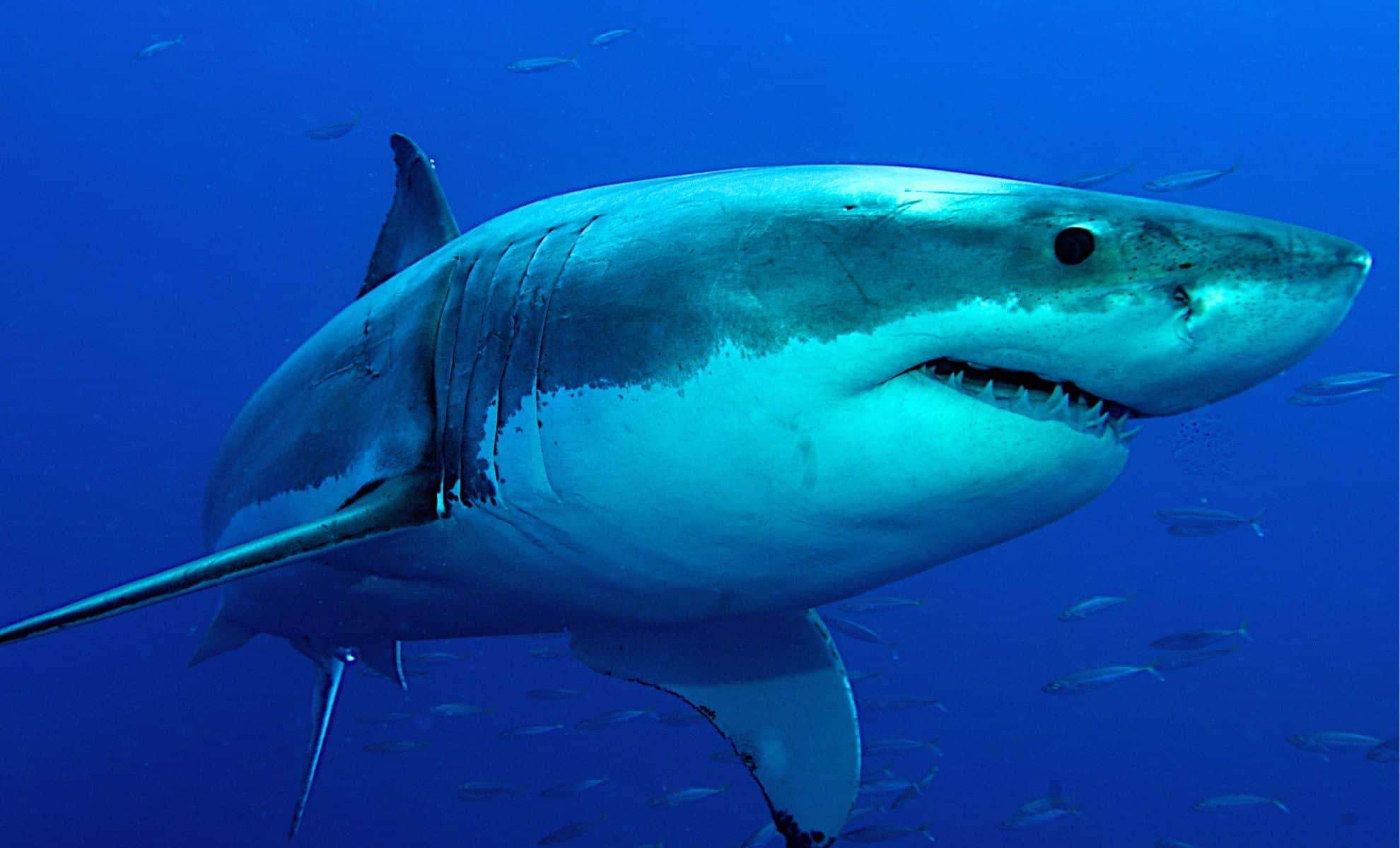
Researchers have successfully tagged the largest male great white shark ever documented in the northwest Atlantic Ocean. The shark, christened Contender, was caught, examined, and released by the nonprofit organization OCEARCH approximately 45 miles off the coasts of Georgia and Florida. Measuring an impressive 13 feet 9 inches (4.2 meters) and weighing about 1,653 pounds (750 kilograms), Contender is roughly the size of a small vehicle and now holds the distinction as the largest male great white historically recorded by the team in this area.
Contender Emerges Among the Giants
Although great white sharks are commonly found in Atlantic waters, males reaching this size are rare. Dr. Harley Newton, OCEARCH’s lead vet and senior scientific researcher, noted that Contender is only the third adult male the group has ever tracked and assessed during the sharks’ seasonal visits to the southeastern U.S. Newton explained that typical male white sharks mature around 26 years old and average roughly 11.5 feet in length. At nearly 14 feet, Contender stands out as an exceptional discovery.
Adult male great whites generally range between 11 and 13 feet, but Contender surpasses this by almost a foot. The Smithsonian National Museum of Natural History confirms this typical size range for mature males, highlighting Contender’s extraordinary length of some 9 inches beyond the average maximum.

The Secretive Lifestyle of Oceanic Predators
Such enormous sharks are rarely encountered likely because they favor deeper, offshore waters, areas where tagging attempts are less frequent. Newton suggested this could explain why mature sharks, both males and females, remain “elusive” to researchers. This makes each successful tagging event—especially of a giant like Contender—a significant scientific breakthrough.
OCEARCH utilized a SPOT (Smart Position and Temperature Transmitting) tag, attached to the shark’s first dorsal fin. These devices transmit signals to satellites every time the shark surfaces, enabling researchers to collect real-time data on its location, plus crucial information about water temperature and depth.
Tracking Contender’s Coastal Expedition
Tagged on January 17, Contender has already navigated a distance of nearly 290 miles (470 kilometers). The most recent signal showed him near Merritt Island, close to Orlando, Florida, on February 10. Followers can monitor his progress via OCEARCH’s shark tracking service, where he is celebrated as the “ultimate ocean warrior.”
In contrast to female great whites, which can grow beyond 20 feet, large males like Contender remain difficult to observe due to their secretive nature. Capturing and tagging such individuals is vital for a deeper understanding of their conservation needs.
Contender is not the overall largest great white on file—that record goes to a 19-foot, 9-inch (6-meter) shark recorded by the Massachusetts Division of Marine Fisheries. Although there have been reports of white sharks reaching sizes up to 23 feet, these remain unconfirmed according to the Florida Museum of Natural History.
Using Technology to Enhance Shark Conservation
The data collected from Contender’s tag could inform researchers for months or even years, assisting in conservation efforts and expanding knowledge about great white shark behavior. This information will help identify preferred habitats, migration patterns, and the species’ broader ecological role in the North Atlantic.
Scientists emphasize that tagging adult sharks such as Contender is crucial because their movements and lifestyles remain largely unknown. Each time a top marine predator is tagged, it opens a window into the rarely seen lives of these formidable creatures beneath the waves.
- Categories:
- News







0 comments
Sign in to Comment