
A repetitive nova explosion in the Large Magellanic Cloud recently set new temperature records, revealing surprising chemical characteristics and enhancing our understanding of how stars evolve. These results appear in the Monthly Notices of the Royal Astronomical Society.
The Most Powerful Nova Recorded Outside Our Galaxy
The recurrent nova LMCN 1968-12a, located in the Large Magellanic Cloud—a satellite galaxy orbiting the Milky Way—has erupted once again. This latest outburst is now considered one of the hottest nova explosions ever observed.
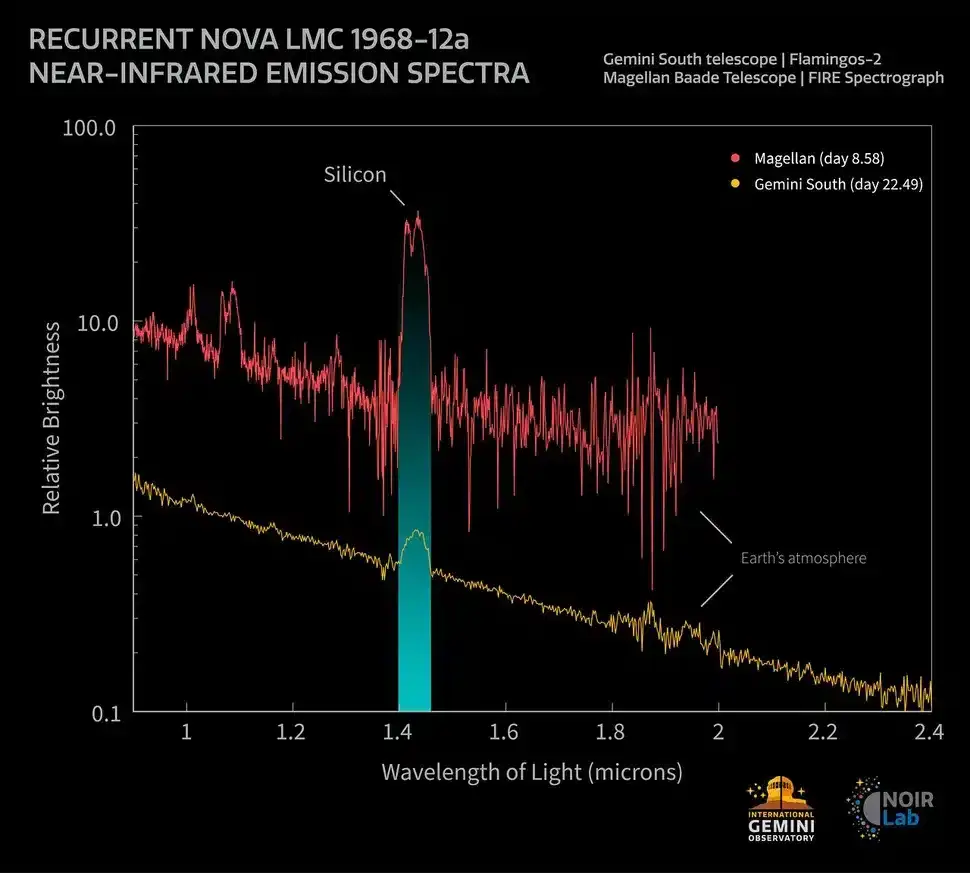
Captured in August 2024, this event belongs to a cycle that repeats approximately every four years. Unlike past eruptions, researchers conducted the first near-infrared study of a recurrent nova beyond our own galaxy. Data was collected using Chile’s Magellan Baade and Gemini South telescopes, focusing on emissions 9 and 22 days post-eruption.

Temperatures soared to an estimated 5.4 million degrees Fahrenheit (about 3 million degrees Celsius). The nova’s brightness and unique chemical composition distinguish it from similar phenomena detected within the Milky Way.
Unexpected Elements Reveal Distinct Stellar Environment
The most surprising discovery was not just the extreme heat. The nova’s spectral signature displayed a pronounced abundance of ionized silicon, shining with intensity roughly 95 times that of the sun’s total output across all wavelengths. Notably missing, though, were typical high-energy elements often found in such explosions: “We would have anticipated signs of energized sulfur, phosphorus, calcium, and aluminum,” explained Geballe.
This deviation suggests an extremely hot and rarefied atmospheric condition, supported by observational models. Tom Geballe, emeritus astronomer at NOIRLab, alongside Arizona State University astrophysicist Sumner Starrfield, proposes the missing elements might be linked to the differing chemical environment of the host galaxy affecting eruption dynamics.
A key factor is metallicity, the proportion of heavy elements present in a star system. The Large Magellanic Cloud features significantly lower metallicity than the Milky Way, which allows a greater build-up of hydrogen and helium on the white dwarf surface prior to eruption. Conversely, higher-metallicity galaxies like ours typically experience less explosive nova events.
How Recurrent Novae Form and Repeat
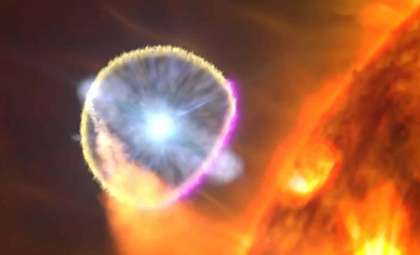
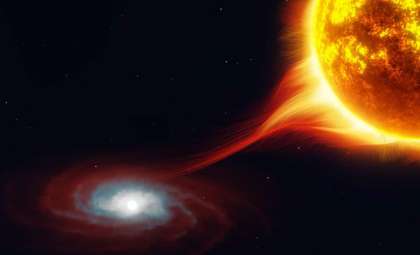
A nova arises when a white dwarf—the compressed core left behind after a star’s demise—accretes gas from a nearby companion star, often a subgiant. This inflowing material gathers within an accretion disk, gradually depositing on the white dwarf’s surface. When enough matter accumulates, rising pressure and temperature ignite a powerful thermonuclear runaway reaction.
This triggers an energetic outburst, ejecting gas and making the system shine dramatically from our perspective. In recurring novae such as LMCN 1968-12a, this cycle repeats multiple times. While the white dwarf remains intact, each explosion expels material and reshapes the system’s behavior.
Due to its consistent timing, LMCN 1968-12a has served as a key subject since its initial sighting in 1968. Observations post-1990 confirm an approximate four-year interval between eruptions, offering astronomers a valuable window into how composition, timing, and eruption mechanisms evolve over decades.
- Categories:
- Space




0 comments
Sign in to Comment