

NASA’s PUNCH mission has successfully delivered its initial set of images during the 90-day commissioning period, ushering in a new era in solar wind research. The mission’s instruments are operating flawlessly, setting the stage for groundbreaking discoveries about the transformation of the Sun’s corona into the heliosphere.
A Unique Fleet of Four Satellites
Instead of deploying a single spacecraft, PUNCH (Polarimeter to Unify the Corona and Heliosphere) consists of four compact satellites launched into Earth orbit. Collaboratively, these satellites function as a single wide-field device capable of detecting and monitoring the subtle structures of the solar wind.
“Each of the four instruments is performing exactly as anticipated. We look forward to completing our commissioning phase and integrating these cameras for coordinated observations,” stated Craig DeForest, the mission’s principal investigator from the Southwest Research Institute (SwRI) in Boulder, Colorado.

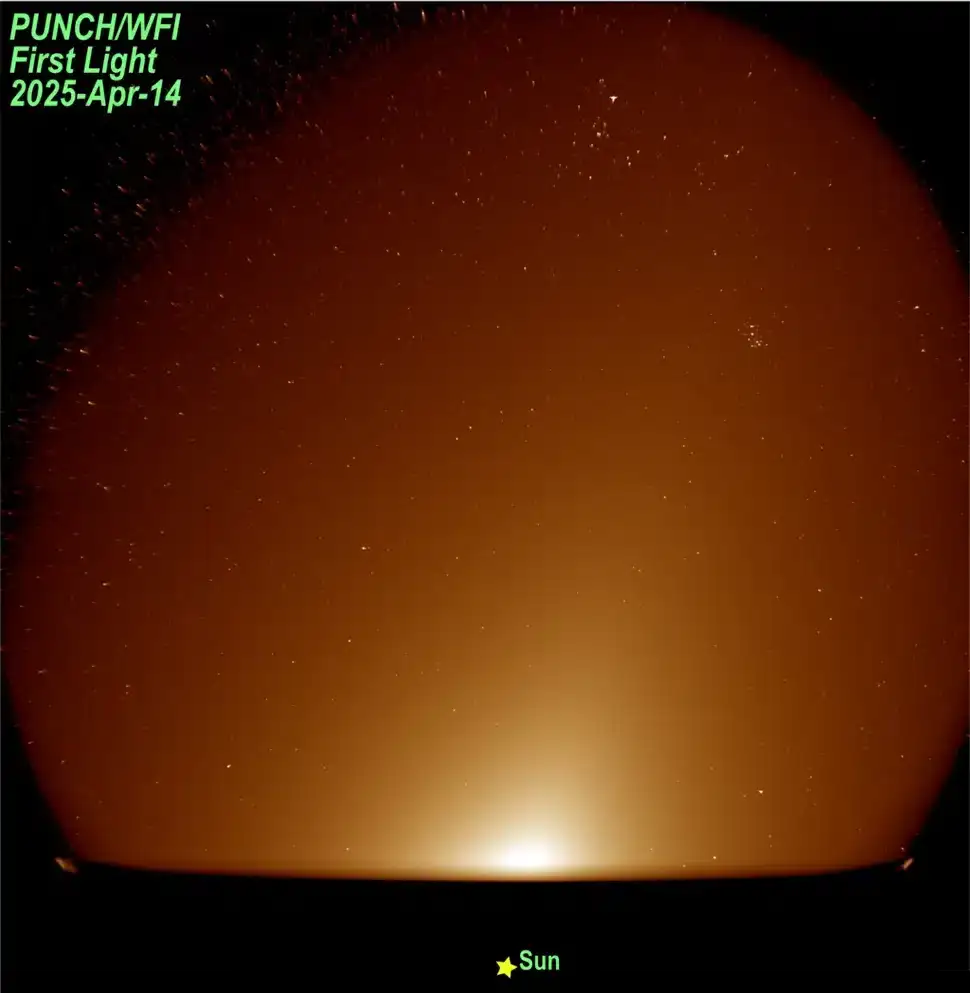
Capturing Zodiacal Light Amid Starry Backdrops
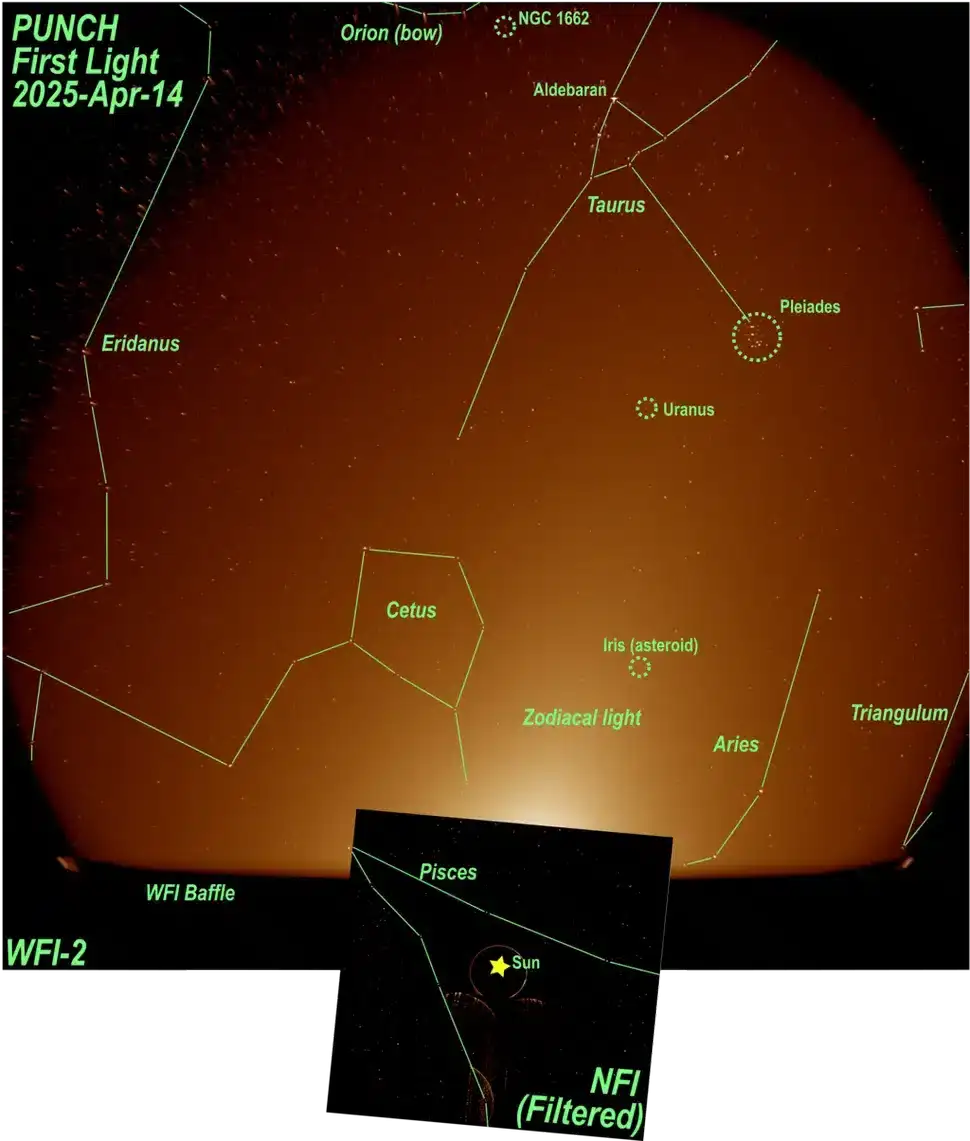
The first images—captured on April 14 and 16—display starry skies tinged with a soft golden glow known as the zodiacal light. This illumination is caused by sunlight reflecting off dust particles orbiting the Sun. Within these scenes, constellations such as Taurus and Cetus are visible, though they are not the primary focus of the mission.
These star fields and the zodiacal glow will be digitally subtracted from future images to isolate the elusive brightness of the solar wind as it emanates from the Sun’s outer atmospheric layer, the corona.
“Throughout the commissioning phase, the PUNCH team is calibrating the NFI data to remove 99% of the light to show materials streaming out from the Sun’s outer atmosphere in stunning detail,” DeForest explained.
Creating Three-Dimensional Views of the Solar Wind
PUNCH’s payload includes three wide-field imagers (WFIs) along with a single near-field imager (NFI). Together, these instruments capture a comprehensive 90-degree field of view encompassing both the solar corona and heliosphere. The mission leverages the phenomenon of polarized light to gain depth perception.
“A polarimeter is a camera that can measure polarized light like you might see through a pair of polarized sunglasses, and we use that to measure what we’re imaging in three dimensions,”said DeForest. “That scattering process polarizes the light, and the degree of polarization tells us where the object was in three dimensions.”
This methodology promises to enable, for the first time, 3D mapping of the solar wind, offering valuable advances for space weather prediction and fundamental studies of heliophysics.
Innovating with Water-Based Propulsion
Besides its scientific instrumentation, the mission also serves as a proving ground for cutting-edge propulsion technology. The commissioning phase demonstrated the capabilities of compact, water-powered thrusters the size of shot glasses.
These thrusters split water into hydrogen and oxygen via electrolysis, which then combust to generate thrust. This approach offers a safer, eco-friendly alternative to conventional rocket fuels.
DeForest noted that the thruster’s “reliable and secure” nature is crucial since each satellite must execute numerous maneuvers to stay aligned within the satellite formation.
Anticipating Initial Scientific Results This Summer
Launched on March 11 aboard a SpaceX Falcon 9 rocket alongside NASA’s SPHEREx mission, which focuses on near-infrared sky mapping, PUNCH is slated to begin its science mission by June following a successful commissioning.
Scientists aim to solve a fundamental solar physics question: how does the hot, structured corona evolve into the chaotic solar wind? With these new tools, the answer may soon be within reach.
- Categories:
- Space








0 comments
Sign in to Comment