
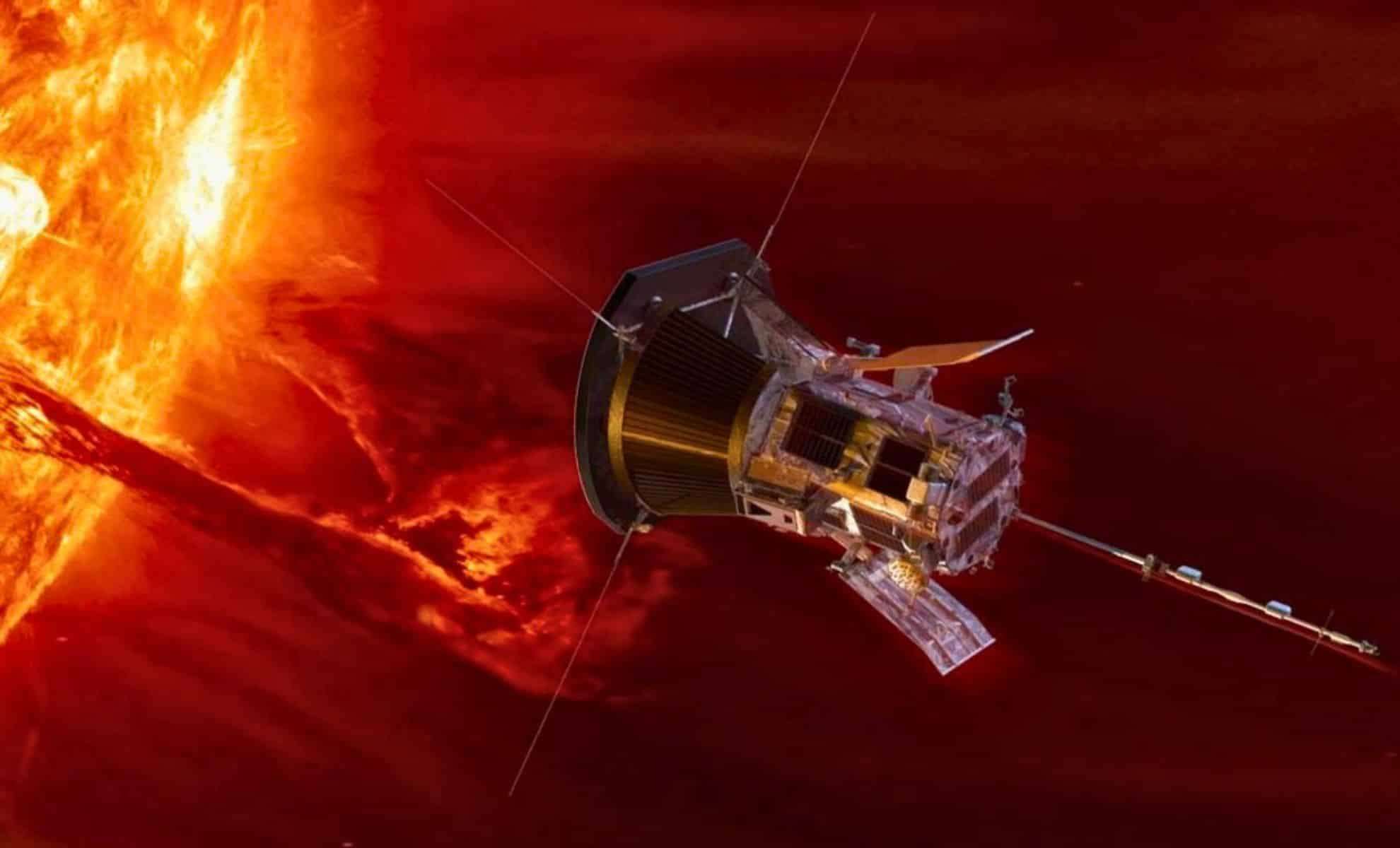
NASA’s Parker Solar Probe is about to embark on a remarkable close encounter with the sun’s corona on December 24. Achieving a blazing velocity of 430,000 mph (692,017.37 km/h), the spacecraft will set a new record as the nearest human-made object to the sun, approaching within just 3.8 million miles of its scorching surface.
This mission, aiming to “touch the sun,” seeks to unravel the mysteries of the sun’s outer atmosphere and its influence on the solar system and Earth. The bold maneuver planned for Christmas Eve represents one of the final and most daring close flybys of the probe’s journey.
Braving the Sun’s Extreme Conditions
The probe will navigate through powerful plasma jets originating from the sun’s surface and may even traverse a solar eruption, resembling a surfer riding beneath a massive wave. Currently, the sun is in an intensely active phase of its 11-year cycle, presenting the spacecraft with an opportunity to witness overlapping solar flares and provide detailed observations of solar turbulence.

A critical component of the mission is the specially engineered thermal shield, capable of enduring temperatures reaching 2,500°F (1,371.11°C). Coated in a reflective white material, the probe manages to bounce heat back into space, keeping its instruments at safe operating temperatures while the heat shield itself withstands up to 1,800°F (982.22°C).
A Six-Year Quest Into Unexplored Regions
Since its launch in 2018 under NASA’s Living With a Star program, the probe has completed more than 20 solar orbits. Highlights from this mission include:
- Discovering why the sun’s corona is vastly hotter than its surface.
- Identifying a dust-free zone near the sun, where extreme heat vaporizes nearby cosmic particles.
- Working in tandem with Europe’s Solar Orbiter to monitor solar wind acceleration, a key factor in space weather dynamics.
The anticipated Christmas Eve close approach will take place at 6:40 a.m. EST, but scientists won’t receive confirmation of the spacecraft’s status until December 27. Initial data and imagery from this event are expected to be released in early January, ushering in fresh discoveries.
Significance for Earth and Future Exploration
The information gathered by the Parker Solar Probe will have broad implications:
- Improving knowledge about solar wind and its impact on Earth’s magnetosphere, satellite operations, and electrical systems.
- Shedding light on how solar phenomena contribute to displays like the auroras and influence space weather.
- Guiding the development of safeguards for upcoming space missions and critical technology.
Celebrating Eugene Parker’s Legacy
The probe honors Eugene Parker, the pioneering physicist whose innovative theories revolutionized our understanding of the sun, including the unexpected heating of the corona and the generation of solar wind. Parker passed away in 2022 at the age of 94, leaving a profound scientific legacy.
Source: space.com
- Categories:
- Astronomy ,
- Space






0 comments
Sign in to Comment