
Physicists have engineered a synthetic diamond in the lab that exceeds the hardness of natural diamonds. By applying intense pressure and heat to graphite, the team created a rare hexagonal diamond, known as lonsdaleite, which is believed to be stronger than the common cubic form of natural diamonds.
Surpassing Traditional Hardness Boundaries
Natural diamonds are renowned as the toughest material occurring in nature, but synthetic versions are now redefining these limits. This novel hexagonal diamond was produced by compressing graphite under extreme pressures and then heating it to about 1,800 K (1,527 °C or 2,780 °F), establishing a new frontier in hardness.
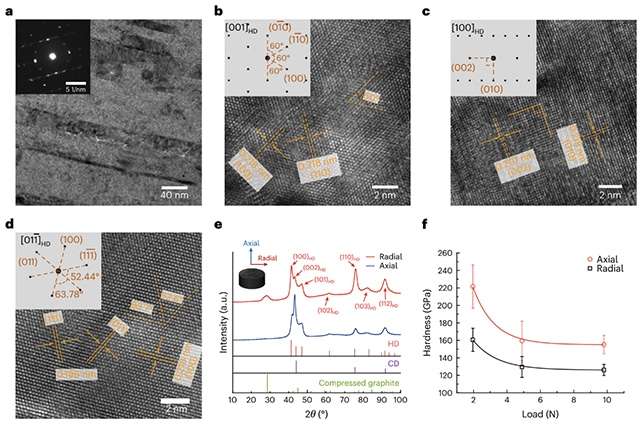
The uniqueness of this diamond lies in its hexagonal atomic arrangement, differing from the cubic lattice in typical diamonds. Although scientists have long theorized that this hexagonal pattern could result in superior strength, confirming it through experiments had been a challenge.

Measured hardness reached 155 gigapascals (GPa), surpassing the 110 GPa characteristic of natural diamonds, positioning it as one of the most resilient materials known. This diamond also withstands temperatures as high as 1,100°C (2,012°F), far outperforming most industrial nanodiamonds in thermal endurance.
Origins Inspired by Cosmic Phenomena
Hexagonal diamonds were first discovered more than five decades ago in meteorites impacted by high-velocity collisions, indicating their formation under extreme pressures in space. This finding inspired efforts to replicate such structures synthetically, though prior experiments yielded only small, impure samples.
Current research offers compelling proof that this hexagonal form enhances both hardness and temperature resistance. It introduces an improved method for synthesizing these crystals, which could eventually support larger-scale production.
The critical insight was recognizing the necessity of compressing graphite at much higher pressures than previously trialed. When the graphite reaches a specific phase under these conditions, subsequent heating triggers its transformation into the hexagonal diamond form.
Industrial Potential and Challenges Ahead
Scaling up production remains a significant hurdle, yet ongoing efforts aim to improve synthesis techniques and refine the material’s purity and durability. If these challenges are overcome, this ultra-hard diamond may revolutionize cutting tools in mining and construction, endure harsh conditions in aerospace engineering, and boost advancements in data storage and quantum computing.
Additionally, the findings deepen our understanding of diamond formation under extreme environments, offering insights relevant to geological science and material development.
Opening Doors to Next-Generation Materials
This breakthrough represents a significant leap in designing exceptional synthetic materials. While natural diamonds will retain their desirability for decorative purposes, the lab-grown hexagonal diamonds are poised to become the preferred material for high-tech applications.
Researchers are hopeful that future innovations will enable mass production, providing industries with ultra-hard, thermally resilient diamonds suited to their most demanding requirements.
“Our results yield important knowledge about how graphite transforms into diamond under elevated pressures and temperatures, paving the way for fabricating and utilizing this unique material,” the research team stated.
- Categories:
- Science












0 comments
Sign in to Comment