
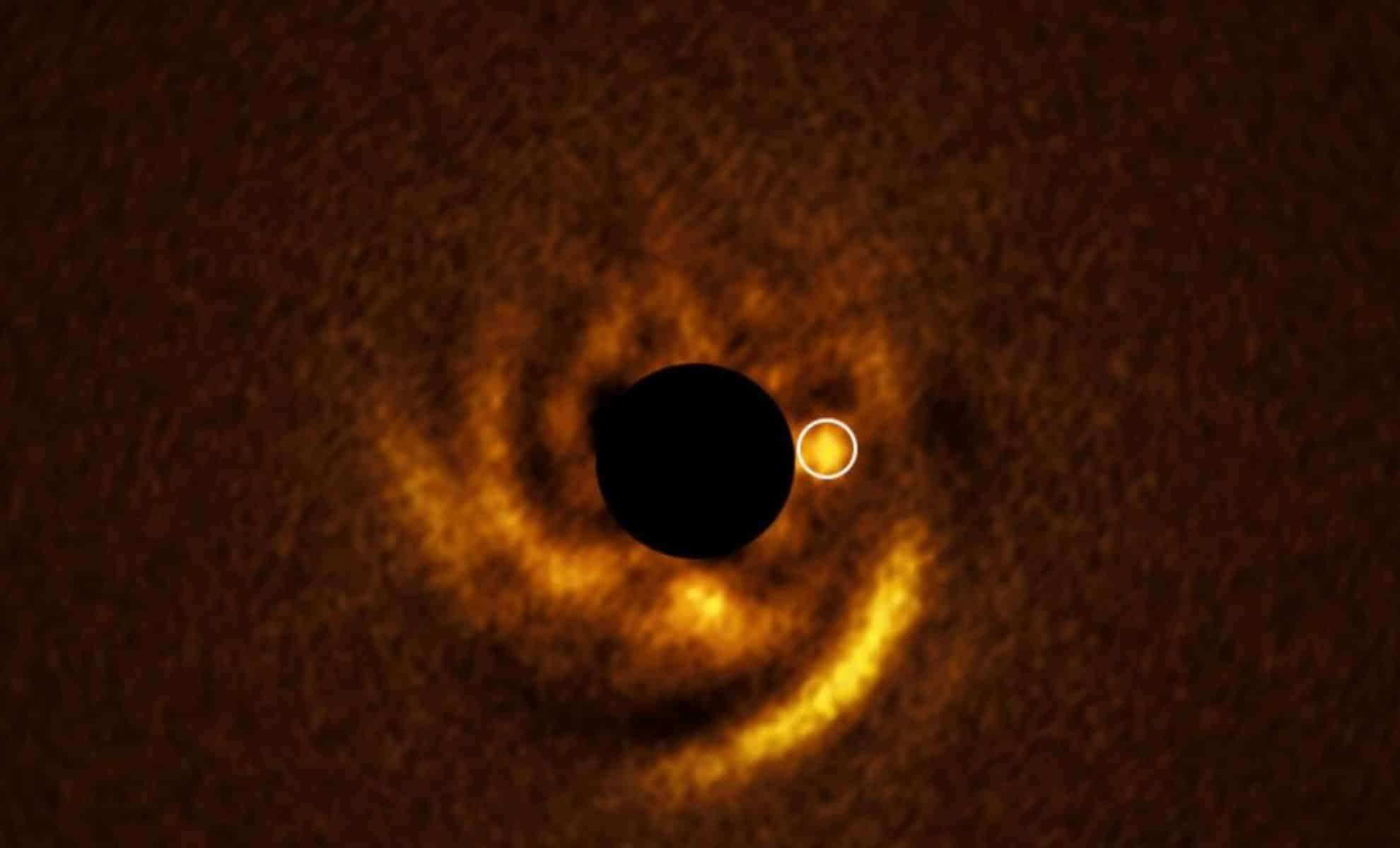
On July 21, 2025, the European Southern Observatory (ESO) unveiled a remarkable finding facilitated by its state-of-the-art instruments: the identification of a spiral disc encircling the youthful star HD 135344B. This remarkable image, captured using the Very Large Telescope (VLT) in Chile, sheds new light on the intricate mechanisms involved in planet formation. Utilizing the advanced ERIS (Enhanced Resolution Imager and Spectrograph) system, astronomers now have the ability to observe far-off star systems with exceptional precision, revealing structures once hidden from view.
Spotting this spiral disc extends beyond merely observing a distant celestial body; it marks an essential advancement in comprehending the dynamic processes that lead to planet creation. By analyzing the spiral patterns and the possible existence of a nascent planet within the disc, researchers aim to assemble a clearer picture of how planetary systems, including our own, arise. Observations of stars like HD 135344B offer a vivid glimpse into the formative periods of solar systems, serving as a cosmic reflection of our own beginnings.
ERIS: Pioneering Detailed Views of Early Star Systems
Until recent times, achieving such detailed imagery of remote stars and their discs was unthinkable. The introduction of instruments like ERIS has revolutionized this pursuit by providing astronomers a window into planet formation with unmatched resolution. Attached to the VLT, ERIS reveals delicate aspects of young star environments, illuminating the processes governing star and planet development.

A key component of these observations is the coronagraph, which blocks the intense glare from the star itself. This enables scientists to focus on the dimmer areas surrounding the star—critical for understanding how planets form. In HD 135344B’s case, the coronagraph unveiled a swirling spiral disc that appears influenced by a potential planet or protoplanet, possibly carving out gaps in the disc as it orbits—an essential phase in planet development.
Thanks to ERIS’s finely detailed capabilities, astronomers can now trace the subtle indicators showing how planets emerge from dust and gas clouds. The disc observed around HD 135344B could be a vital piece in uncovering how planetary bodies take shape and evolve during a young star’s early life.
HD 135344B: A Stellar Nursery
Around 440 light-years from Earth, HD 135344B stands as a prime example of a star early in its lifecycle, surrounded by an abundant disc where planets begin to form. Its youthful status and visible disc make it a perfect subject for astronomers studying planetary origins. Observations of this system offer critical information helping improve theoretical models of how planets are born.
This system has long been an object of interest for planet formation researchers. The spiral structure seen in the disc is thought to be shaped by gravitational forces between a youthful planet or protoplanet and the surrounding dust and gas. These interactions generate the distinct twisting patterns, mirroring the processes that likely shaped our Solar System billions of years ago.
Discovering such a disc not only fuels scientific curiosity but also highlights the universe's dynamic evolution. Continued monitoring of stars like HD 135344B allows scientists to delve deeper into cosmic forces and unravels clues about the formation history of our own cosmic neighborhood.
Watching Planets Take Shape in Real Time
Examining stars like HD 135344B provides a rare window into the real-time development of planetary systems. These natural observatories allow scientists to put their theories about planet and moon formation to the test. The spiral disc encircling HD 135344B exemplifies the kind of natural laboratory that planetary scientists rely on.
Understanding planet formation remains a central quest in astrophysics. Investigating systems such as this not only clarifies the origins of our planetary system but also sheds light on the conditions required for habitability elsewhere in the cosmos. Grasping these formation processes better equips us to hunt for life beyond our planet.
Ongoing observation of HD 135344B will continue to supply valuable insights into planetary system evolution. This research is crucial to answering some of astronomy’s deepest questions: How did our Solar System come into existence? What makes a planet capable of supporting life? And how do planetary systems change over time?
Is This the Dawn of a New World?
One of the most thrilling possibilities emerging from the study of the HD 135344B system is that the bright feature within the spiral structure might be a newborn planet still forming. Although definitive confirmation remains challenging, this spot could indicate a planet in its infancy, gradually gathering dust and gas to become a solid world.
If confirmed, observing such a young planet offers a unique opportunity to understand the environmental conditions fostering planet formation, including physical properties like temperature and elemental makeup. These insights could enhance our comprehension of the likelihood and nature of planet birth in other star systems, guiding future searches for habitable exoplanets.
As research on HD 135344B advances, astronomers anticipate uncovering more about this captivating system. Continued study may unlock further secrets of planet formation, helping to address fundamental questions in astrophysics.
- Categories:
- News








0 comments
Sign in to Comment