
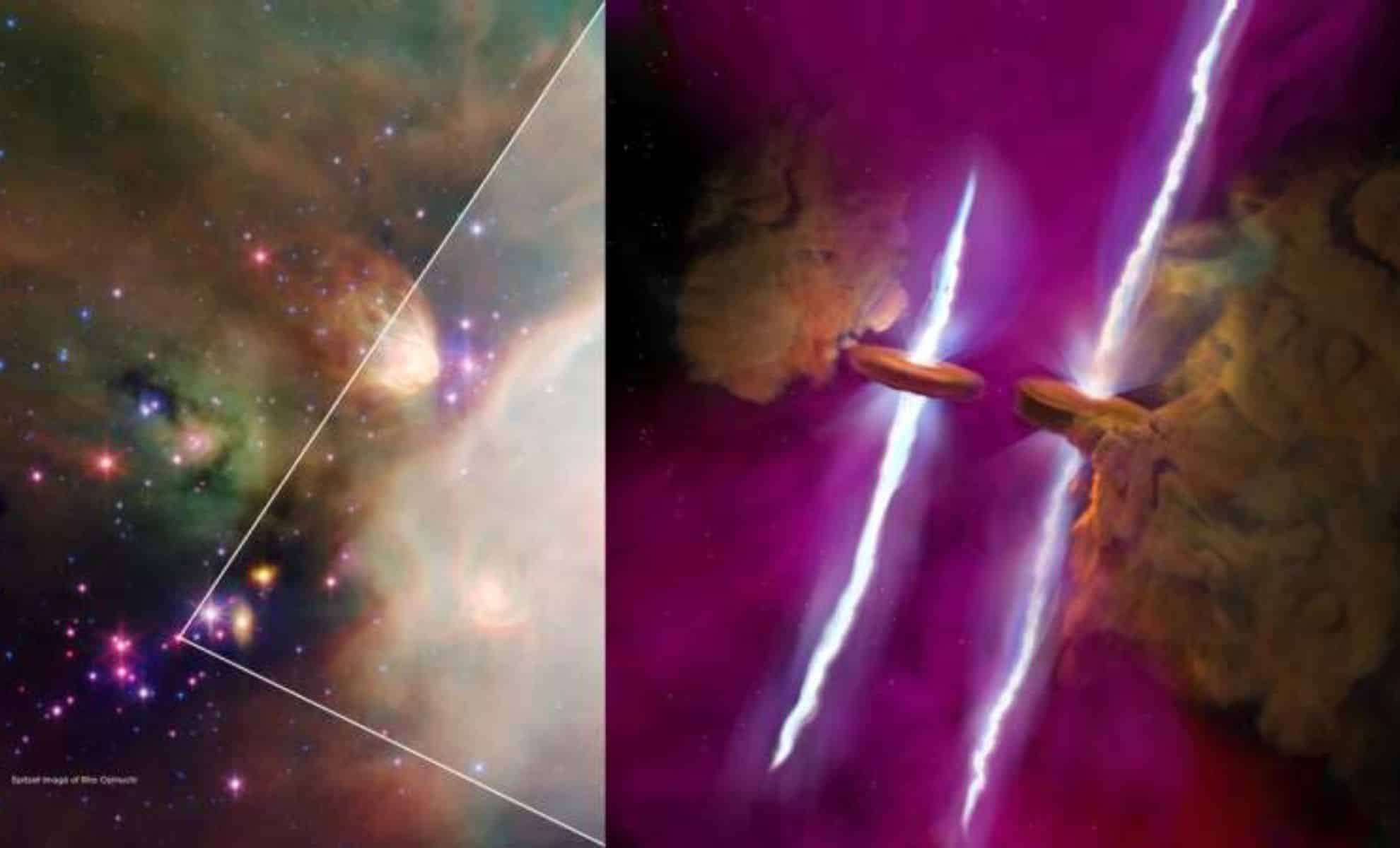
Utilizing the capabilities of the Atacama Large Millimeter/submillimeter Array (ALMA) and NASA’s James Webb Space Telescope (JWST), astronomers have achieved a remarkable breakthrough.
They detected twin circumstellar disks and jets arranged in parallel coming from two youthful stars within the binary system WL20, situated more than 400 light-years away in the rho Ophiuchi molecular cloud. This surprising observation opens new windows into how stars form and evolve during their infancy.
An Unexpected Revelation
Led by astronomer Dr. Mary Barsony, the research uncovered previously unrecognized details about the WL20 system. What initially appeared as a single youthful star was revealed by combined ALMA and JWST Mid-Infrared Instrument (MIRI) data to be two closely spaced stars.

Both stars are encircled by disks, each launching jets parallel to the other’s. Dr. Barsony stated, “Our findings were astonishing. While WL20 has been known for some time, the unusual youth of one star in the system really drew our focus.”
Given WL20 resides in a widely studied region, discovering such a dynamic binary highlights the value of combining diverse observational tools. Barsony added, “By employing both MIRI and ALMA, we realized what seemed like a single star was actually two neighbors, each surrounded by a disk, with aligned jets.”
Leveraging Diverse Wavelengths
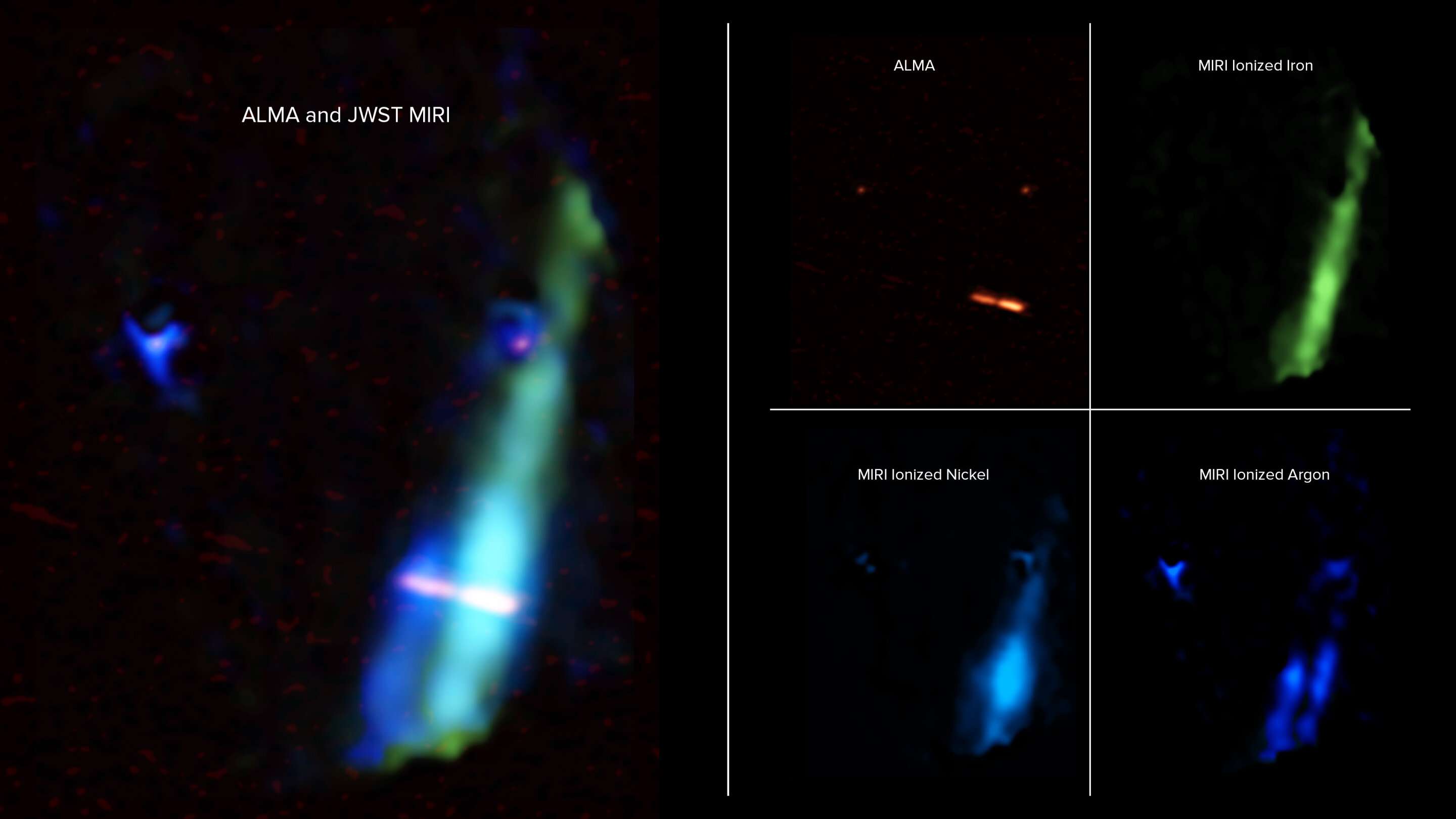
The synergy of ALMA and JWST was critical for this breakthrough. ALMA’s radio wave observations revealed the disks, while infrared data from JWST’s MIRI exposed the jets. This multi-spectrum approach unveiled details missed by earlier instruments. As Barsony emphasized, “Without MIRI, the jets would have remained hidden.”
Data analysis involved several experts: Valentin J.M. Le Gouellec (NASA-ARC) processed archival ALMA data; Lukasz Tychoniec from Leiden Observatory generated detailed disk imagery showing their massive scale, spanning roughly 100 times the Earth-Sun distance; Martijn L. van Gelder analyzed MIRI data to identify the jets’ chemical components.
Advancing Our Understanding of Star Formation
With ALMA’s detailed imaging revealing disk structures at enormous scales, the study offers fresh perspectives on the intricate star formation in multi-star environments. Dr. Barsony noted, “Without knowing about the twin jets, the ALMA data might be mistaken as a single, large, edge-on disk with a gap, rather than two disks with aligned jets — a remarkable distinction.”
These insights deepen knowledge about how young binary stars form and interact, providing clues about the developmental dynamics of closely bound star systems. Observing these features in such detail paves the way for further exploration into stellar birth mechanics.
Next Steps and Broader Impact
The team intends to exploit forthcoming enhancements to ALMA, including the Wideband Sensitivity Upgrade, to further probe star and planet formation processes. These upgrades will sharpen our picture of the complex interactions shaping young stellar structures.
At the 244th American Astronomical Society meeting in Madison, Wisconsin, Dr. Barsony shared these exciting results. Her colleague, Michael Ressler of JPL, reflected on the fortunate nature of the discovery, stating, “While I originally planned to focus on binaries in the Perseus region, I slipped in WL20 — a region I’ve studied for nearly 30 years — and the surprising outcome was extraordinary.”
By combining the complementary power of ALMA and JWST, this discovery exposes the subtle complexities in star system formation and encourages continued study that promises to unravel more cosmic mysteries.
- Categories:
- Astronomy ,
- News ,
- Space









0 comments
Sign in to Comment