
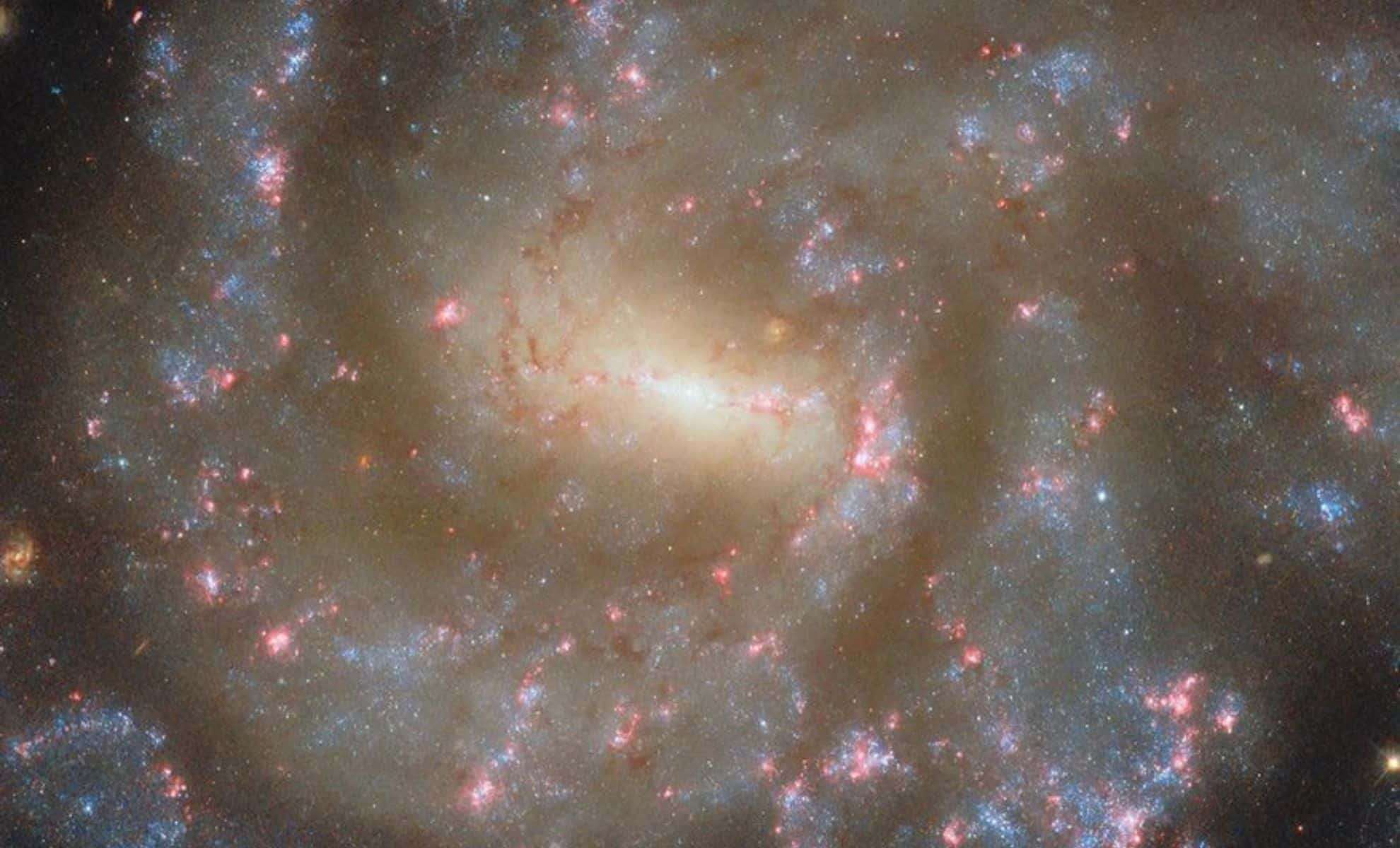
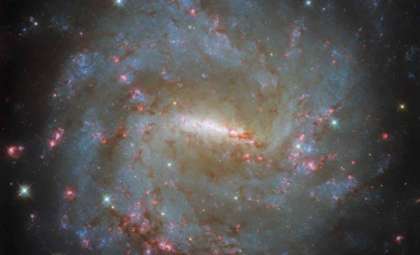
The NASA/ESA Hubble Space Telescope has captured a breathtaking view deep into the cosmos, presenting a detailed look at the barred spiral galaxy NGC 685, situated about 64 million light-years away in the constellation Eridanus. As highlighted by NASA Science on June 6, 2025, this image highlights a galaxy teeming with newborn stars, featuring concentrated regions of blue star clusters and vibrant pink hydrogen gas clouds, or H II regions, which are active sites of stellar formation. These observations contribute to two scientific initiatives focused on unveiling the mysteries behind star formation in nearby galaxies.
Cosmic Harmony: Bars and Spirals in Motion
NGC 685 exemplifies a classic barred spiral galaxy, a type shared by our own Milky Way. Unlike typical spirals where arms spiral outward from a bulging center, this galaxy’s arms originate from the edges of a central star-studded bar. Though resembling the Milky Way’s structure, NGC 685 is roughly half its size. Its spiral arms are dotted with bright blue clusters, signifying recent star formation. The central bar plays a crucial role by channeling interstellar gas inward, fueling both ongoing star birth and the galaxy’s evolution.
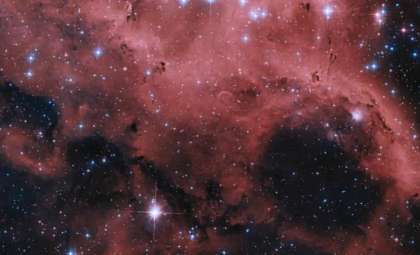
The striking visual contrasts here are more than mere aesthetics—they reveal valuable scientific data. The luminous blue patches indicate the presence of short-lived massive stars, while the distinctive pinkish zones mark regions filled with ionized hydrogen. A prominent H II region radiates near the image’s lower edge, showcasing a stellar nursery illuminated until the newborn stars’ radiation clears the surrounding gas.

Significance of NGC 685 in Stellar Formation Research
Despite its visually abundant star-forming areas, NGC 685 creates less than half a solar mass’s worth of stars annually. This relatively low output contrasts with the galaxy’s vivid appearance. For scientists, such observations provide valuable insights into the interplay of gas, dust, and gravitational forces that govern star creation across galaxies of varying sizes and forms.
These latest images of NGC 685 are part of two sweeping research projects focused on mapping star-forming zone evolution. The studies aim to catalogue around 50,000 H II regions and 100,000 stellar clusters across neighboring galaxies. Each environment offers diverse conditions—such as density and chemical composition—helping astronomers decode the fundamental principles underlying star formation.
Integrating Observations from Multiple Telescopes
Hubble’s data is synthesized with observations from other observatories to offer a comprehensive view of stellar life cycles. Combining Hubble’s high-resolution optical and ultraviolet images with infrared insights from the James Webb Space Telescope (JWST) and radio data from ALMA (the Atacama Large Millimeter/submillimeter Array in Chile) reveals different facets of the star formation process.
While Hubble captures bright UV emissions from young stars and the glowing ionized gas, JWST probes into the obscuring dust clouds, uncovering protostars still coalescing in dense nebulae. Meanwhile, ALMA observes the cold molecular gas reservoirs that feed star formation. This collaborative, multi-wavelength approach enables scientists to piece together the transition from dark gas clouds to glowing new stars across thousands of galactic birthplaces.
- Categories:
- News


0 comments
Sign in to Comment