

For the first time, scientists have successfully charted the atmospheric conditions of a faraway exoplanet, exposing a realm of violent winds, scorching temperatures, and unexpected atmospheric stratification. Using Chile's Very Large Telescope (VLT), the team captured a detailed 3D snapshot of the planet’s atmosphere, disclosing a turbulent and intricate weather system that upends previous conceptions of extraterrestrial climates.
An Extreme Exoplanetary Environment
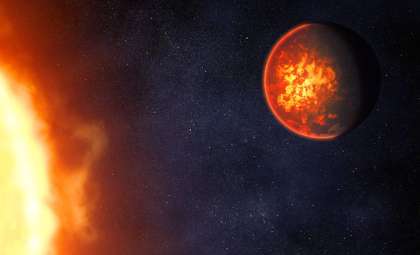
The focus of the study, WASP-121b, nicknamed Tylos, is categorized as an “ultra-hot Jupiter”—a massive gas planet orbiting dangerously close to its star. Situated about 900 light-years away in the Puppis constellation, WASP-121b completes a full revolution in less than 30 hours, causing one hemisphere to endure constant intense daylight while the opposite side remains in permanent darkness.
This synchronous rotation causes dramatic temperature disparities. The sun-facing region reaches temperatures exceeding 2,500°C (4,500°F), capable of vaporizing metals, whereas the night side is cooler but far from mild. The resulting extreme gradient powers powerful jet streams racing through the atmosphere at extraordinary velocities.

“The atmospheric dynamics of this world push the boundaries of our understanding—not just for Earth but for planetary weather in general. It’s almost as if it’s a scenario from science fiction,” said Julia Victoria Seidel, lead investigator at the European Southern Observatory (ESO).
Decoding an Exotic Atmosphere
Employing high-resolution spectroscopy, researchers examined how starlight passes through successive layers of WASP-121b’s atmosphere. This method enabled them to construct a three-dimensional model of the planet’s atmospheric circulation, uncovering an elaborate and layered climate system.
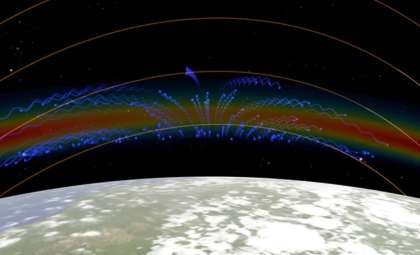
The 2025 report published in the journal Nature revealed that the atmospheric structure comprises multiple layers, each with distinct characteristics. The lower atmosphere is dominated by iron-laden winds surging at extreme speeds, while a swift sodium jet stream sweeps around the planet’s equator in the layer above.
“We observed something unexpected: a jet stream shapeshifts material along the equatorial band, while another current at lower altitudes transports gas from the searing day side toward the cooler night side. This circulation pattern has no analog in any known planetary atmosphere,” Seidel noted.
Unanticipated Metal Signatures
A remarkable finding was the identification of titanium beneath the upper jet stream layer. Prior efforts to detect this metal on WASP-121b had been unsuccessful, making this discovery pivotal to understanding metal distribution and behavior on scorching exoplanets.
Tracking iron, sodium, and hydrogen movements allowed scientists to observe the exchange between the superheated dayside and cooler nightside atmospheres.
These observations confirm that powerful jet streams transport metallic elements and gases, contributing to the planet’s fierce and unpredictable weather patterns.
The winds on WASP-121b outpace the most intense storms found in our Solar System by a wide margin.
Advancing Exoplanet Exploration
To capture these groundbreaking insights, astronomers utilized the Very Large Telescope Interferometer (VLTI), which combines the light from four telescopes to acquire a highly detailed atmospheric profile during a single transit event.
“Achieving this level of observation is a challenge for space telescopes, underscoring the crucial role of ground-based exoplanet observations,” remarked Leonardo A. dos Santos, assistant astronomer at the Space Telescope Science Institute.
Looking Ahead to Rocky Worlds
Although WASP-121b is an extreme gas giant, these findings pave the way for applying similar methods to rocky, Earth-sized planets that might harbor life. Scientists are eager to study planets with thinner atmospheres and milder climates using these advanced techniques.
With the forthcoming Extremely Large Telescope (ELT) currently being built in Chile’s Atacama Desert, astronomers anticipate even more detailed explorations of distant planetary atmospheres.
“The progress made here makes me excited about the incredible discoveries lying just ahead—things we can merely imagine today,” said Bibiana Prinoth, a PhD researcher at Lund University and contributor to a related study in Astronomy & Astrophysics.
- Categories:
- Space










0 comments
Sign in to Comment