
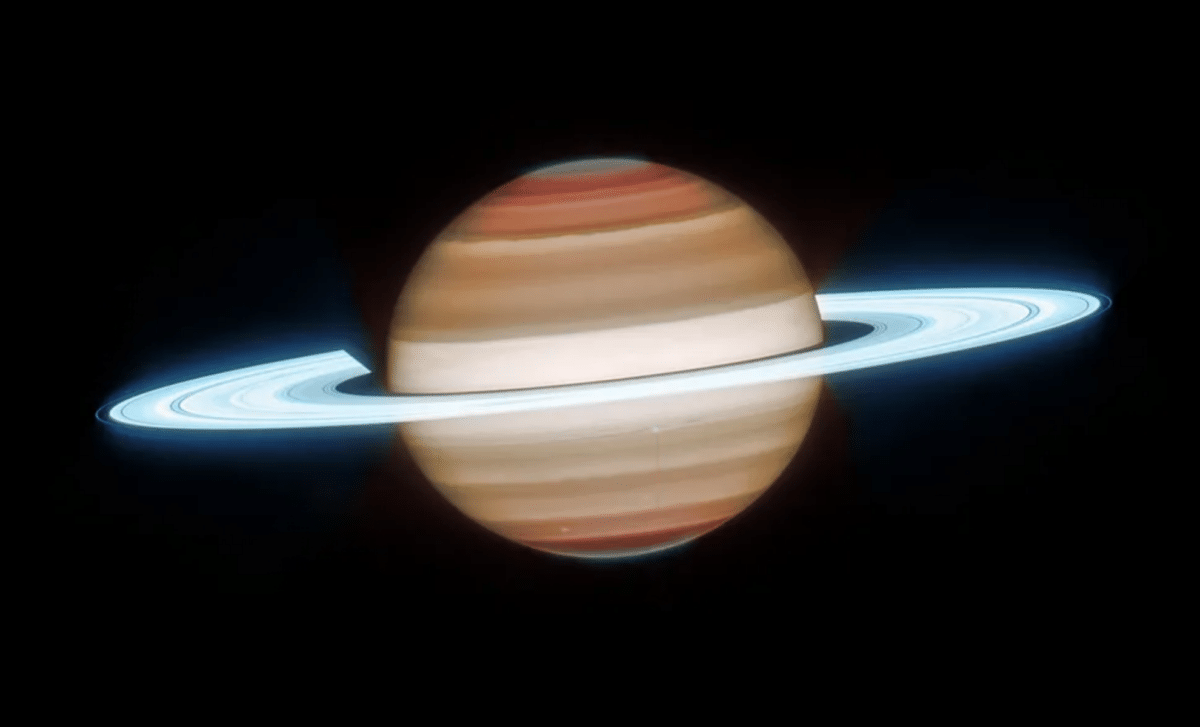
NASA has advanced our understanding of Saturn by capturing extraordinary images that unveil the planet’s atmosphere and rings in remarkable detail. By combining the capabilities of the Hubble Space Telescope with the James Webb Space Telescope (JWST), researchers have produced the most intricate portrayal of Saturn ever recorded. Utilizing infrared, visible, and ultraviolet wavelengths, these observations provide a richer and more comprehensive insight into Saturn’s complex environment, delivering crucial data for scientists investigating the gas giant’s dynamic systems. This unprecedented synergy sheds new light on how Saturn’s atmosphere operates as an interlinked three-dimensional structure.
Saturn Like Never Before: A Collaborative Telescope Effort
Known for its magnificent rings and dense atmosphere, Saturn has fascinated astronomers for centuries. While earlier missions have offered snapshots of the planet, none delivered such a detailed multi-layered perspective. Leveraging observations from both NASA’s Hubble and JWST, this recent study assembles a composite image that merges multiple wavelengths, allowing an unparalleled exploration of Saturn’s atmospheric layers and intricate ring system.
Hubble provides vivid visible-light images highlighting cloud formations and atmospheric textures, while JWST’s infrared vision reveals thermal patterns and hidden structures deep beneath the cloud tops. This coordinated approach enables a more dynamic and layered visualization of Saturn, broadening the understanding of its atmospheric processes.

“Each telescope tells a different part of Saturn’s story, and the observations together help researchers understand how Saturn’s atmosphere works as a connected three-dimensional system,” NASA officials stated in their announcement.
Beyond advancing knowledge of Saturn’s atmospheric dynamics, the gathered data contributes to broader studies of planetary weather and seasonal atmospheric changes across the solar system.
Illuminating Saturn’s Depths with Hubble and Webb
The Hubble Space Telescope has long captured Saturn’s visible-light features, showcasing its legendary cloud bands and sparkling rings with exceptional clarity. However, these observations primarily expose the planet’s outermost atmospheric layer. In contrast, JWST’s infrared capabilities delve deeper, uncovering temperature variations and underlying atmospheric structures. Together, these telescopes complement each other, providing a multidimensional portrayal of Saturn’s atmosphere.
Images from Hubble gathered in August 2024 reveal the luminous rings and soft atmospheric bands, while JWST’s late-2024 infrared data uncovers intricate features such as swirling jet streams in Saturn’s northern mid-latitudes, possible auroras, and scattered storms in the southern hemisphere. This blend of visible and infrared perspectives allows researchers to effectively "slice" through Saturn’s atmosphere, offering an unprecedented, layered view of its complex systems.
“Together, scientists can effectively ‘slice’ through Saturn’s atmosphere at multiple altitudes, like peeling back the layers of an onion,” NASA officials added.
This comparison highlights just how deeply these images penetrate, revealing Saturn’s concealed atmospheric intricacies beyond surface visuals.
Exploring the Rings and Seasonal Dynamics
Saturn’s legendary rings, composed mostly of water ice, define the planet’s unique appearance. The latest imagery exposes fine structural details of the rings in both the visible and infrared spectra. Hubble captures their dazzling reflection of sunlight, while JWST’s infrared observations provide contrast against the darkness of space, revealing previously hidden aspects.
Saturn’s lengthy seasonal cycles, each nearly 29 Earth years, gradually influence both atmospheric conditions and ring behavior. Understanding these shifts is critical for tracking the planet’s climatic evolution. NASA’s Outer Planet Atmospheres Legacy (OPAL) program has monitored Saturn’s atmospheric variations over more than ten years, producing a vital long-term record now enriched with JWST’s recent infrared insights.
As the 2025 equinox approaches, this combination of data empowers researchers to enhance their models of Saturn’s seasonal and atmospheric changes, deepening our comprehension of how this giant planet transforms over time.
- Categories:
- Nasa






0 comments
Sign in to Comment