

NASA’s Scientific Balloon Program has returned to Antarctica, deploying two innovative balloon projects aimed at investigating fundamental questions about the universe. The launches took place in early December near McMurdo Station, initiating an extensive scientific operation. These high-altitude balloons will assist researchers in studying dark matter and high-energy cosmic particles.
The missions, named PUEO and GAPS, are set to collect crucial information that could revolutionize our cosmic knowledge. PUEO is dedicated to detecting elusive, high-energy neutrinos, while GAPS targets particles that may be linked to dark matter. Both endeavors represent NASA’s commitment to exploring distant cosmic phenomena through cutting-edge technology.
PUEO Mission: Tracking High-Energy Neutrinos
The PUEO mission is a landmark for NASA as it’s the initial project under the Astrophysics Pioneers program, which emphasizes impactful science with cost efficiency. PUEO aims to identify neutrinos—tiny, nearly massless particles that journey through the cosmos undisturbed. These particles hold valuable clues about extreme cosmic phenomena such as black holes and neutron star collisions.

To capture these faint signals, NASA will utilize Antarctica’s ice sheet as a vast detection medium. According to NASA, PUEO will listen for radio emissions that arise when high-energy neutrinos interact with the ice.
“I’m excited to see our first Astrophysics Pioneer mission on the launch pad, with more to come very soon,” said Shawn Domagal-Goldman, NASA’s acting director of Astrophysics. “The PUEO mission is essentially like using the Antarctic ice as one big telescope.”
This project promises to deliver the most sensitive survey ever of these cosmic neutrinos.
GAPS Mission: Unraveling Dark Matter’s Secrets
The GAPS mission constitutes a vital part of this exploration, focusing on the enigmatic dark matter that comprises the majority of the universe’s mass. Though invisible, dark matter’s existence is confirmed through its gravitational influence. GAPS aims to detect antimatter particles thought to emerge when dark matter undergoes decay.
Observing even one of these particles could redefine current cosmic theories, potentially opening new doors in our comprehension of dark matter and its cosmic role.
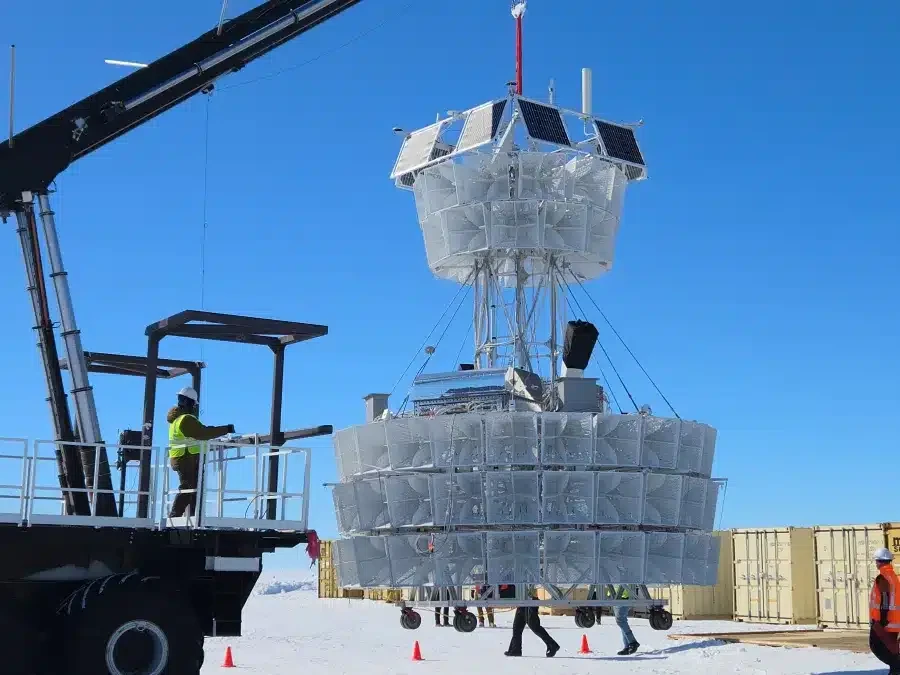
Why NASA Chooses Balloons for Extended Space Research
The balloons utilized in these missions are uniquely engineered to maintain stability within the atmosphere, essential for prolonged flights over Antarctica. These zero-pressure balloons balance against atmospheric pressure, making them ideal for polar expedition conditions.
NASA’s Wallops Flight Facility manages this balloon program, with Peraton handling logistics and engineering. The balloons are manufactured by Aerostar. This blend of advanced technology and collaboration enables NASA to conduct lengthy missions that spacecraft alone cannot easily accomplish, providing extraordinary opportunities for data gathering in challenging environments.
- Categories:
- Nasa






0 comments
Sign in to Comment