
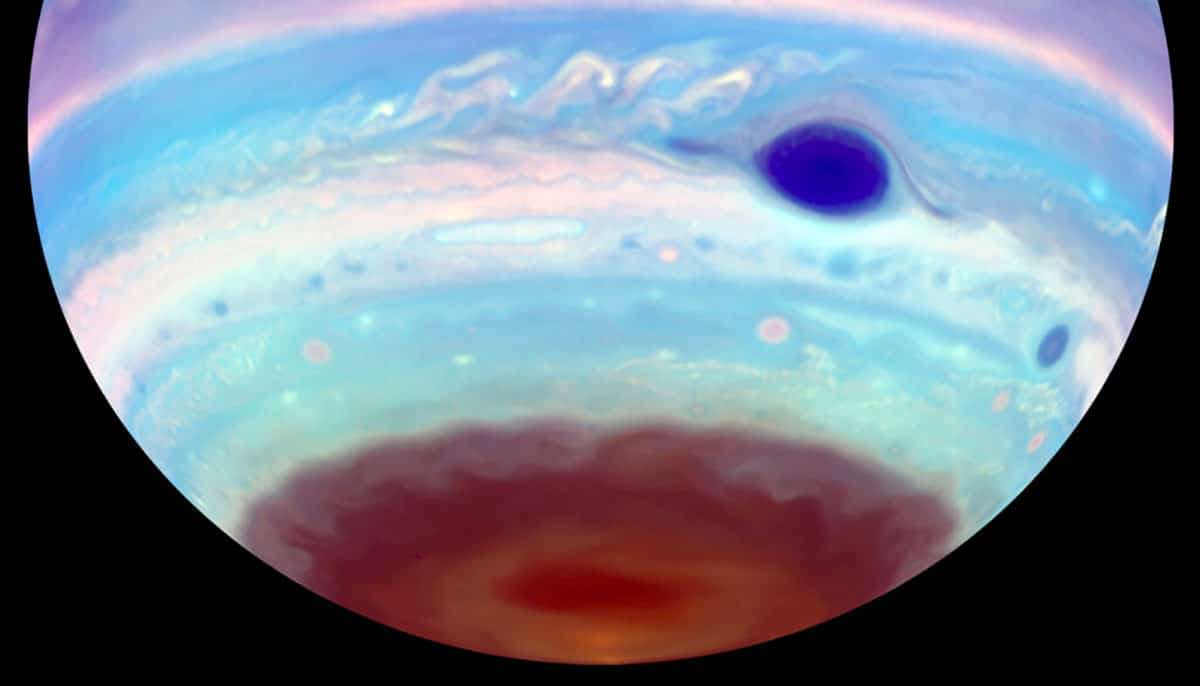
Jupiter’s polar regions are home to mysterious oval-shaped features visible exclusively in ultraviolet light. Comparable in size to Earth, these dark spots emerge and disappear unpredictably within the planet’s upper atmospheric layers, offering new insights into the giant planet’s complex environment:
- South Pole: Dark UV ovals appear in approximately 75% of observations
- North Pole: These ovals are detected far less frequently, found in only one-eighth of images
- Size: Roughly Earth-sized
- Position: Located just beneath the bright auroral emissions
The ability of these ovals to absorb UV light, making them appear as dark shadows in views from NASA’s Hubble Space Telescope, points to unusual magnetic interactions within Jupiter’s atmosphere. These processes extend significantly deeper than Earth’s auroral activity, revealing complex magnetospheric influences.
Although first spotted in the late 1990s, the physical importance of these dark ovals became clearer after a systematic analysis by a UC Berkeley undergraduate, Troy Tsubota, who uncovered their regularity and distribution patterns through detailed examination of archival Hubble imagery.

Magnetic Vortexes: Driving Jupiter’s Atmospheric Dynamics
The generation of these UV-dark ovals is attributed to a captivating magnetic phenomenon known as magnetic tornadoes. These swirling vortices arise from interactions between Jupiter’s magnetic field lines at two distinct regions:
- The ionosphere, which shows evidence of rotational motion
- The hot, charged plasma encircling Jupiter, energized by its volcanic moon Io
Similar in behavior to Earth’s tornadoes yet governed by magnetic forces, these vortices gradually weaken as they extend downward. Upon reaching Jupiter’s lower hazy atmosphere, they agitate the gases, producing dense hazy regions that scientists detect as dark spots in ultraviolet light.
This phenomenon shares conceptual similarities with how supermassive black holes influence their surrounding galaxies, illustrating the widespread impact of powerful astrophysical forces across different scales.
Peering into Jupiter’s Layered Atmosphere
The identification of these ultraviolet-absorbing ovals has significantly advanced knowledge of the structure and mechanics of Jupiter’s atmosphere. Analysis indicates that haze density inside these ovals is around 50 times greater than in adjacent atmospheres, suggesting their emergence results from vortex-driven mixing rather than chemical changes induced by energetic particles.
To deepen this understanding, astronomers have compiled key observational data:
Scientists estimate that these ovals form rapidly over roughly one month and dissipate within a few weeks, underscoring the dynamic and transient nature of Jupiter’s polar atmospheric conditions.
Broader Impact: Insights into Planetary Atmospheres
Studying Jupiter’s magnetic tornadoes provides invaluable perspectives on planetary weather systems beyond our solar system, helping researchers develop models applicable to other gas giants and exoplanets.
By exploring the complex interactions between Jupiter’s inner magnetic dynamo, plasma environments driven by its moons, ionosphere, and layered hazes, scientists gain a holistic view of how planetary atmospheres function and evolve.
This work also highlights the critical role of long-term monitoring projects like the Outer Planet Atmospheres Legacy (OPAL) program, which enable astronomers to track atmospheric changes and identify subtle trends in the giant planets over years.
As exploration continues, this discovery of magnetic vortexes on Jupiter not only enriches our understanding of planetary atmospheres but also builds bridges to cosmic-scale phenomena. The lessons learned here may eventually aid in unraveling enigmas tied to quasar environments in the early universe, linking planetary and galactic sciences in exciting new ways.
- Categories:
- Astronomy





0 comments
Sign in to Comment