
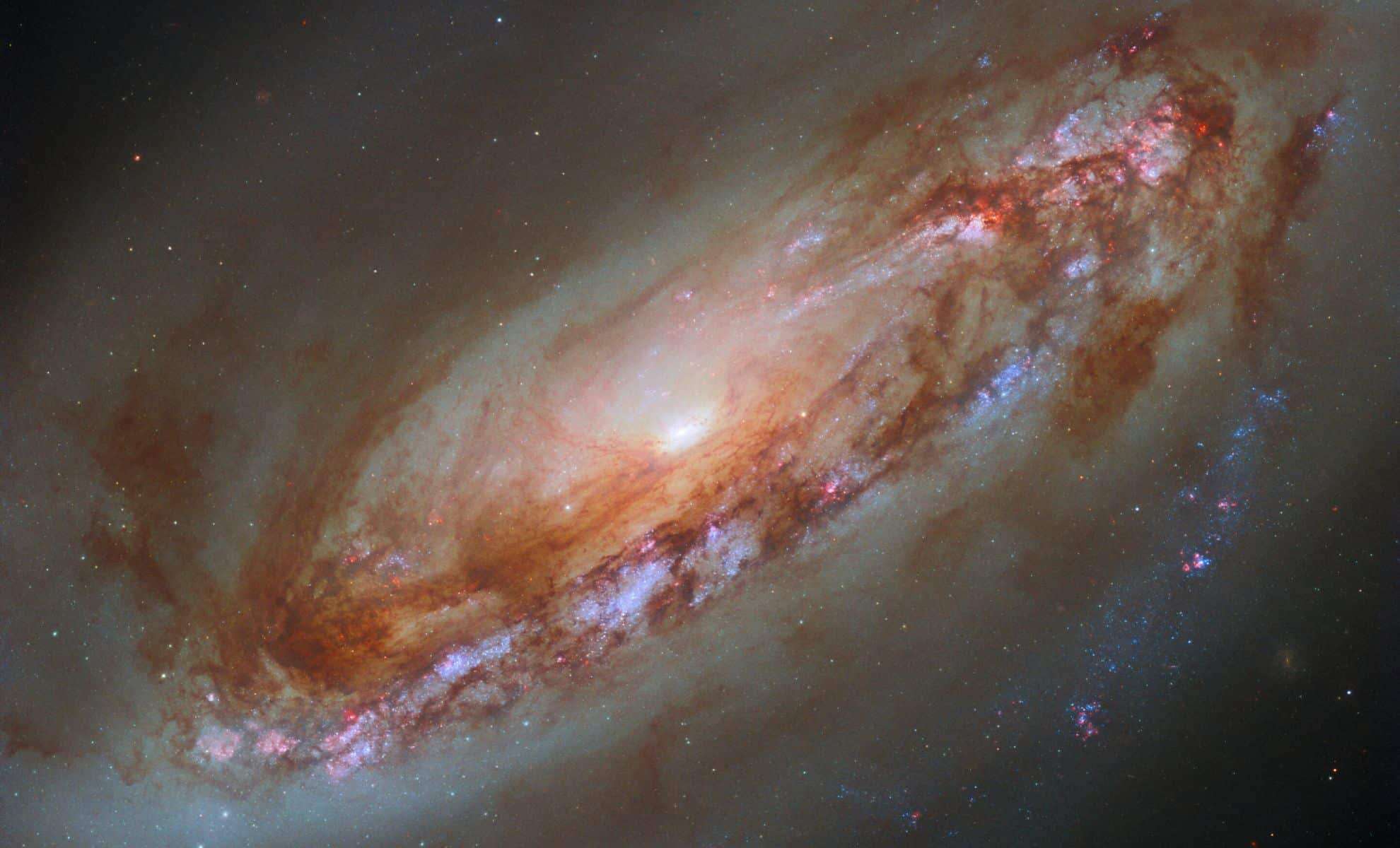
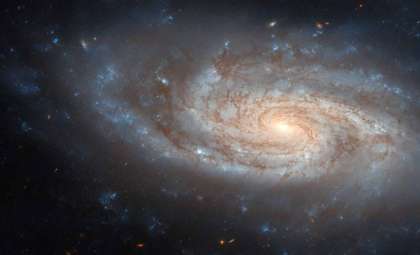
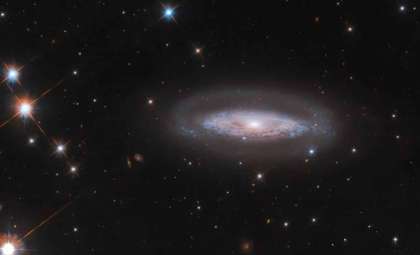
The Hubble Space Telescope has delivered a captivating new portrait of Messier 90 (M90), a magnificent spiral galaxy located in the Virgo constellation that is notably approaching Earth. Positioned roughly 55 million light-years away, M90 is a member of the Virgo Cluster, a nearby galaxy cluster. Distinctly, M90 is among the few galaxies actively moving closer to our planet, contrasting the typical outward movement of most galaxies.
Exploring M90 Through Hubble’s Advanced Optics
Captured with Hubble’s Wide Field Camera 3 (WFC3), the latest image exposes extraordinary details of M90’s formation. The image vividly displays the galaxy’s luminous core, dust-laden disk, and a soft halo of gas enveloping the galaxy, features that previous images with older tools could not resolve as clearly.
This enhanced perspective offers a comprehensive look at M90’s intricate makeup, highlighting areas where star formation continues, visible through the reddish glow of H-alpha emissions from nebulae within its disk. Yet much of the galaxy exhibits little star-forming activity, attributed to its depletion of gas.

Earlier Hubble snapshots, such as the 1994 image taken with the Wide Field and Planetary Camera 2 (WFPC2), displayed a distinctive jagged pattern caused by sensor alignment. The superior WFC3, installed in 2010, produces much sharper images, enabling deeper analysis of M90’s current condition and developmental trajectory.
Uncommon Movement: M90 Approaches Earth
M90 is experiencing a notable transformation. As it voyages within the Virgo Cluster, it encounters dense intergalactic gas near the cluster’s core. This interaction acts like a wind resistance, stripping away the raw materials necessary for star birth and producing the faint gaseous halo observed around M90. This loss of gas foreshadows M90’s gradual dimming as a spiral galaxy, eventually transitioning into a lenticular galaxy over several billion years.
Most galaxies are receding from Earth due to cosmic expansion, but M90 is uniquely moving towards us. Scientists attribute this unusual velocity to its gravitational encounters with the Virgo Cluster’s center. As M90 continues escaping the cluster, it will gradually approach the Milky Way, allowing astronomers to observe this evolving galaxy in greater detail over immense timescales.
A Galaxy Changing Over Time
Hubble’s fresh image is not just visually impressive; it captures M90 in a pivotal phase. While pockets near the galaxy’s center still showcase active star formation, the galaxy is rapidly losing the gas it needs to sustain these processes.
This phenomenon, called ram pressure stripping, results from M90 plowing through the dense surroundings of the Virgo Cluster. Eventually, the remaining gas will be depleted, halting new star creation and pushing M90 toward becoming a lenticular galaxy.
M90 represents the intricate forces that mold galaxies across billions of years. As it closes in on Earth, it provides a rare chance for scientists to study a galaxy undergoing significant evolutionary changes.
Hubble’s Ongoing Quest to Decode the Cosmos
Hubble’s revealing portrait of M90 contributes to its larger task of probing the universe’s secrets. Utilizing cutting-edge imaging tools, the telescope continues to capture awe-inspiring glimpses of distant galaxies, stars, and cosmic phenomena.
The approach of M90 offers a unique research opportunity to monitor a galaxy's transformation over time. Hubble’s observations will advance knowledge about galaxy formation, evolution, and their interaction within the cosmic environment.
In the billions of years ahead, as M90 moves even closer to Earth, astronomers will have an unparalleled window into the life cycle of galaxies—including clues about the distant future of the Milky Way.
- Categories:
- Astronomy ,
- News ,
- Nasa




0 comments
Sign in to Comment