
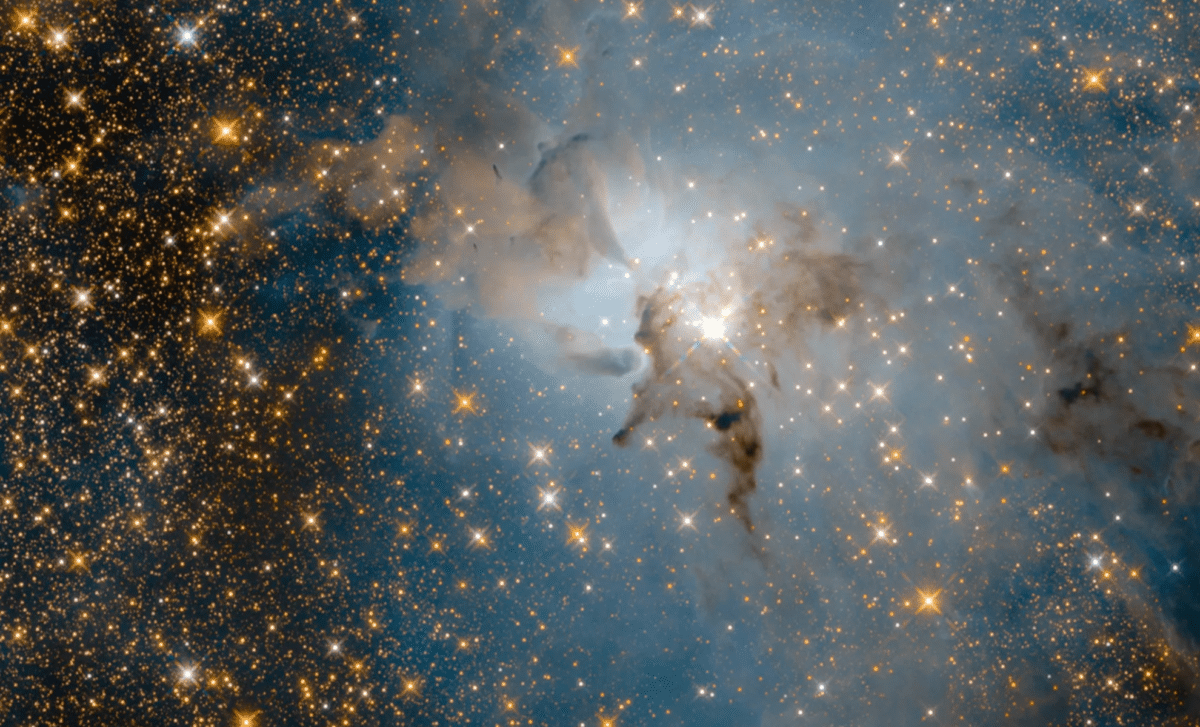
NASA’s Nancy Grace Roman Space Telescope is gearing up to launch a groundbreaking mission aimed at revealing the intricate and vast structure of our galaxy, the Milky Way. Utilizing its cutting-edge infrared instruments, Roman will offer detailed views into star birth, unseen cosmic formations, and the dynamics shaping our galaxy’s evolution. Central to Roman’s primary objectives, the Galactic Plane Survey seeks to unlock long-standing mysteries about the Milky Way and its distant reaches.
NASA’s Revolutionary Milky Way Mapping Initiative
NASA has revealed plans to conduct an unparalleled detailed survey of the Milky Way galaxy. Taking advantage of the Nancy Grace Roman Space Telescope’s sophisticated capabilities, the Galactic Plane Survey will target regions previously veiled by dense cosmic dust. By observing in infrared, Roman is capable of penetrating these obscuring layers to uncover new stellar bodies, nebulas, and other galactic features.
Julie McEnery, Roman’s senior project scientist at NASA’s Goddard Space Flight Center, highlighted the significance of this survey, stating,

“The Galactic Plane Survey will revolutionize our understanding of the Milky Way. We’ll be able to explore the mysterious far side of our galaxy and its star-studded heart. Because of the survey’s breadth and depth, it will be a scientific mother lode.”
This landmark venture will enable researchers to assemble a more comprehensive portrait of galactic formation and the intricate processes occurring within the Milky Way.
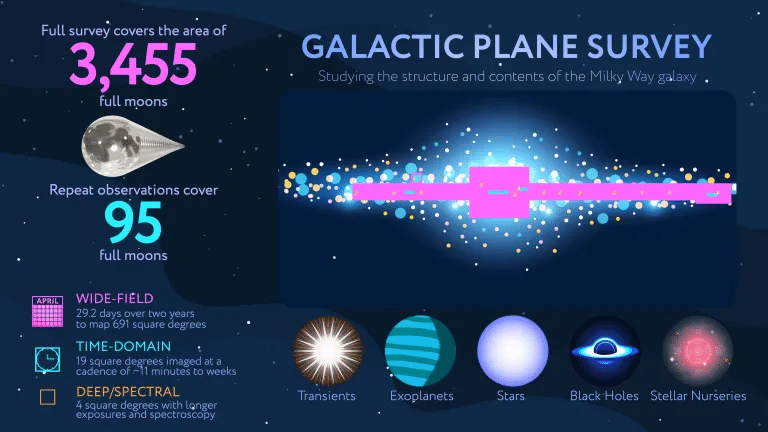
The survey plans to examine nearly 700 square degrees of the celestial sphere—an area comparable to about 3,500 full moons—offering expansive coverage of the galactic plane. Over two years, Roman will collect detailed data on billions of stars and their surroundings, shedding light on the mechanisms behind stellar formation and cycles.
Infrared Vision: Overcoming Cosmic Dust Barriers
One major obstacle for astronomers exploring the Milky Way is the dense clouds of gas and dust that block visible light. Roman’s infrared observation capability offers a powerful tool to cut through these clouds, revealing hidden stellar nurseries and other previously invisible galactic components. This will advance the study of star formation and stellar evolution within these obscured regions.
“It blows my mind that we will be able to see through the densest part of our galaxy and explore it properly for the first time,” said Rachel Street, a senior scientist at Las Cumbres Observatory and co-chair of the committee that designed the Galactic Plane Survey. “This survey will study such a huge number of stars in so many different stellar environments that we’ll be sampling every phase of a star’s evolution.”
Roman will prioritize key stellar environments, including regions rich in star formation, tightly packed star clusters, and the galaxy’s central bulge. These areas provide critical clues about the early lives of stars and the intricate processes that lead to the creation of new stars and planetary systems.
Decoding the Life Cycle of Stars
The Galactic Plane Survey offers a unique chance to witness stars at various life stages. Roman will observe youthful stars still forming as well as aging stars approaching their end, enabling researchers to analyze the birth, evolution, and death of stars across multiple environments.
This mission will investigate nearly 2,000 young, loosely bound open clusters alongside numerous ancient, densely concentrated globular clusters. By comparing stars from these contrasting settings, scientists hope to uncover how different conditions influence stellar development and destinies.
“Compact binaries are particularly interesting because they’re precursors to gravitational-wave sources,” said Robert Benjamin, a visiting professor at the University of Wisconsin-Whitewater.
These closely orbiting dual-star systems may eventually merge neutron stars or black holes, producing gravitational waves—ripples that travel through spacetime and provide insights into extreme cosmic events. Roman’s observations will be vital for understanding how these mergers take place and what initiates them.
- Categories:
- News





0 comments
Sign in to Comment