

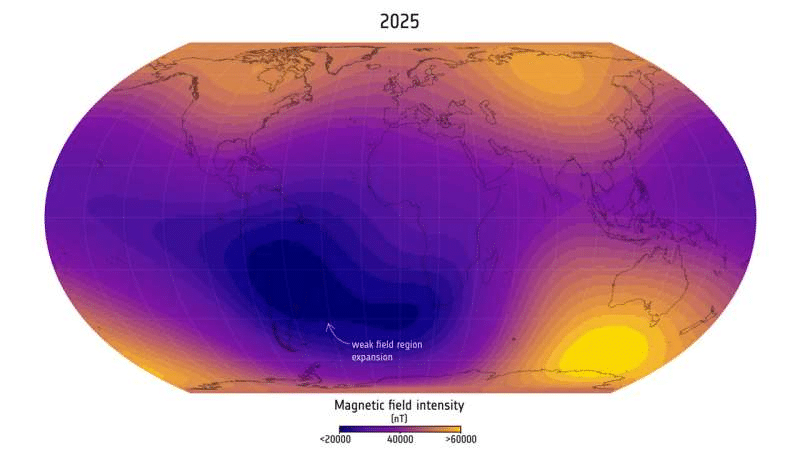
The South Atlantic Anomaly (SAA) is a known area where Earth's magnetic field is notably weaker, and it has been closely monitored by the European Space Agency's Swarm mission for more than ten years. Recent analyses reveal that this vulnerable zone has been growing swiftly since 2014, accompanied by substantial shifts in the Earth's magnetic dynamics. According to ESA reports, the SAA's expansion prompts new inquiries into how Earth's core behaves and the consequences for space environment safety.
Rapid Changes in the South Atlantic Anomaly
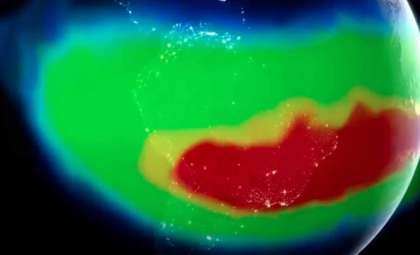
Data collected in 2014 by the Swarm satellite array indicated a marked increase in the size of the South Atlantic Anomaly. This region, located over the South Atlantic Ocean near South America, exhibits a significantly weaker magnetic field compared to surrounding areas. The diminished magnetic strength makes satellites more vulnerable to intense solar radiation while traversing the anomaly. Given the growing reliance on satellite technology, it’s vital to deepen our understanding and devise ways to minimize risks caused by such magnetic irregularities.
“The South Atlantic Anomaly is not just a single block,” says Chris Finlay, Professor of Geomagnetism at the Technical University of Denmark. “It’s changing differently towards Africa than it is near South America. There’s something special happening in this region that is causing the field to weaken in a more intense way.”
Add Cosmo Herald as a Preferred Source

This finding illustrates the complex behavior of the SAA, showing that it's not only expanding but also displaying distinct variations in magnetic weakness across different sections of the anomaly.
Linking Earth's Core Movements to Magnetic Field Changes
Earth's magnetic field originates from the movement of molten iron deep within the outer core, approximately 3,000 kilometers beneath the planet’s surface. The turbulent flow of this liquid metal generates electric currents, which in turn produce the global magnetic field. However, the Swarm mission’s data indicate that this mechanism is far more intricate than scientists had anticipated.
Typically, magnetic field lines emerge outward from Earth's core in the southern hemisphere. In the South Atlantic Anomaly region, however, researchers have identified an unusual reversal in this pattern. Instead of extending outward, some magnetic lines curve back into the core, leading to the area's notably weaker magnetic intensity.
“Normally we’d expect to see magnetic field lines coming out of the core in the southern hemisphere. But beneath the South Atlantic Anomaly, we see unexpected areas where the magnetic field, instead of coming out of the core, goes back into the core,” explains Prof. Finlay. “Thanks to the Swarm data, we can see one of these areas moving westward over Africa, which contributes to the weakening of the South Atlantic Anomaly in this region.”
This unusual phenomenon shows a complex interplay between the liquid outer core and Earth's mantle, affecting both the strength and spatial distribution of magnetic forces.
The Value of Data from the Swarm Satellites
Swarm’s fleet of three identical spacecraft, launched in 2013 as part of the European Space Agency’s Earth Explorer program, has been crucial in refining our grasp of Earth's magnetic environment. These satellites provide continuous, detailed measurements of magnetic signals generated by Earth's core, mantle, crust, seas, and ionosphere. The long-term data collection from Swarm enables scientists to monitor the evolving nature of Earth's magnetic field with unmatched accuracy.
This rich dataset supports the improvement of global magnetic field models, essential for accurate navigation and space weather forecasting. Such models are vital to predict geomagnetic storms that might disrupt communication networks, navigation satellites, and power infrastructure.
“When you’re trying to understand Earth’s magnetic field, it’s important to remember that it’s not just a simple dipole, like a bar magnet. It’s only by having satellites like Swarm that we can fully map this structure and see it changing,” says Prof. Finlay.
Consequences for Space Exploration and Security
A major finding from the Swarm mission highlights the risks posed by the SAA to space infrastructure. Satellites flying through this anomaly encounter heightened radiation exposure, increasing the chance of technical failures or operational interruptions. Extended exposure can even lead to permanent satellite damage. As space-based technology becomes more integral for communication, Earth observation, and navigation, understanding the anomaly’s effects is vital to protect both spacecraft and astronauts.
ESA’s Swarm Mission Manager, Anja Stromme, stressed the mission's ongoing importance: “It’s really wonderful to see the big picture of our dynamic Earth thanks to Swarm’s extended timeseries. The satellites are all healthy and providing excellent data, so we can hopefully extend that record beyond 2030, when the solar minimum will allow more unprecedented insights into our planet.”
- Categories:
- News










0 comments
Sign in to Comment