
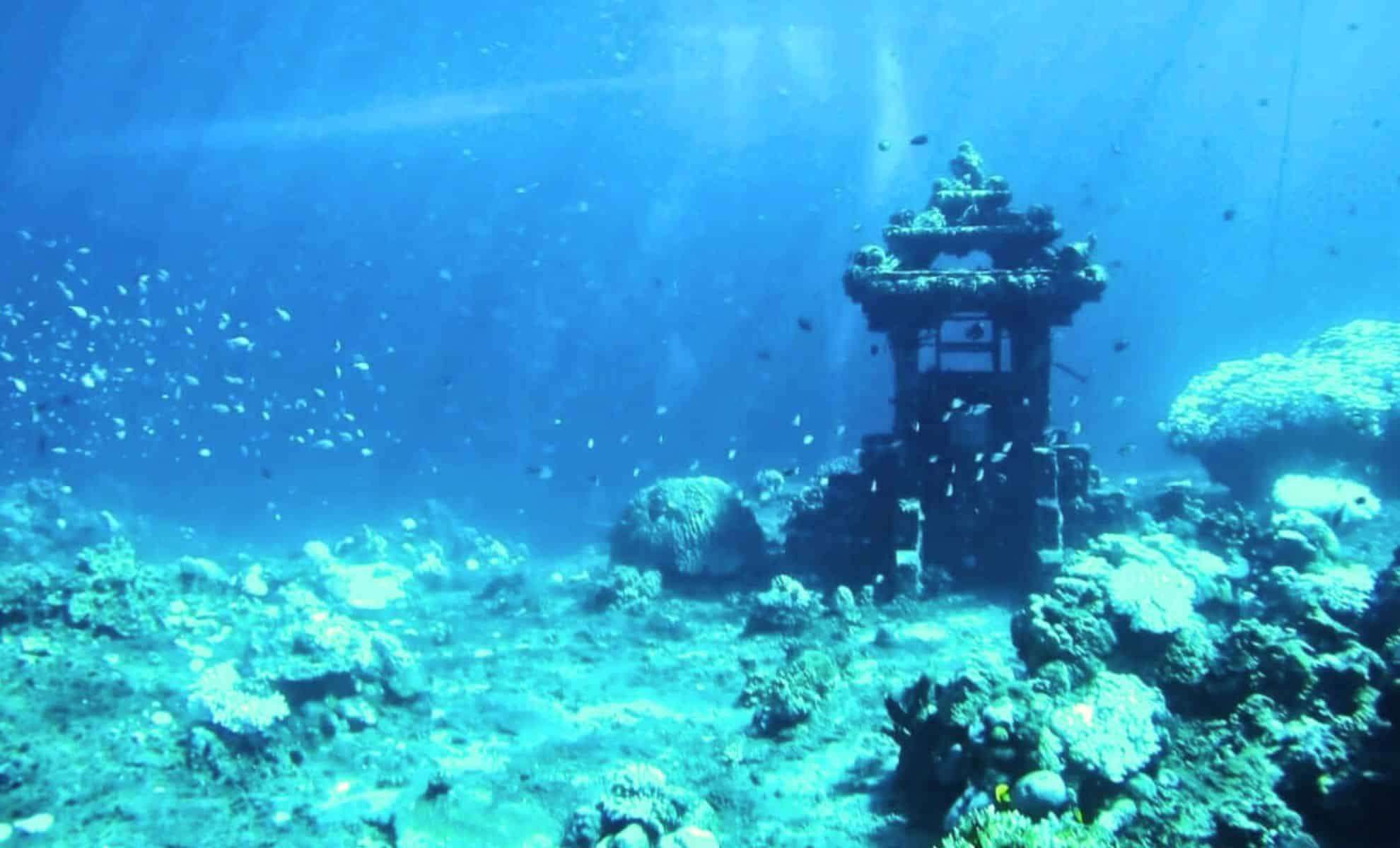
An international group of researchers has uncovered a remarkable paleoanthropological site beneath the Madura Strait near Java. This underwater river valley, concealed for over 100,000 years, has produced the inaugural underwater fossils of Homo erectus along with a vast collection of more than 6,000 vertebrate specimens, altering prevailing views of ancient ecosystems in Southeast Asia.
Published in the 2025 edition of Quaternary Environments and Humans, this decade-long investigation was headed by Harold Berghuis at Leiden University in partnership with experts from Indonesia, Australia, Germany, and Japan. Located close to modern-day Surabaya, the site reveals a submerged ecosystem teeming with prehistoric megafauna, flowing waterways, and signs of early human presence.
From Industrial Byproduct to Archaeological Breakthrough
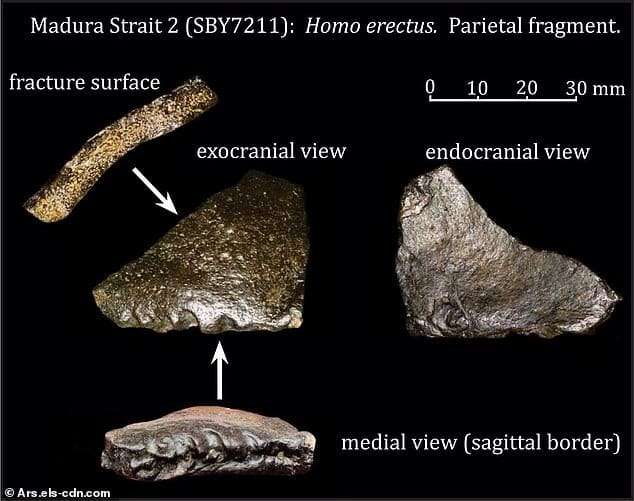
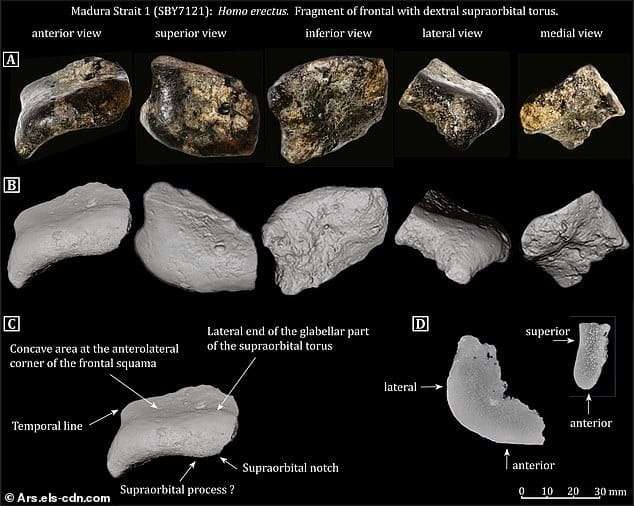
The initial discovery occurred in 2011 during sand mining operations where workers retrieved fossilized bones from the sea bed. Though initially unrecognized, later tests identified two skull fragments, one frontal and one parietal, as belonging to Homo erectus, dated between 163,000 and 119,000 years ago using Optically Stimulated Luminescence (OSL) techniques.

The fossils originated from a submerged river valley that was once part of the Solo River system, an ancient network running across Sundaland—a prehistoric landmass spanning much of Southeast Asia during the Pleistocene epoch. Notably, this site contrasts with other well-known Homo erectus locations in Java such as Ngandong, Trinil, and Sangiran, which are situated inland and at higher elevations.
“This makes our discoveries truly unique,” Berghuis said. “The fossils come from a drowned river valley, which filled up over time with river sand.”
A Diverse Pleistocene Biosphere Revealed
Beyond human remains, the excavation uncovered over 6,000 fossils representing no fewer than 36 species. Among these were bones from Komodo dragons, buffalo, deer, and the colossal Stegodon, an ancient elephant relative towering over 13 feet.
The presence of cut marks on water turtle and bovid bones suggests active butchery practices by early humans. This points to hunting and sophisticated food processing behavior among Homo erectus groups, indicating cognitive abilities and social organization often underestimated for this species.
“Among our new finds are cut marks on the bones of water turtles and large numbers of broken bovid bones, which point to hunting and consumption of bone marrow,” Berghuis noted in the study.
Challenging Previous Views on Homo erectus Isolation
The research challenges prior assumptions that Javanese Homo erectus populations lived in isolation without contact with other hominin groups. Earlier inland fossil sites suggested limited external interaction.
However, evidence from the Madura Strait site reveals advanced butchering methods and the exploitation of diverse resources, implying possible cultural exchanges or genetic mixing with other Asian hominin populations. This finding presents a more interconnected evolutionary history than previously thought.
Insights Into Geological and Environmental Transitions
Geological analysis offers crucial clues about how Middle Pleistocene climate changes reshaped Southeast Asia. During periods of low sea levels, Sundaland comprised widespread savanna-like landscapes, resembling African grasslands more than today’s dense rainforests.
As sea levels rose between 14,000 and 7,000 years ago, driven by glacial retreat, much of Sundaland and the fossil site became submerged. The shift from terrestrial to marine conditions enabled exceptional preservation beneath layers of silt and sediment.
The study identifies the sediments as part of a transitional unit marking the change from riverine to marine environments, reflecting a swift environmental transformation. This setting provides researchers a rare window into the paleoecology of a vanished world.
Broadening Perspectives on Human Evolution and Movement
This site extends the known geographic range of Homo erectus in Asia and underscores their adaptability to diverse habitats, from river valleys to grassland plains. The region’s ancient Brantas and Solo rivers likely served as vital migration corridors for animals and early humans amid climatic fluctuations.
The Madura Strait fossils provide a well-dated snapshot into the late Middle Pleistocene, particularly during Marine Isotope Stage 6, a glacial period spanning 190,000 to 130,000 years ago. These discoveries enhance understanding of the interplay between climate, geography, and human evolution in Southeast Asia’s deep past.
- Categories:
- Science






0 comments
Sign in to Comment