
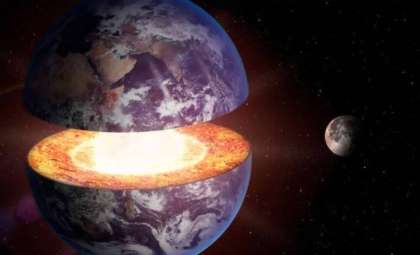
The chemical processes hidden deep inside Earth’s mantle may dramatically impact the formation and longevity of continents. A recent study published in Science Advances, led by researchers from the Guangzhou Institute of Geochemistry (GIG-CAS), highlights how carbon locked in the mantle can either reinforce ancient continental cores or initiate their breakdown. Through high-pressure experiments and the study of deep-Earth diamond inclusions, they found a surprising link between carbon chemistry in the mantle and the fate of Earth's continents.
The Role of Deep Carbon in Forming and Fracturing Landmasses
Far beneath the surface, a complex process unfolds when carbon-rich material carried down by subducting oceanic plates reaches depths as deep as 660 kilometers. Under these intense pressure and temperature conditions, carbon-bearing minerals transform in ways that can either stabilize the ancient roots of continents or erode them from beneath. The research shows that the mantle’s redox state—a measure of its electron transfer capacity—is a critical factor in determining these outcomes.
“The oxidation-reduction environment deep in the mantle governs the cycling of volatile elements like carbon between Earth's surface and interior,” explained Professor YU Wang, who led the study. In cooler, more reduced environments, carbon crystallizes into diamonds and iron-rich compounds that solidify the stable continental keels. Conversely, in warmer, oxidized mantle regions—often influenced by mantle plumes—carbon remains in a mobile, melt state. These carbon-rich melts permeate the lithosphere, dissolving stabilizing elements like iron and magnesium, thereby weakening continental foundations.

Cool Mantle Conditions Support Formation of Durable Continents
Within mantle zones that are cooler and less affected by plume activity, subducted carbonates undergo a gradual reduction process. This leads to the formation of carbonatite melts that crystallize into diamonds and metal phases, integrating with the base of cratons to create robust, chemically stable layers resistant to deformation over geological time. Professor YU Wang stated, “Our findings indicate that mantle temperature and redox conditions critically shape how subducted carbon influences continental stability across Earth's history.”
The Amazonia Craton exemplifies such cold mantle environments. Diamonds from this area contain inclusions like ferropericlase and cohenite, minerals formed exclusively under high-pressure and reduced conditions. These inclusions trace the carbon’s mantle journey and support the concept that reduced mantle zones fortify continents, preserving them for hundreds of millions of years.
Heat and Oxidation in the Mantle Trigger Continental Disintegration
In contrast, the Kaapvaal Craton in southern Africa displays evidence of significant lithospheric weakening and partial mantle removal. This is driven by oxidized, carbon-rich melts derived from mantle plume activity. These silico-carbonatite melts stay molten at elevated temperatures, infiltrating the continental base and breaking down key minerals, resulting in chemical deterioration and gravitational instability. Such processes can lead to volcanic eruptions, uplift, and the detachment of lithospheric fragments.
This disruptive activity leaves detectable mineral markers. Diamonds from notable Kaapvaal mines, including Jagersfontein and Monastery, harbor majorite garnets rich in FeO and MgO but deficient in calcium and sodium, signaling an oxidized mantle environment. These melts did not solidify but continued to reshape the continent’s foundation, contributing to geological events like kimberlite eruptions and the breakup of Gondwana during the Mesozoic.
Diamonds as Geological Archives of Mantle Dynamics
Diamonds serve as microscopic time capsules, preserving mineral inclusions that reveal mantle conditions during their formation. In reduced mantle settings like Amazonia, majorite shows elevated sodium and low calcium—indicators of progressive diamond growth. Conversely, in plume-affected oxidized areas such as Kaapvaal, majorite displays contrasting trends, reflecting melt interactions that destabilized the region.
The behavior of ferropericlase also varies significantly. It occurs abundantly in Amazonia under lower magnesium-nickel ratios, often accompanied by native iron at moderate depths, while in the oxidized Kaapvaal mantle, it is scarce and confined to extreme depths, overtaken by silicate minerals. These mineralogical distinctions affirm that mantle redox conditions directly dictate whether carbon fosters continental strength or causes their breakdown.
- Categories:
- News




0 comments
Sign in to Comment