
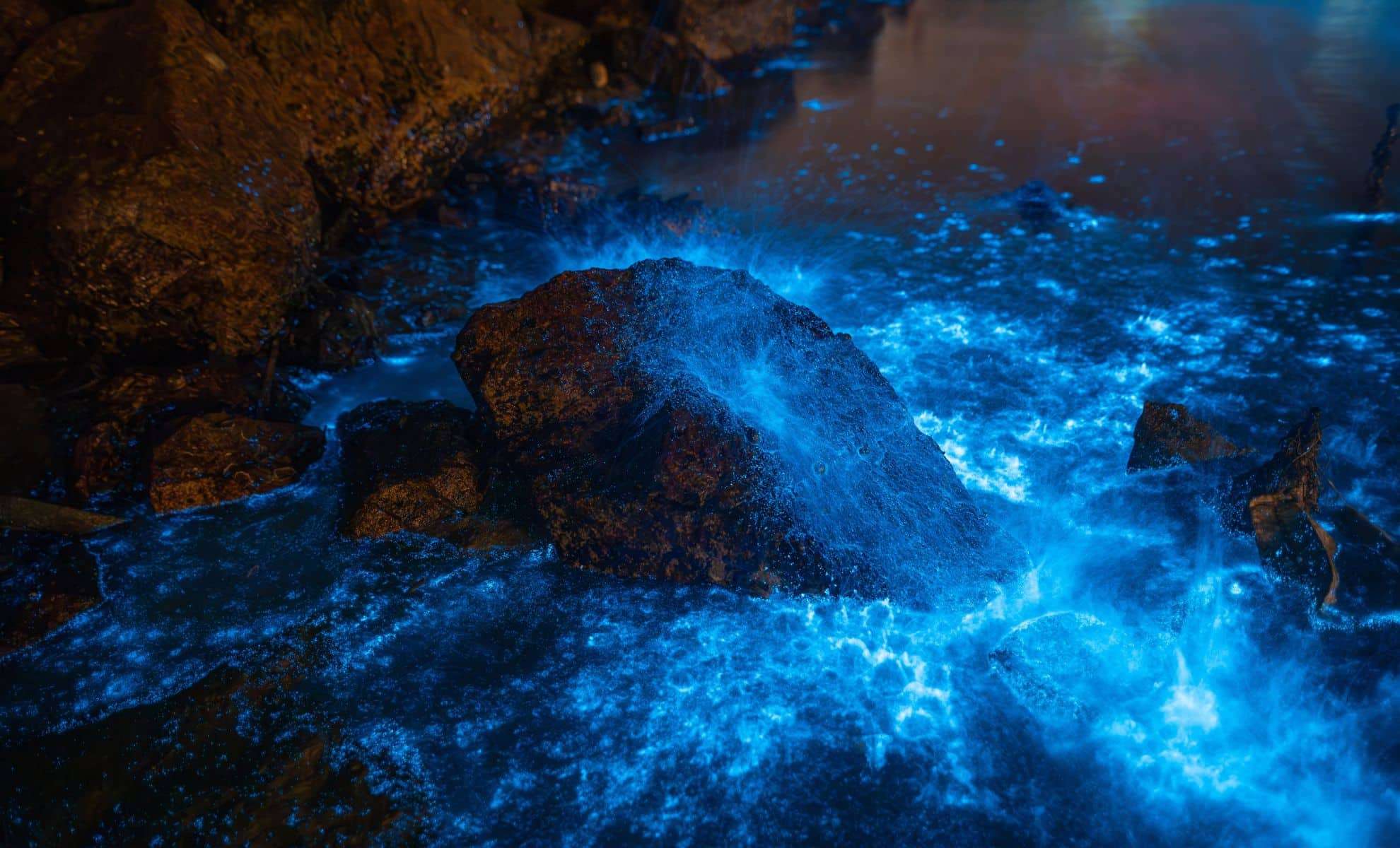
For more than twenty years, researchers have been intrigued by a vivid turquoise shimmer appearing in the chilly waters of the Southern Ocean. First detected in early 2000s satellite images, this glowing phenomenon remained unexplained—until a recent scientific expedition pinpointed its origin: a vast gathering of billions of tiny marine organisms, prompting a rethink of marine ecosystem dynamics and their influence on the planet’s carbon cycle.
Unraveling a Bioluminescent Enigma Beneath the Surface
The study, featured in Global Biogeochemical Cycles, describes how this bright turquoise patch starkly contrasted the usual muted tones of the ocean, highlighting a remote area often obscured by persistent cloud cover, turbulent seas, and floating ice masses.
Experts initially proposed explanations including light reflecting off drifting ice, glacial sediment, algal blooms, or trapped air bubbles. However, these hypotheses did not withstand detailed scientific investigation.

Located just beneath the prominent calcite belt—a swirling ocean current laden with coccolithophores, minuscule plankton adorned with reflective calcite plates called coccoliths—this area is known for its role in carbon absorption. These organisms fix inorganic carbon to form their protective scales, sequestering roughly 30 million tonnes of carbon every year, which scatter sunlight and create bright ocean surfaces visible even from orbit.
Yet, the polar waters south of this belt are normally too frigid for coccolithophores to flourish, leaving scientists puzzled about what caused the unexpected luminance. To solve this mystery, oceanographers turned to direct ocean sampling beyond satellite surveillance.
Exploring the Depths Aboard the Roger Revelle
Oceanographer Barney Balch and his team embarked on an expedition aboard the research vessel Roger Revelle, voyaging from Hawaii to the South Pole. They traversed the great calcite belt and ventured into the southern high-latitude waters where the glow was first spotted.
“Satellites capture only the very surface layers, but we obtained comprehensive measurements across various depths,” Balch said. The team collected extensive data on ocean color, calcification activity, photosynthetic rates, as well as inorganic carbon and silica concentrations—the essential components for coccolithophores and their counterparts, diatoms.
Diatoms build their protective shells from silica and compete with coccolithophores in marine environments. Both are key players in carbon storage and energy flow through marine food webs.
Unexpected Insights From Polar Marine Life
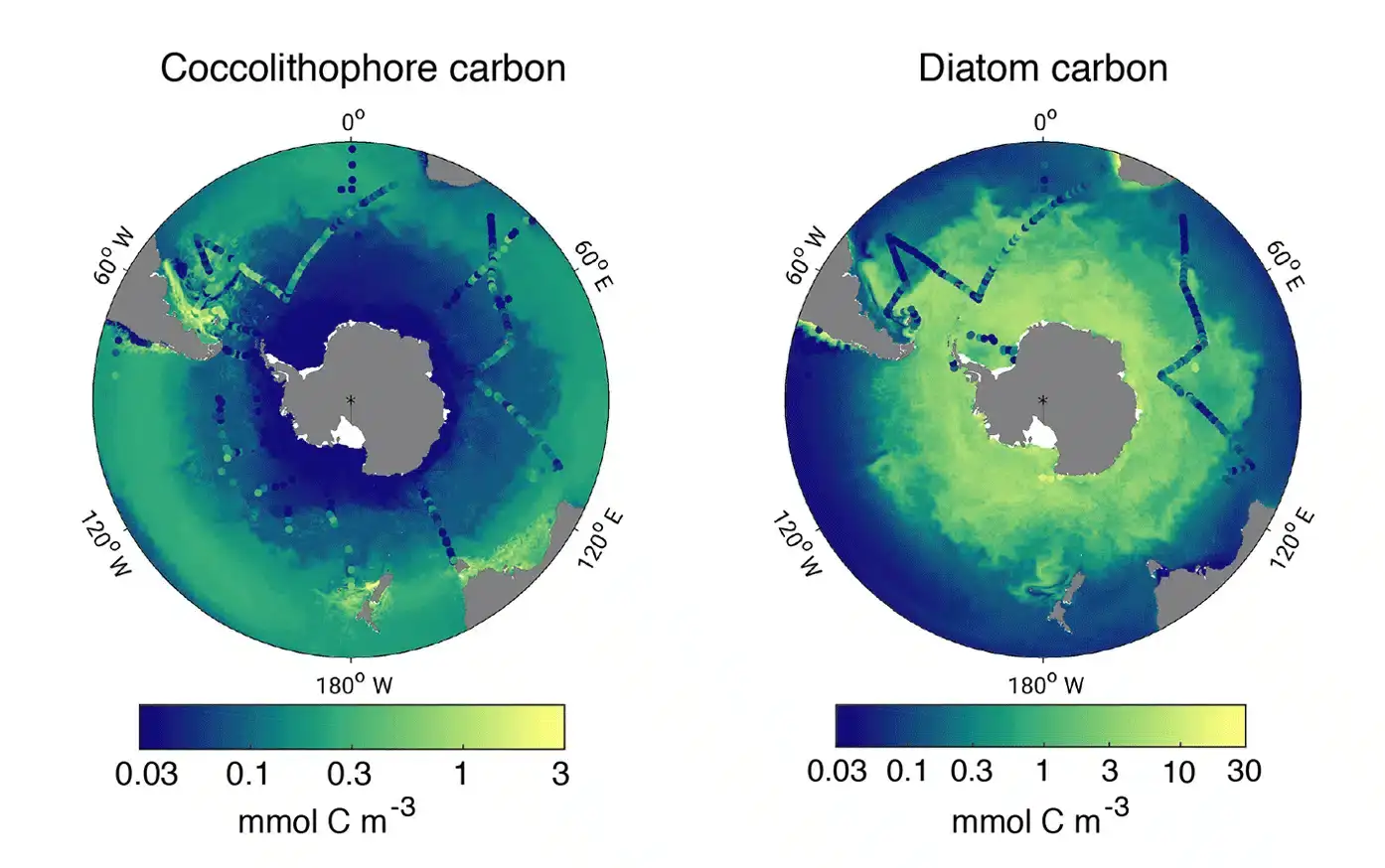
Contrary to prior beliefs that coccolithophores cannot endure polar climates, the expedition uncovered moderate populations of these phytoplankton and their separated coccoliths extending southward to about 60°S latitude. This marked the first direct proof of calcification occurring in such cold waters. However, their quantity alone was insufficient to account for the bright reflectivity seen in satellites.
Further investigation revealed that the dominant contributors were actually diatoms. Their silica-based shells, called frustules, reflected light similarly to coccoliths. “Our analysis indicates that the brilliant shine of these polar waters is primarily caused by light scattering from diatom frustules rather than coccolithophores, leading to misinterpretations of particulate inorganic carbon levels in satellite assessments,” the research team concluded.
Implications for Satellite Monitoring and Marine Ecology
This breakthrough calls for a reassessment of satellite-derived measurements of particulate organic carbon in polar regions, which may have long confused optical signals from different particulate sources. It also expands knowledge of coccolithophore habitats and underscores the significant yet previously underestimated light-scattering contribution of diatoms in extreme marine environments.
Balch summarized, “Our findings broaden the known habitat of coccolithophores and shed light on the anomalous patterns observed in satellite imagery of this seldom-studied ocean sector,” emphasizing how rare direct observations continue to revise established scientific perspectives.
- Categories:
- News










0 comments
Sign in to Comment