
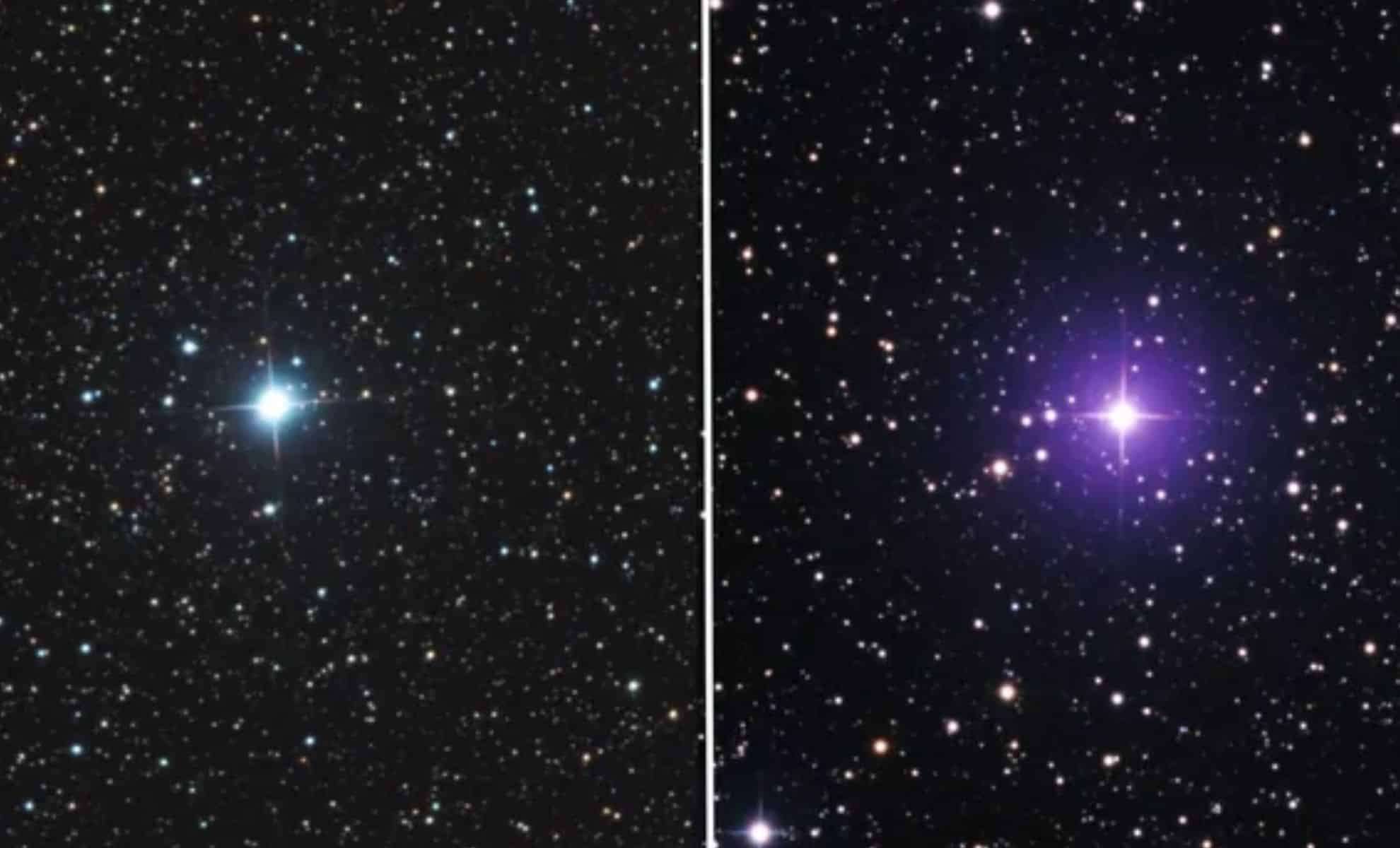
At this moment, stargazers in the Southern Hemisphere have a unique celestial show: two novae are simultaneously visible to the naked eye. Such an event is exceptionally rare, with the previous occurrence documented only once before, in 1936. Novae arise when a white dwarf star siphons gas from a neighboring star, triggering a powerful explosion that’s usually too faint to see without optical aids. However, for a limited time, these twin novae—V462 Lupi and V572 Velorum—are shining brightly together, offering an extraordinary chance to witness stellar outbursts firsthand. This phenomenon heightens excitement in the astronomical community, following the recent detection of a new interstellar object approaching the Sun, as reported by EarthSky. Both instances highlight the ever-changing and surprising nature of our cosmos.
Exploring the Nature of a Nova
Although the word “nova” translates to “new” in Latin, these aren’t newly formed stars. Instead, a white dwarf—the dense core left behind when a star runs out of fuel—accumulates matter, generally hydrogen, from a companion star. When enough material accumulates, nuclear fusion ignites on the white dwarf’s surface, releasing a sudden burst of light. This results in a star brightening significantly, sometimes to the point that it can be viewed without telescopes. While fleeting, this brilliant phase may endure for several weeks before fading once more into the celestial backdrop.
The Extraordinary Nature of Dual Naked-Eye Novae
Spotting two novae simultaneously without optical equipment is extraordinarily uncommon. The first, V462 Lupi, was detected in mid-June 2024 and reached peak brightness on June 21. Although it is now dimming, it remains visible under dark skies. The second nova, V572 Velorum, appeared shortly after, peaking at a magnitude of 4.8 on June 27 before gradually fading to 5.8. Neither is exceptionally bright, but their naked-eye visibility is nonetheless remarkable. Most novae occur too far away to be seen unaided. The last comparable dual event went unnoticed in 1936 due to its brief visibility, underscoring how extraordinary it is to witness two novae shining simultaneously.

A Momentous Astronomical Occasion
The concurrent appearance of two novae is exceptionally rare. Renowned astronomer Stephen O’Meara described it as “an extremely rare event, if not a historical one.” Although two novae nearly overlapped in 1936, they never coincided visibly for most observers. The fleeting nature of these eruptions makes capturing such an event challenging. This brief overlap provides an unparalleled occasion for astronomers and enthusiasts alike, offering a reminder of the rapid shifts that can occur in our night sky and the limited time we have to observe these cosmic outbursts.
Viewing Tips for the Southern Skies
Both V462 Lupi and V572 Velorum shine in the deep southern sky, making them invisible from most northern latitudes. Observers situated in the Southern Hemisphere have the best chance to see this rare vivid display. The novae appear near the well-known Southern Cross constellation and are only accessible to viewers at latitudes south of roughly 40°. To fully appreciate this spectacle, a dark, unobstructed sky free of light pollution is essential. Those fortunate enough to be in suitable locations can spot these dazzling stellar eruptions with the naked eye, though keen eyesight is necessary.
- Categories:
- News






0 comments
Sign in to Comment