
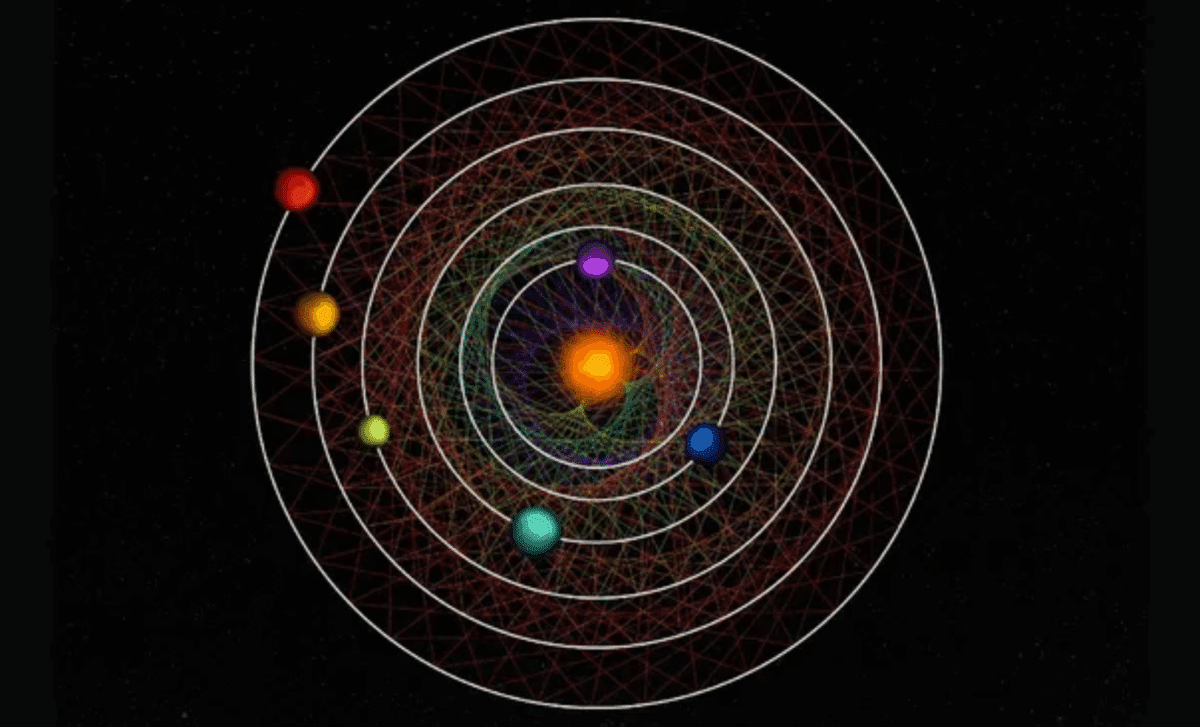
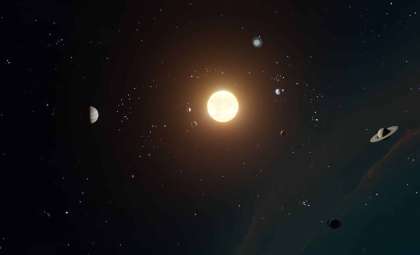
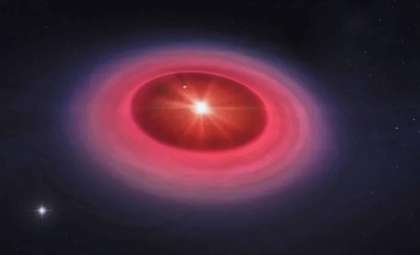
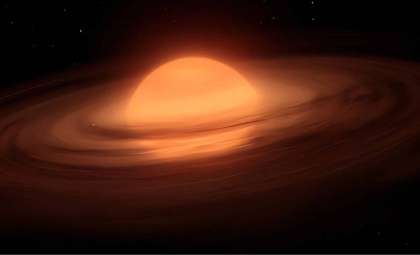
A group of astronomers has uncovered an extraordinary planetary system situated 105 light-years away in the constellation Coma Berenices. The star HD 110067 is orbited by six Neptune-sized planets, all synchronized in a remarkable orbital resonance. Their orbits follow a precise mathematical sequence that has remained stable for billions of years, providing a rare example of one of the most orderly systems known.
A Harmonious Dance of Planets in Resonance
In a newly published paper in Nature, scientists detailed how these six worlds orbit their orange K-type star in flawless mathematical coordination. The planets form a chain of resonant orbits, with the inner planets locked in a 3:2 resonance—one planet completes three orbits while its neighbor completes two. Going outward, the resonance shifts to a 4:3 ratio, sustaining a delicate dynamic balance throughout the system.
This resonant configuration implies a tranquil and stable past. Unlike many planetary systems disturbed by gravitational interactions, stellar activity, or collisions, HD 110067 exhibits a remarkably undisturbed orbital pattern. This stability suggests the system has avoided major upheavals since its birth, preserving insight into early planetary formation processes.

The planetary system’s existence was initially revealed through rhythmic brightness dips recorded by the TESS space telescope. Subsequent verification by the European Space Agency's CHEOPS satellite confirmed the precise resonance timings predicted by astrophysical models. This discovery not only showcases cutting-edge observational techniques but also provides a new framework for exploring planetary formation and migration under stable conditions.
Close-In Sub-Neptunes in a Quiescent Star System
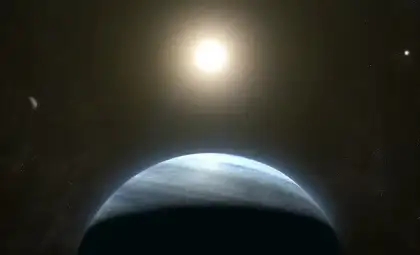
All six planets orbiting HD 110067 belong to the sub-Neptune class—planets larger than Earth but smaller than Neptune. Their sizes range roughly from twice to nearly three times Earth’s radius, with orbital periods spanning from 9 to 55 days. Positioned close to their host star, these planets endure high levels of heat and radiation. Even the planet with the longest orbit, circling every 55 days, is too hot to sustain conditions similar to Earth’s.
Despite their unwelcoming environments, these planets are scientifically valuable. Their combined characteristics—size, mass, and atmospheric makeup—offer essential clues about the variety of planets beyond our solar system. Studying their densities relative to rocky and gaseous worlds helps astronomers understand why sub-Neptunes are prevalent and what drives their evolutionary paths.
Exploring the Atmospheres of These Distant Worlds
The HD 110067 system offers an exceptional setting for transmission spectroscopy, a technique that examines starlight filtered through planetary atmospheres during transit. Molecules such as methane, water vapor, and hydrogen absorb specific wavelengths of light, creating identifiable spectral signatures. The presence of six planets around a single star gives researchers a unique chance to compare atmospheric compositions under uniform stellar conditions—a rare opportunity to investigate the influence of stellar radiation on planetary atmospheres.
Upcoming missions, including the James Webb Space Telescope (JWST), will likely target this system. By analyzing atmospheric spectra, scientists hope to uncover how atmospheres on sub-Neptunes evolve based on their star proximity and how their gaseous components are distributed. The planets’ aligned orbits, allowing multiple transits visible from Earth, further enhance the prospects for detailed comparative studies.
- Categories:
- News






0 comments
Sign in to Comment