
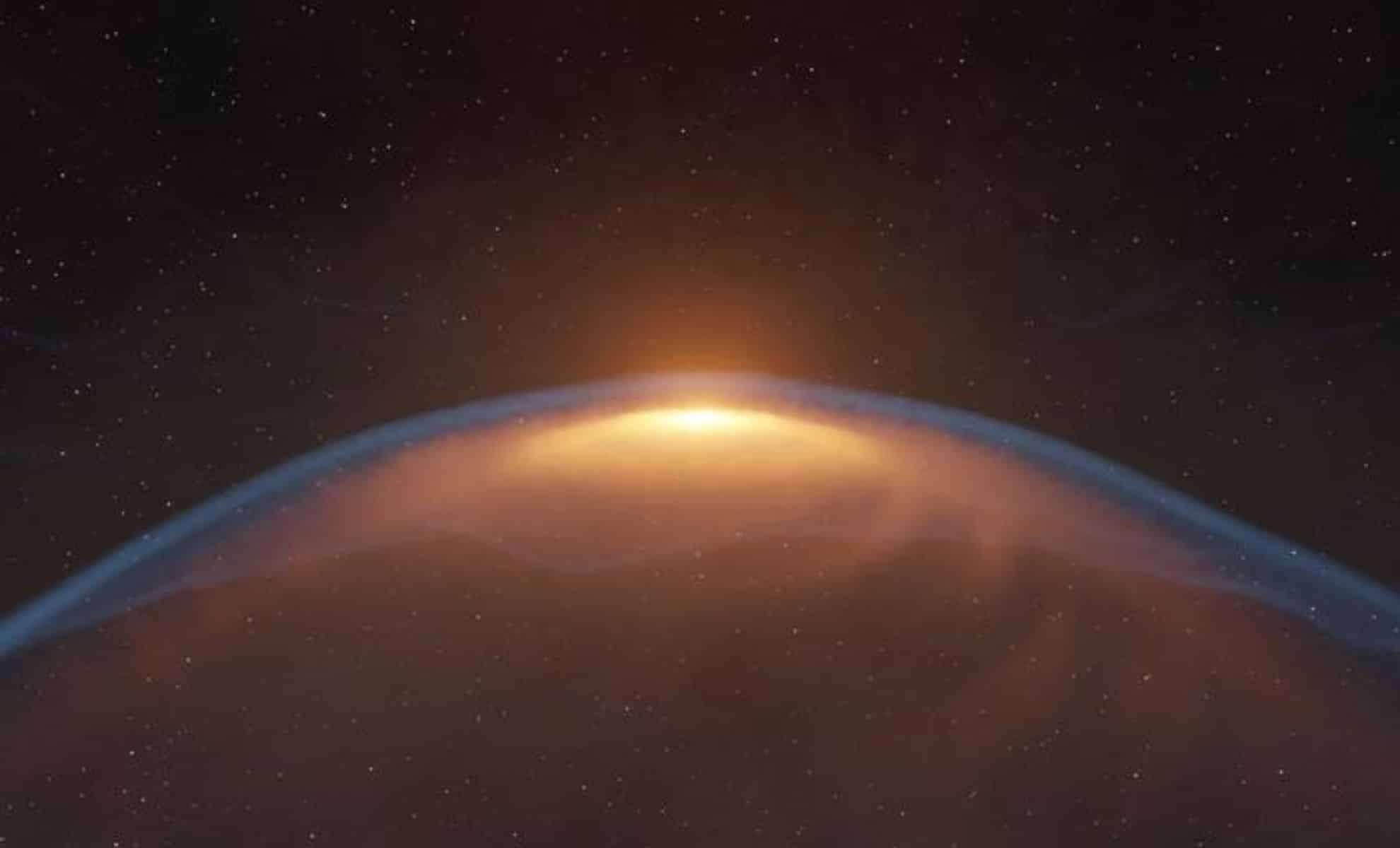
Researchers have uncovered an extraordinary event revealing the chaotic conditions in which stars are born. They observed a nascent star caught in the middle of an explosion it appears to have triggered itself, shedding new light on the extreme circumstances young stars and their developing planetary systems may encounter.
Dynamic Jets Shape Star Birth
Published on August 4, 2025, in The Astrophysical Journal, the study explores how stars and their planets originate from collapsing molecular clouds. As these clouds contract, they spin and form a swirling structure called a protoplanetary disk.
Material within this disk gradually forms stars and planets, while powerful jets eject remaining gas and dust along the disk’s rotation axis, helping regulate the system’s mass and momentum.

While reexamining data from the Atacama Large Millimeter/submillimeter Array (ALMA), astronomers discovered an expanding bubble near the protoplanetary disk WSB 52, situated about 441.3 light-years away in the constellation Ophiuchus. This bubble’s shockwave was actively distorting the disk — a phenomenon not previously documented in similar young stellar settings.
Delving Into the Expanding Bubble
Deeper investigation revealed the bubble's center perfectly aligned with the disk’s rotation axis. Such precise alignment is highly unlikely to be accidental, pointing to a direct connection between the disk and the bubble’s formation.
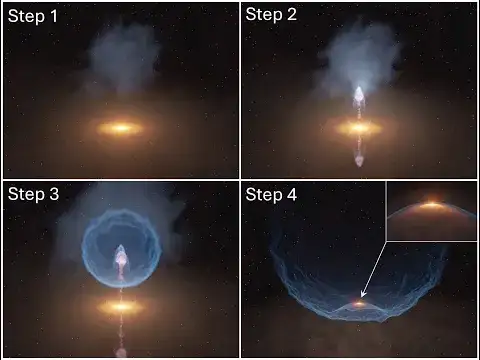
Scientists inferred that a jet emanating from WSB 52 collided with adjacent cold molecular gas centuries ago, compressing it and sparking a powerful explosion. This event triggered the rapid expansion of gas forming the bubble, which then disrupted the neighboring disk.
Masataka Aizawa, a principal investigator at Ibaraki University, likened the incident to sci-fi scenes where a beam strikes a target, creating an explosion whose blast rebounds toward the source—only on a far more colossal scale, demonstrating the extreme energies at work in space.
Unveiling New Intricacies in Star Formation
This groundbreaking observation challenges conventional ideas about the environments where stars and planets develop. If such explosive interactions between jets, bubbles, and disks are common, then the early stages of star and planet formation may be far more violent and unpredictable than scientists previously imagined.
The research team suggests that these energetic outbursts could heavily influence the architecture and evolution of emerging planetary systems, potentially leading to more tumultuous development pathways.
Aizawa emphasizes the discovery's significance, noting it underscores the immense complexity governing the processes of star and planet creation: “This finding once again shows that cosmic phenomena are far more intricate than our assumptions.” The team aims to advance their study of these explosions to better comprehend their impact on the birth and maturation of stars and their planets, enriching our understanding of universal forces.
- Categories:
- News





0 comments
Sign in to Comment