
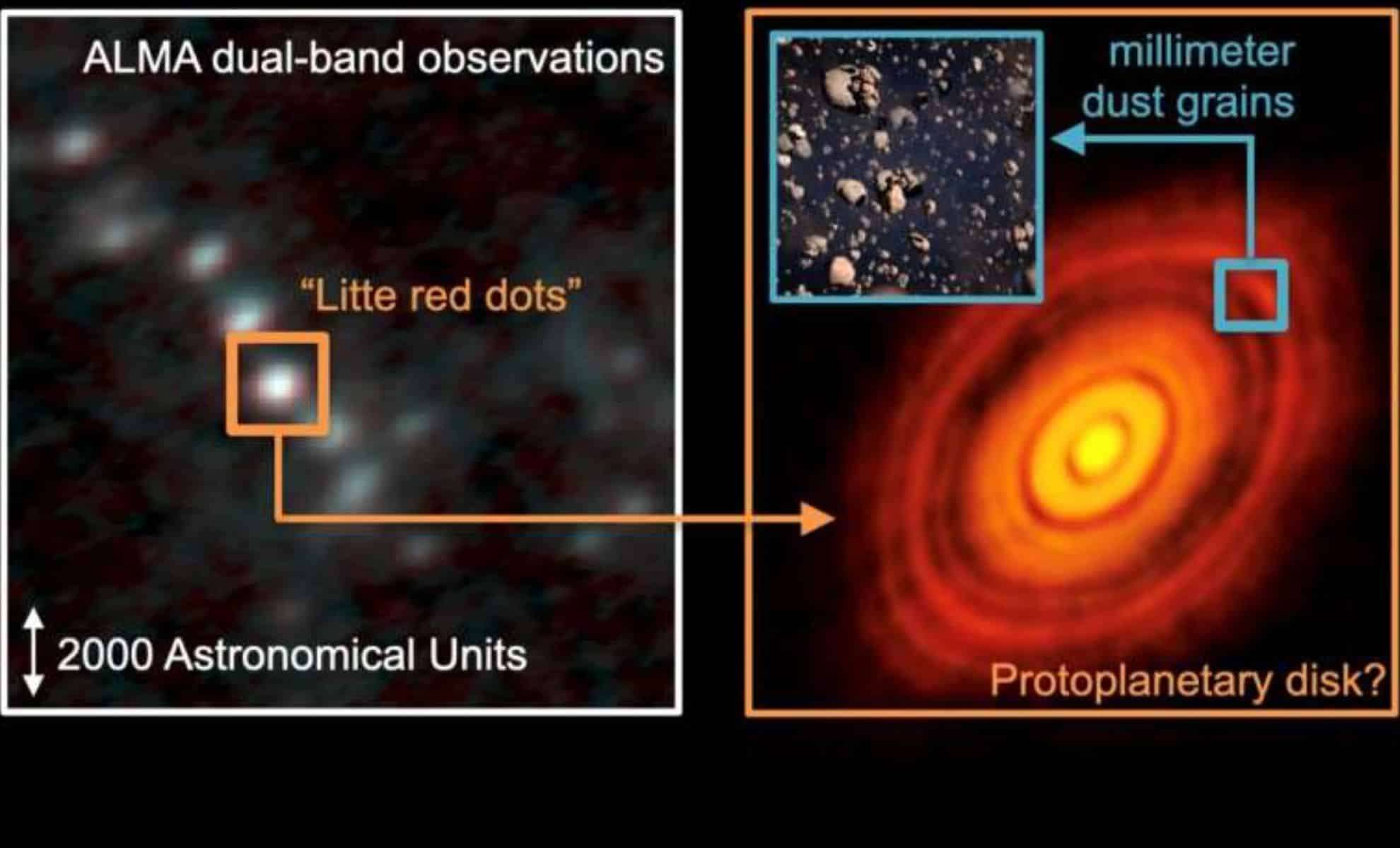
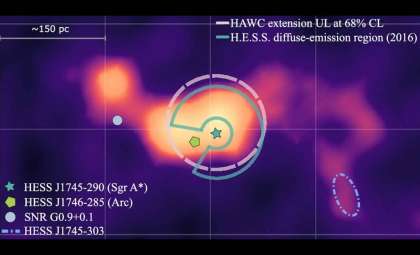
Astronomers have uncovered an extensive collection of candidate protoplanetary disks embedded within the turbulent central molecular zone (CMZ) adjacent to the heart of the Milky Way galaxy. This pioneering research, recently published in Astronomy & Astrophysics, identifies hundreds of these disks, which represent early planetary system development, existing in one of the galaxy’s most extreme and enigmatic regions.
Protoplanetary Disks in an Intense Galactic Setting
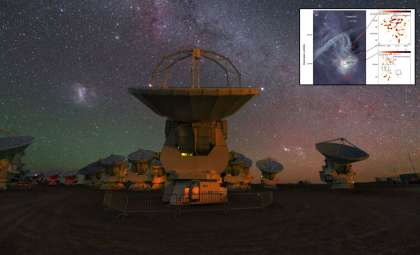
The central molecular zone is characterized by intense pressure, density, and dynamic turbulence, conditions that contrast sharply with those of the calmer galactic neighborhoods where most known disks have been discovered. Employing the most sensitive and detailed observations yet of three representative molecular clouds within the CMZ, an international research team utilized the Atacama Large Millimeter/submillimeter Array (ALMA) to identify more than 500 dense cores—regions where star and planet formation begins.
“This capability enables us to resolve structures as small as a thousand astronomical units, even at CMZ distances of roughly 17 billion astronomical units,” explained Professor Xing Lu from the Shanghai Astronomical Observatory, who leads the ALMA project. This achievement allowed the team to detect faint signals originating from deeply embedded regions obscured by dense interstellar dust.

Using a two-band imaging method to simultaneously capture emissions at two wavelengths, the researchers gained valuable data on the physical and chemical characteristics of these distant star-forming regions. This technique made it possible to differentiate candidate protoplanetary disks from the enveloping dense gas—an observation previously thought unattainable in such a complex environment.
“Little Red Dots” Hint at Hidden Protoplanetary Disks
A particularly notable discovery was the identification of numerous “little red dots” spread across the molecular clouds—dense cores displaying significantly redder emissions than expected. According to first author Fengwei Xu, a doctoral student at the University of Cologne, “We were amazed to observe these ‘little red dots’ throughout the clouds. They reveal the concealed nature of these dense star-forming cores.”
The detected reddening challenges prior assumptions that these cores are simple, transparent spheres. Instead, the team proposes that these red dots may be optically thick, compact structures consistent with protoplanetary disks exhibiting self-absorption at shorter wavelengths. Another viable explanation involves growth of dust grains within the disks to millimeter sizes, far exceeding the typical micron-scale particles found in the diffuse interstellar medium.
Either scenario suggests widespread formation of protoplanetary disks near the galactic center, with over 300 such systems identified in the surveyed clouds alone. This discovery broadens planet formation research into environments previously regarded as too extreme for such phenomena.
New Perspectives on Planet Formation Across the Milky Way
Finding so many protoplanetary disk candidates in the CMZ offers fresh opportunities to explore how planets arise under conditions dramatically different from those near our solar system. Professor Peter Schilke, co-advisor to Fengwei Xu at the University of Cologne, remarked, “Detecting these possible disks at the galactic center is thrilling. The environment there is unlike our local region and may provide vital insights into planet formation in harsh settings.”
Examining the development of planets amid intense radiation, high density, and turbulent gas flows could challenge and refine current theoretical models. These observations aim to assess how universal or diverse planetary formation mechanisms are throughout the galaxy, especially around supermassive black holes and dense stellar clusters.
Future investigations employing multiple wavelengths and even higher resolutions will be essential to elucidate the physical properties, dust evolution, and lifespans of these disks. These efforts promise to deepen our understanding of early star and planet formation in one of the Milky Way’s most extreme zones.
- Categories:
- News





0 comments
Sign in to Comment