
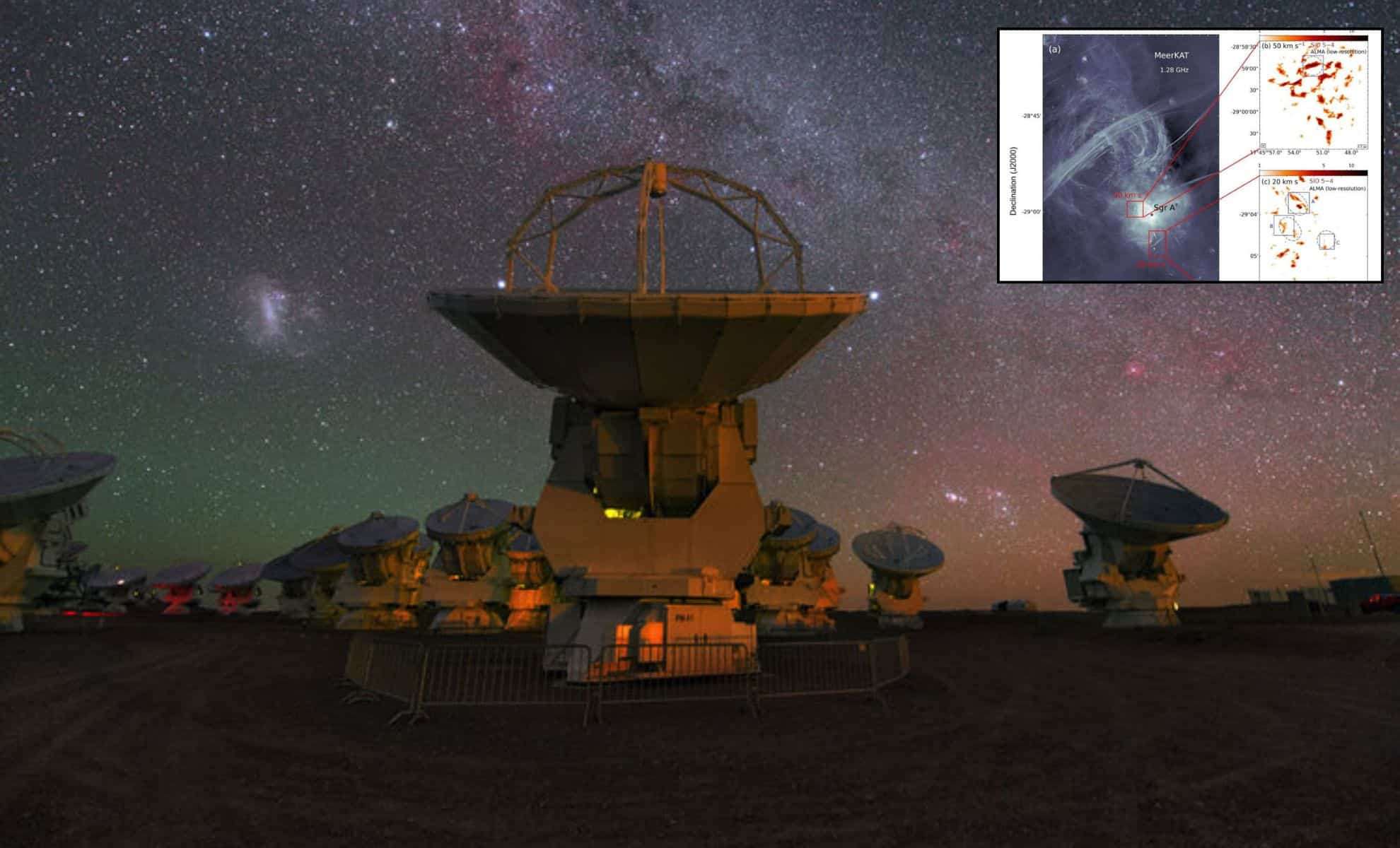
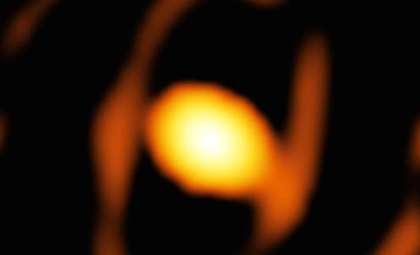
Close to the Milky Way’s central supermassive black hole, Sagittarius A*, researchers have identified slender, rotating gas structures resembling cosmic tornadoes. Utilizing the precision of the Atacama Large Millimeter/submillimeter Array (ALMA), a team led by Kai Yang from Shanghai Jiao Tong University captured unprecedentedly detailed images of this chaotic epicenter, enhancing resolution by 100 times. Their findings, featured in Astronomy & Astrophysics, propose that these filaments are crucial for moving gaseous matter throughout the galaxy’s core, affecting how interstellar clouds form and dissipate.
Distinct from known dense filaments linked to star birth, these newly discovered gas threads appear isolated from stellar nurseries, challenging existing theories of molecular cloud dynamics. While their exact genesis is uncertain, shock waves are the leading explanation, reshaping notions about gas circulation in our galaxy’s nucleus.
Galactic Tornadoes: Unveiling a Novel Cosmic Structure
The Central Molecular Zone (CMZ) enveloping the Milky Way’s core is notorious for its turbulent gas and dust, influenced by gravity, radiation, and supernova events. This study, however, reveals an unforeseen feature—extended, thread-like formations composed of silicon monoxide (SiO), a molecule indicative of intense shock phenomena.

These narrow, elongated filaments are characterized by:
- Extending across multiple parsecs in length
- Being unconnected to regions with active star formation, discounting young stellar outflows
- Exhibiting coordinated movement, suggesting organized dynamics rather than random dispersal
- Lacking associated dust emission, unlike typical gas filaments
Xing Lu, research professor at the Shanghai Astronomical Observatory and study co-author, described:
“We can envision these as space tornadoes: they are violent streams of gas, they dissipate quickly, and they distribute materials into the environment efficiently.”
These filaments likely emerge when shock waves propagate through the galactic center, stirring interstellar matter in unprecedented ways.
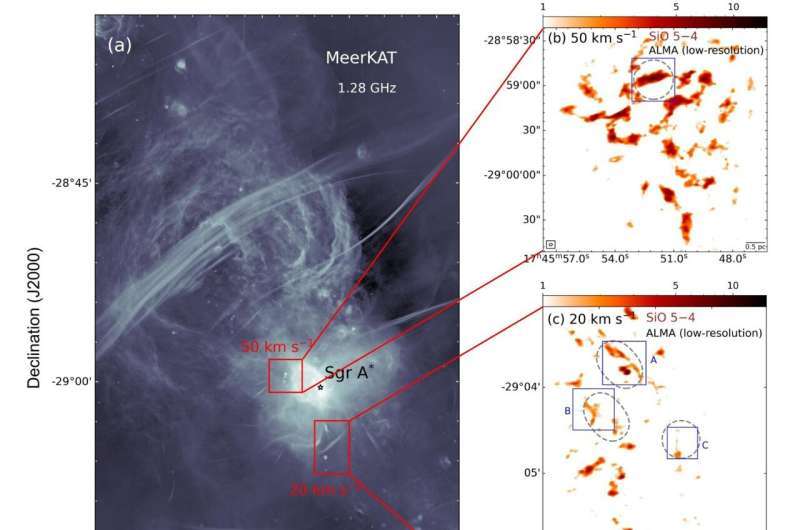
Detecting the Twisting Filaments of the Galactic Core
The team employed ALMA’s high-resolution imaging of molecular lines, focusing on the SiO 5-4 rotational transition, which arises predominantly in high-energy shocked regions. The detection of various complex organics like methanol (CH₃OH), acetonitrile (CH₃CN), and cyanoacetylene (HC₃N) reinforced the shock-related origin of these formations.
Yichen Zhang, a professor at Shanghai Jiao Tong University, emphasized ALMA’s role:
“ALMA’s outstanding angular resolution and sensitivity enabled us to observe these filaments at a refined scale of just 0.01 parsecs, revealing where shocks actively shape the gas.”
This breakthrough offers new insights into the cyclical nature of gas depletion and replenishment within the CMZ.
- Categories:
- News






0 comments
Sign in to Comment