
Over a century ago, the transmission of Earth's radio signals took flight, beginning with Reginald Aubrey Fessenden's groundbreaking broadcast in 1906. These signals have since been expanding outward at light speed, creating what scientists call Earth's “radio bubble.”
The Origin of Earth's Radio Expansion: Fessenden’s Historic Transmission
On the evening of December 24, 1906, Reginald Aubrey Fessenden made a pioneering broadcast intended for a broad audience. Breaking away from the traditional Morse code transmissions, Fessenden’s broadcast featured a violin rendition of “O Holy Night” alongside a reading from the Bible, marking a pivotal moment in radio history. This broadcast, picked up by ship operators in the Atlantic Ocean, sparked the ongoing journey of Earth’s radio waves as they travel through space.
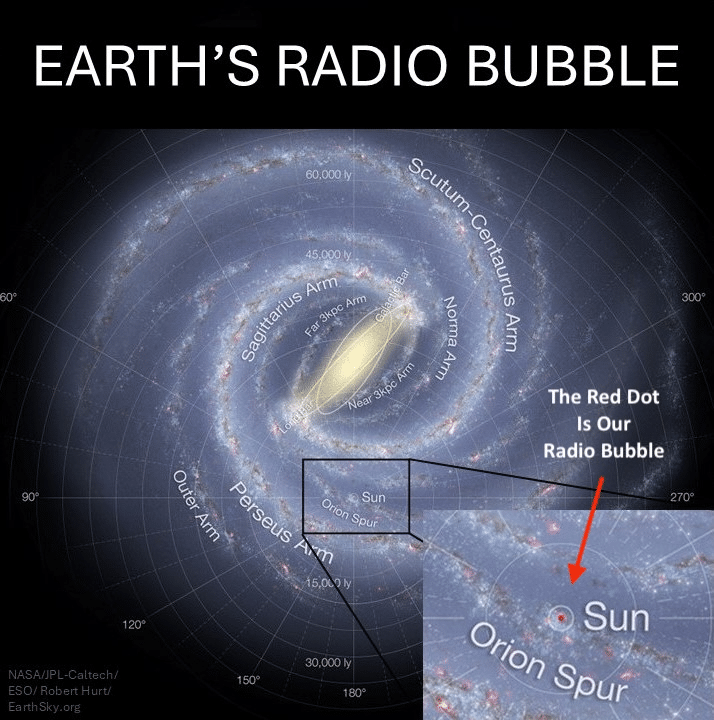
More than 100 years later, those early radio signals carrying Fessenden's violin notes continue their voyage through the cosmos. As EarthSky notes, these waves have now covered approximately 119 light-years, forming a growing spherical region. While the vast galaxy contains innumerable stars, some could eventually detect these signals. The big question remains: how expansive will Earth’s radio bubble become, and what might this cosmic communication reveal?

Defining Earth’s Radio Bubble
Earth’s radio bubble identifies the physical area around our planet reached by radio transmissions over the years. Because radio waves travel at light speed, the current radius of about 119 light-years represents how far signals have moved since Fessenden’s initial broadcast. This “bubble” is not a rigid boundary but a fading cloud of signals that weaken the farther they journey from Earth.
Spanning roughly 238 light-years in diameter, this bubble is minuscule compared to the Milky Way’s vast span, which is roughly 100,000 light-years across. In cosmic terms, Earth’s radio transmissions are just a tiny blip within the enormous galactic neighborhood. For context, it would take Fessenden’s original signal around 23,000 years to reach the Milky Way’s outer edges and about 77,000 years to cross the galaxy fully. This immense scale highlights both the enormity of the universe and the limited reach of our current emissions.
The Reach of Our Signals So Far
Signals generated by Fessenden’s 1906 broadcast have already passed nearby stars, including Proxima Centauri, our closest stellar neighbor, 4.24 light-years away. However, by the time they reach these distant suns, the transmissions have diminished so greatly that they blend into the cosmic background noise. Even highly advanced star systems would struggle to decipher the exact details of our broadcasts.
Essentially, these signals serve as faint whispers drifting among the stars. For potential alien civilizations, our broadcasts would hint at technological activity, but the faintness of these waves limits any substantial understanding of their content. Still, the fact that our radio emissions are reaching out toward the galaxy opens fascinating considerations about future interstellar interactions.
Stars That May Have Detected Earth’s Radio Emissions
Recent research has begun identifying stars that could have been exposed to Earth’s radio transmissions. A 2019 study by Lisa Kaltenegger and Jackie Faherty from Cornell University uncovered 75 stars within 119 light-years whose regions overlap with the spread of our broadcasts. Many of these stars also have vantage points able to observe Earth's solar transits, potentially signaling the existence of a habitable planet. While this represents a small fraction of the galaxy, it confirms the extent to which our planet has already sent out detectable signals.
However, as EarthSky points out, the full star count within this 119-light-year zone remains uncertain. A significant number of celestial bodies are dim red dwarfs, difficult to detect with current technology, which means some star systems within our radio bubble remain unidentified as potential recipients of our signals.
The Changing Nature of Our Radio Waves: Signal Strength Over Time
Technological progress has transformed how we communicate on Earth. Contemporary fiber optic and digital networks emit far less radio frequency energy than early analog transmissions like those by Fessenden. Although our radio bubble continues to grow, the density and intensity of signals decrease, making detection by extraterrestrials — or even by our distant descendants — increasingly challenging.
This evolution prompts a key question: will Earth's future artificial emissions keep expanding into space or remain localized as radio-based technology declines? The answer could influence the future landscape of messages exchanged beyond our planet.
- Categories:
- Astronomy








0 comments
Sign in to Comment