

As space activities expand rapidly, the environmental challenges linked to spacecraft are becoming increasingly critical. A recent study featured in Chem Circularity on December 1, 2025, advocates for a fundamental shift towards a sustainable and circular model for space operations. This research urges a reconsideration of spacecraft design, manufacturing, and end-of-life processes to address the escalating issue of orbital debris and its lasting impacts.
Escalating Threat of Orbital Debris
Orbital debris remains a significant hazard that jeopardizes the future of space missions and the integrity of functioning satellites. Specialists point out that collisions, retired satellites, and deteriorating rocket remnants are the main contributors to this growing problem.
“As space activity accelerates, from mega-constellations of satellites to future lunar and Mars missions, we must make sure exploration doesn’t repeat the mistakes made on Earth,” says Jin Xuan, senior author of the study and chemical engineer at the University of Surrey.
Add Cosmo Herald as a Preferred Source

Many pieces of debris continue to orbit Earth, classified as toxic leftovers in so-called “graveyard orbits.” After satellites end their service, they are often abandoned in space, creating hazards for subsequent expeditions. The accumulation of fragments due to impacts or explosions has generated a reinforcing cycle where debris leads to more debris. The surge in commercial satellite deployments and constellation projects further amplifies this crisis, turning Earth’s surrounding orbit into a potential disaster zone.
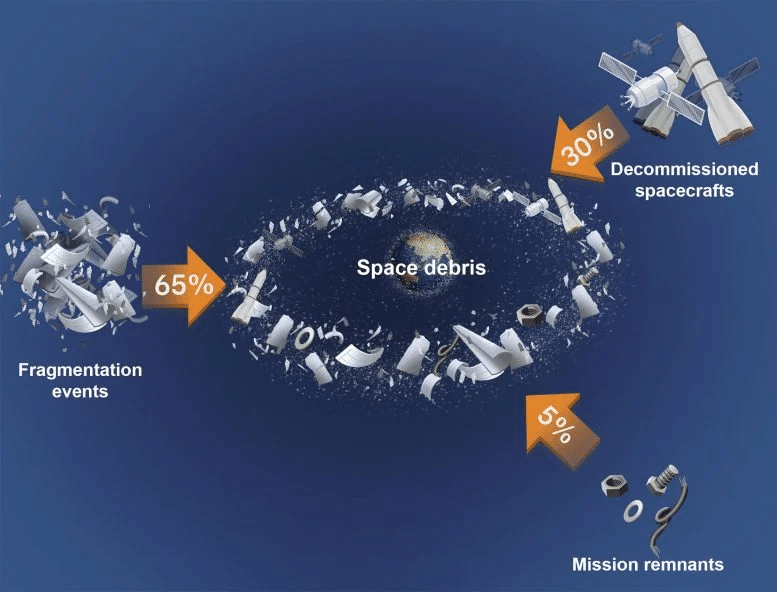
Traditional space missions generally overlook sustainable disposal, leading to an accumulation of orbital junk. This practice wastes materials and resources that remain stranded in space without any recovery or recycling possibilities. Implementing a circular space economy could provide a transformative solution to managing and repurposing space debris effectively.
Circular Economy: Revolutionizing Spacecraft Engineering
The circular economy concept, centered on waste minimization and material reuse, is reshaping terrestrial industries but has yet to be widely adopted in aerospace. The article in Chem Circularity argues that embracing these principles in spacecraft construction and operations could redefine space exploration.
“Our motivation was to bring the conversation about circularity into the space domain, where it’s long overdue,” Xuan states.
In this envisioned circular ecosystem, spacecraft would be engineered for repair, reuse, and final recycling, instead of disposal post-mission. This requires designs that emphasize modularity and robustness, alongside prioritizing materials suitable for recycling. Additionally, orbital facilities capable of repairing, refueling, and manufacturing components could drastically cut new launches, fostering sustainability and reduced costs.
Redesigning spacecraft for durability and maintainability is essential to lowering the environmental impact of space ventures. Such innovation would also facilitate access to space by decreasing launch frequency, which currently carries high financial and ecological costs.
Advanced Technologies Driving Sustainable Space Practices
Integral to the circular economy are cutting-edge tools, including artificial intelligence and robotics, which can monitor, collect, and recycle space debris, helping to avoid further fragmentation. AI might predict and evade collisions between debris and satellites while guiding the creation of greener space vehicles.
Robotic technologies, such as mechanical arms or capture nets, could retrieve derelict objects for reuse or as raw materials for manufacturing in orbit. These tools play a vital role in cleaning orbital environments and supporting sustainable debris management.
Embedding these solutions into regular space operations is vital for achieving long-term eco-friendly exploration.
“We need innovation at every level, from materials that can be reused or recycled in orbit and modular spacecraft that can be upgraded instead of discarded, to data systems that track how hardware ages in space,” Xuan explains.
These advancements promise not only greener but also more economical space missions in the future.
- Categories:
- News









0 comments
Sign in to Comment