
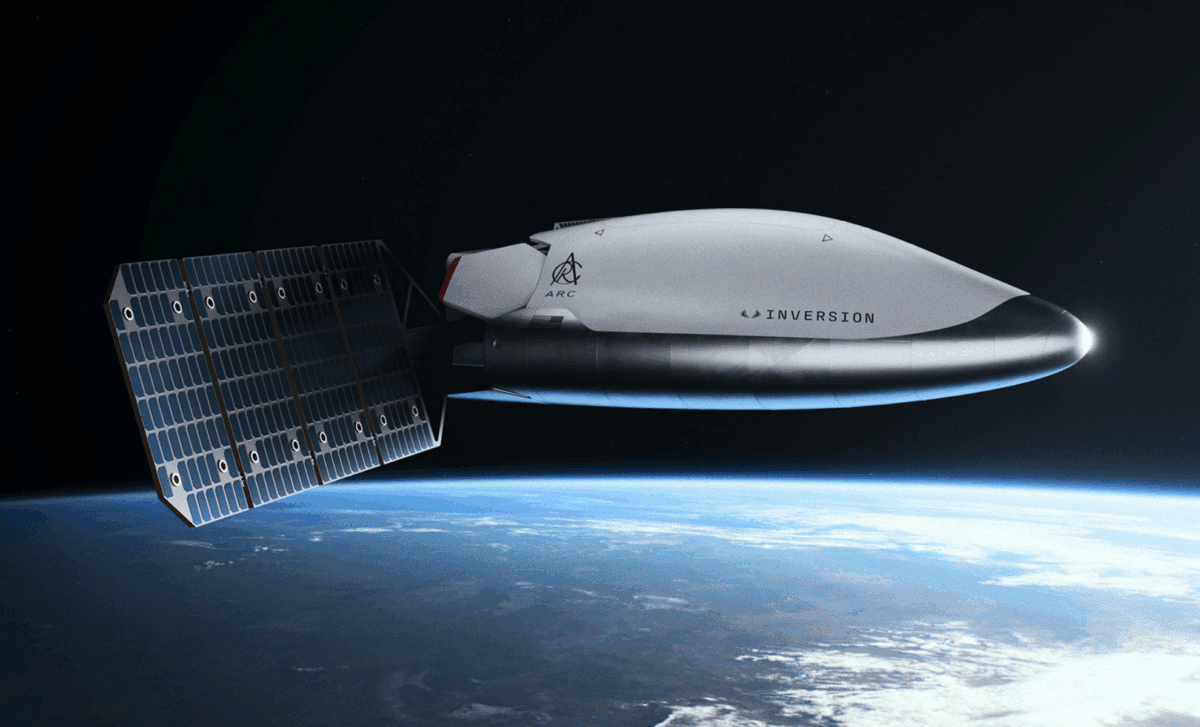
Signaling a major leap in worldwide transportation and defense strategies, the Arc spacecraft developed by Inversion aims to redefine swift cargo movement. According to a report by Ars Technica, this innovative vehicle is engineered to deliver essential supplies—military or civilian—anywhere on the planet in less than an hour. The Arc spacecraft could revolutionize urgent shipments for sectors like healthcare and drone deployment.
Reimagining Cargo Transport with Arc
The core concept behind Arc is to facilitate lightning-fast, on-demand cargo shipments to nearly any point on Earth. This cutting-edge spacecraft transforms the notion of space from merely a distant frontier into a vital logistical channel bridging global locations. Inversion’s co-founder and CEO, Justin Fiaschetti, described this strategic outlook in an interview:
“Space is fun to talk about as a destination, and people really were talking about it that way then. But the true economic value of space is accessing the globe, and we realized we could do that with physical cargo, rather than with just data. And so we founded Inversion to go and build reentry vehicles to go do that.”
Add Cosmo Herald as a Preferred Source

This perspective, viewing space as a practical enabler for worldwide logistics instead of just exploration, drives the mission of the Arc spacecraft. The team at Inversion is focused on deploying Arc for rapid response cargo delivery addressing emergencies or time-sensitive requests, moving beyond data to physically transport critical goods almost anywhere on Earth within sixty minutes.

Engineering and Performance Highlights of Arc
Unlike typical satellites, the Arc spacecraft is a lifting body craft designed to enter and exit Earth's atmosphere efficiently. With dimensions of roughly 4 feet wide by 8 feet tall, it maneuvers through the atmosphere with an impressive cross-range of 1,000 kilometers during reentry, allowing it precise steering toward targeted landing zones without depending on traditional runways.
Arc’s autonomous parachute-assisted landing system requires minimal infrastructure, enabling flexible deployment to diverse environments—be it military installations, isolated regions, or urban settings. Its propulsion system prioritizes safety by using non-toxic materials, allowing immediate human approach post-landing without protective equipment, a critical factor when rapid cargo access is necessary.
Military Impact and National Security Applications
The military’s keen interest in the Arc stems from the urgent need for timely and dependable deliveries of vital materials during operations. As Fiaschetti notes,
“We like to describe this as mission-enabling cargo or effects. This could be a wide variety of specific payloads, anything from medical supplies to drones to what have you. But the key discriminator is, does this make a difference in the moment it’s needed when it gets back down to the ground?”
Arc’s capabilities cater to delivering essential resources—like ammunition, medical kits, or drones—with speed regardless of the location of a crisis or conflict. Fiaschetti further emphasizes the benefits of deployment flexibility:
“The nominal mission for us is pre-positioning Arcs on orbit, and having them stay up there for up to five years, able to be called upon and then autonomously go and land wherever and whenever they’re needed, being able to bring their cargo or effects to the desired location in under an hour.”
This swift logistics approach is especially vital in modern combat scenarios where delays may be critical. Arc’s design ensures supplies can reach pinpoint locations promptly with full autonomy.
Beyond Defense: Unlocking New Horizons for Global Supply Chains
While military applications represent a primary market, Arc’s potential extends widely into commercial sectors. Its rapid delivery function could transform industries including healthcare, emergency response, and humanitarian aid. The ability to transport vital medical supplies or technology to remote or disaster-stricken regions within an hour could have profound global impacts.
Fiaschetti and Inversion envision a future where orbital Arc units are strategically stationed, capable of instant activation to deliver urgent cargo worldwide. This technology promises to become a critical resource for governments, NGOs, and businesses seeking unparalleled delivery speed and reliability.
- Categories:
- News











0 comments
Sign in to Comment