
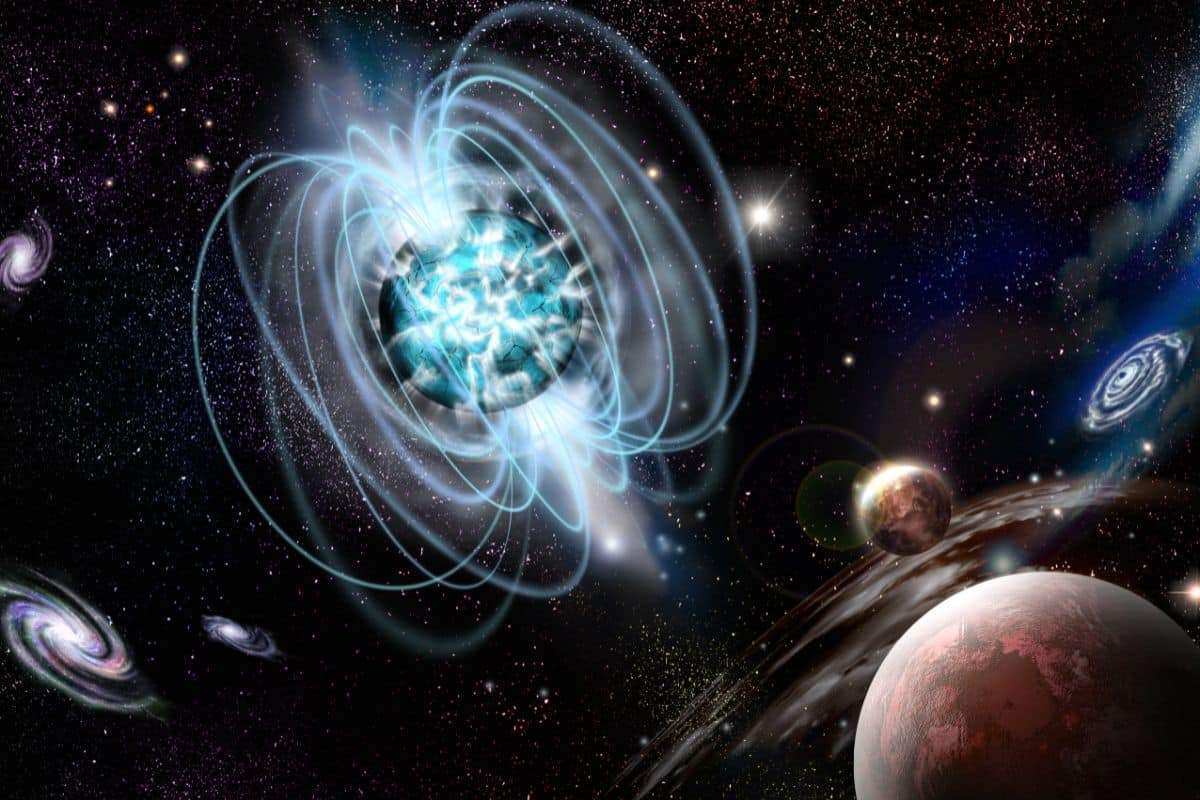
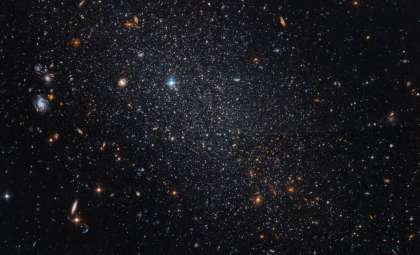
An international team of astronomers has pinpointed the source of a fast radio burst (FRB) in a surprising setting—a tiny and dim dwarf galaxy located over halfway across the known universe. This finding challenges current understandings of these puzzling cosmic flashes and indicates their origins might be far more varied than scientists once thought.
An Unusual Source for an Intense Signal
Fast radio bursts are among the universe’s most baffling phenomena. These brief but powerful pulses of radio energy last only milliseconds while emitting energy comparable to hundreds of millions of Suns. Although many FRBs appear just once, making them elusive targets, some repeat, allowing astronomers to trace them back to their host galaxies.
The particular burst examined, FRB 20190208A, was initially recorded in February 2019. Astronomers affiliated with the University of Amsterdam followed its position using radio observatories over multiple years. Between 2021 and 2023, they detected two more bursts from the same spot. Subsequent observations with optical telescopes aimed to identify the galaxy housing this source.

Contrary to expectations, the search did not reveal a massive, star-forming galaxy typically linked to FRBs. Instead, researchers found an extremely faint dwarf galaxy, suggesting that the range of environments where FRBs arise is broader than previously recognized.
Why Does This Matter?
The majority of known FRBs have been linked to large galaxies abundant in massive stars that end their lives as supernovae. These explosive events often leave behind magnetars, highly magnetized neutron stars believed to be potential FRB sources. Discovering FRB 20190208A inside a dwarf galaxy raises compelling questions about alternative origins.
Astronomer Danté Hewitt, a collaborator on the project, highlighted the surprising nature of this finding: "the faintness of the FRB 20190208A host galaxy implies that it’s one of the least massive FRB host galaxies we’ve ever seen – so that was definitely surprising!"
This points to the possibility that specific conditions in low-metallicity dwarf galaxies might encourage FRB production. These environments tend to form the universe’s most massive stars, which upon collapsing, could generate the exotic objects behind these intense bursts.
Linking Magnetars to Fast Radio Bursts
A leading theory posits that magnetars, remnants of supernova explosions with extraordinarily strong magnetic fields, drive the generation of FRBs. Dwarf galaxies are fertile grounds for such stars because their low metal content allows extremely massive stars to develop, ultimately collapsing into magnetars.
Hewitt proposes that this association might be more than coincidence:
“When the most massive stars die, they unleash some of the most energetic explosions in the Universe; and then maybe, the remnants of those explosions continue to scream into the void, repeatedly producing FRBs.”
This evocative statement suggests a cosmic cycle where the aftermath of the universe’s most violent stellar deaths continues to send powerful signals across space long after the initial explosions have ceased.
- Categories:
- Space







0 comments
Sign in to Comment