
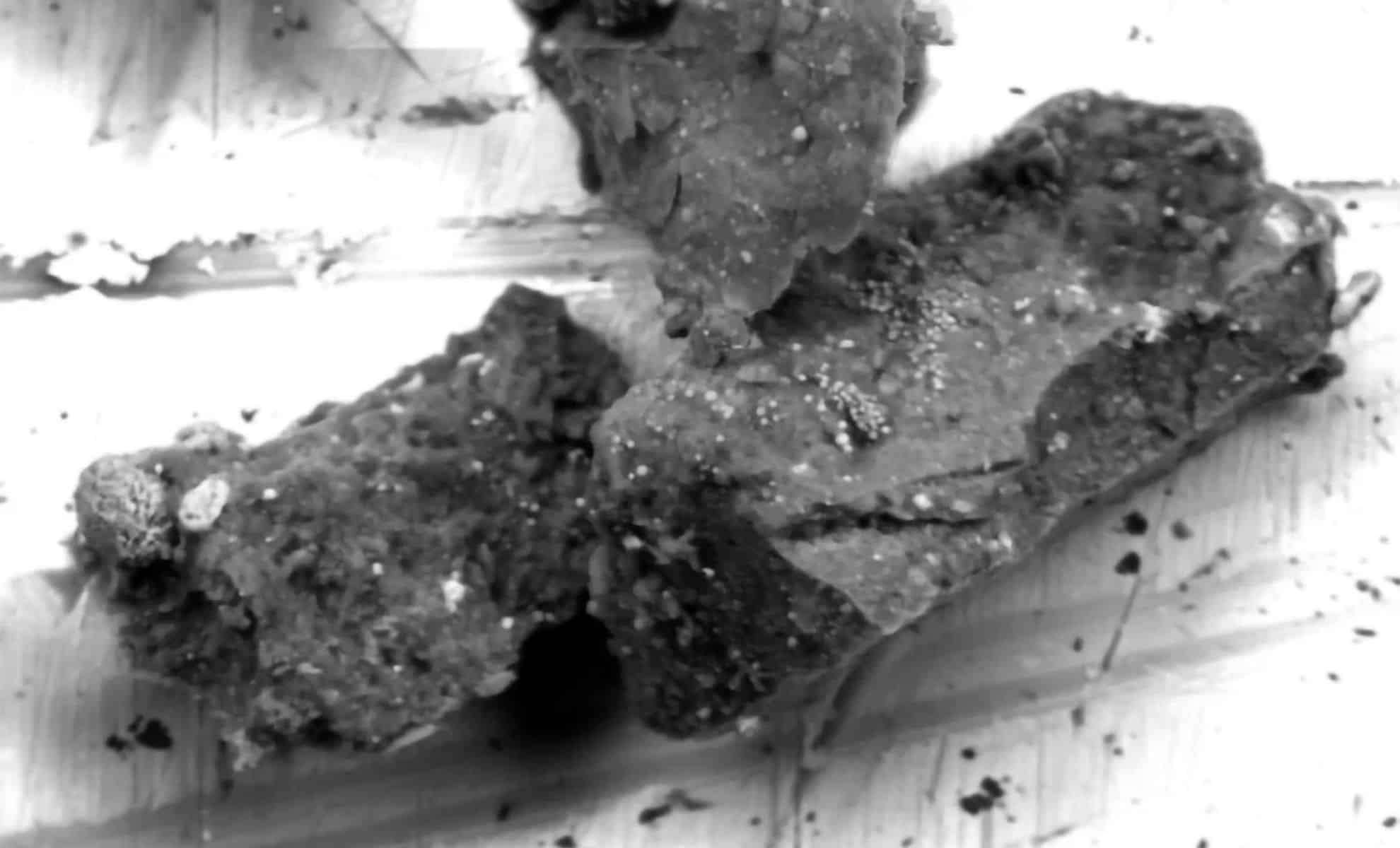
A minute particle retrieved from asteroid Ryugu by Japan’s Hayabusa2 spacecraft has revealed a mineral that scientists did not anticipate. The mineral, known as djerfisherite, is typically associated with environments characterized by very high temperatures and scarce oxygen. Finding this mineral on a cold, ice-covered asteroid poses new questions about asteroid development and sheds light on conditions in the early Solar System.
Ryugu Sample Yields an Unexpected Mineral
The tiny fragment from Ryugu, which arrived on Earth aboard the Hayabusa2 mission in late 2020, is prompting researchers to revise their perspectives on asteroid compositions. Ryugu is classified as a C-type asteroid, rich in carbon compounds and believed to have formed in the Solar System’s icy outskirts. These well-preserved particles were expected to reveal untouched glimpses into primordial cosmic conditions.
Yet, within one particle, a group of scientists from Hiroshima University found djerfisherite, a sulfide mineral containing potassium, iron, and nickel. This mineral normally emerges in highly reduced, high-temperature settings, conditions not associated with Ryugu, thought to be cold and chemically different. Discovering djerfisherite on Ryugu is akin to encountering a tropical plant fossil in arctic ice, hinting at localized heating or external mineral delivery.

Rethinking Ryugu’s Mineral Diversity
The presence of djerfisherite challenges the idea that Ryugu has a uniform makeup shaped solely by cold, ice-rich conditions. Instead, it raises the possibility that localized thermal events or mixing of materials from varied parts of the early Solar System influenced the asteroid’s composition.
Masaaki Miyahara, lead author of the research, stated, “The identification of djerfisherite in a Ryugu particle indicates that materials with distinctly different formation backgrounds may have combined early in the solar nebula’s evolution, or that Ryugu underwent localized, chemically diverse conditions previously unrecognized.”
Debating the Mineral’s Origin
Two main theories arise from the djerfisherite finding on Ryugu. One suggests the mineral was transported from hotter regions closer to the Sun, where it could form naturally. The alternative is that Ryugu’s parent asteroid, though formed far from the Sun’s warmth, experienced heating above 350°C, enabling the mineral’s in situ crystallization.
Studies of other asteroids show djerfisherite’s formation in extreme environments, like those of enstatite chondrites originating nearer the Sun. Thermodynamic models reveal this mineral forms directly from hot gas. However, Ryugu’s origin story involved much cooler conditions dominated by ice and frozen gases such as carbon dioxide.
Miyahara adds, “Our ultimate aim is to unravel the early mixing and thermal processing that shaped small celestial bodies like Ryugu. This will enhance our comprehension of planetary formation and movement of materials in the young Solar System.”
Future Directions for Ryugu Investigations
To further uncover the origins of this enigmatic mineral, researchers plan to conduct isotopic analyses. These will enable scientists to trace the thermal history and provenance of the samples collected from Ryugu.
By examining isotopic signatures, experts hope to decode the mixing mechanisms and heating episodes that affected Ryugu and similar primitive asteroids. This unexpected mineral discovery opens new avenues for understanding the intricate processes involved in early asteroid evolution.
- Categories:
- News




0 comments
Sign in to Comment