
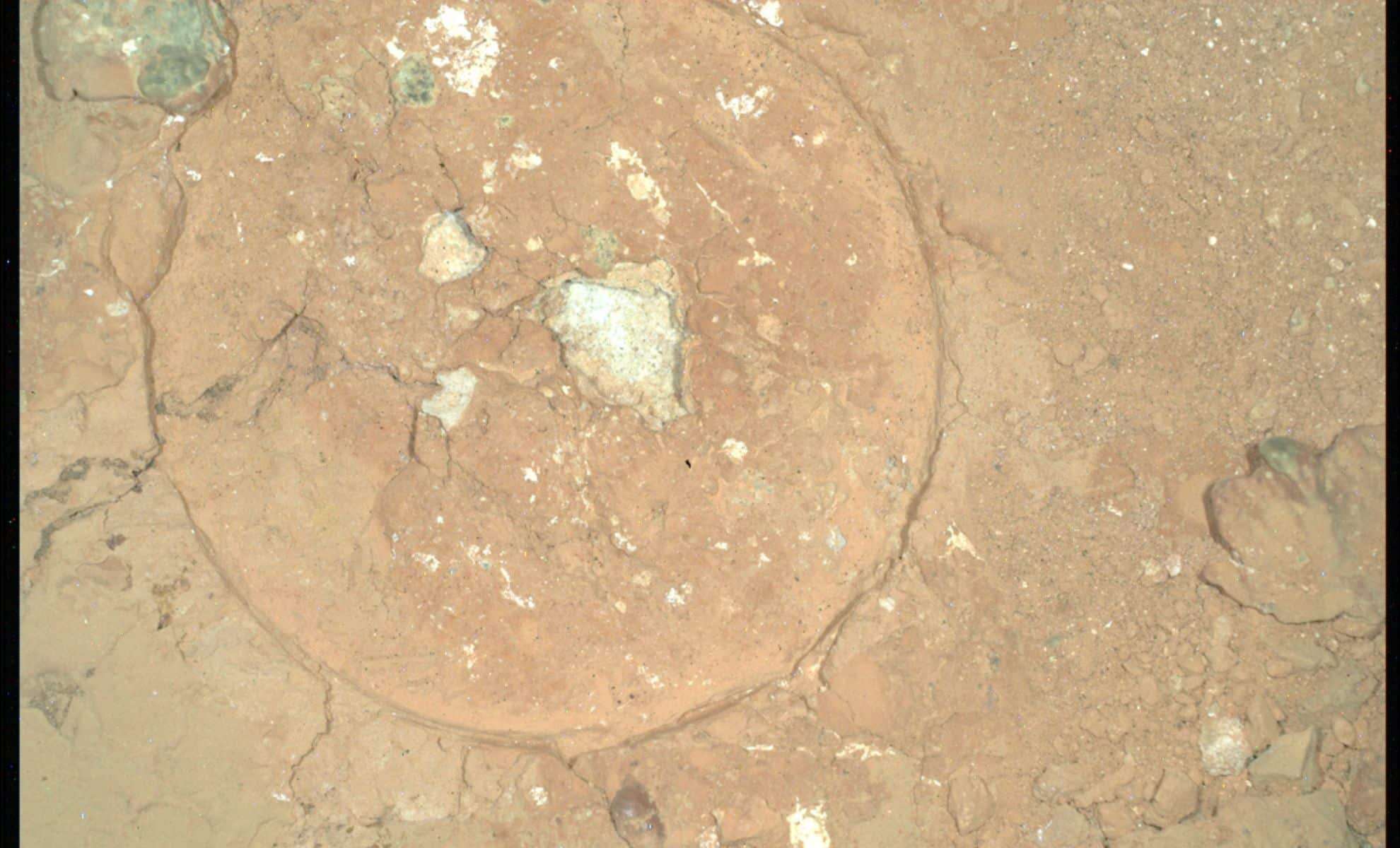
NASA’s Perseverance rover has uncovered unexpected green-tinted spots embedded within red rock surfaces in Jezero Crater on Mars.
Captured through the rover’s specialized SHERLOC WATSON camera during nighttime observations, this fascinating discovery could shed light on Mars’ historical water activity and the possibility of past microbial existence.
Unexpected Color Variations at Serpentine Rapids
On August 19, 2024 (Mars mission sol 1243), Perseverance conducted a rock abrasion experiment at a location called “Serpentine Rapids” within Jezero Crater. The scraped area, labeled “Wallace Butte,” measuring roughly five centimeters across, showed a surprising assortment of hues: white, black, and notably, dull green spots. One green patch approximately two millimeters wide drew particular attention due to its rarity amidst the otherwise iron-oxide rich, reddish landscape.

This occurrence is somewhat familiar to geologists on Earth. Terrestrial rocks known as “red beds” owe their deep red tone to oxidized iron—similar to rust or the red pigmentation in blood. Their green spots emerge when water infiltrates these iron-heavy sediments, triggering a chemical shift from oxidized iron (Fe3+) to its reduced form (Fe2+), which imparts a green shade. According to NASA, these green markings form when liquid water passes through sediment prior to rock solidification. The transformation can involve microbes or non-biological processes such as organic decay or sulfur-iron interactions.
Insights Into Mars’ Water History From the Green Patches
The green discoloration within Martian rock does more than intrigue scientists—it could be a vital clue to ancient water flows on Mars, a necessary ingredient for life. Science communicator Conor Feehly noted, “While the rock’s exact composition remains uncertain, this intriguing discovery promises that Perseverance may uncover additional remarkable features soon.”
Researchers are particularly captivated by the possibility that microbes might have played a role, similar to Earth, influencing the rock’s chemical properties. However, terrain challenges prevented Perseverance from using SHERLOC and PIXL instruments to study the green spots’ chemistry in detail, leaving some uncertainty about their origin. Feehly added, “The team hopes future finds will allow a clearer understanding of the chemical processes behind these green features.”
Facing the Next Challenge: Exiting Jezero Crater
As Perseverance prepares to ascend from Jezero Crater after nearly four years, the mission faces a difficult climb. Steep slopes and rugged terrain lie ahead, but the climb will open access to new rock formations that could deepen knowledge of Mars’ geologic past. Adrian Broz, a postdoctoral researcher on the mission, remarked, “Our team is filled with anticipation about the secrets the crater rim’s ancient rocks might reveal.”
Despite the obstacles, the team remains hopeful that Perseverance’s upward journey will prove fruitful. Once on the crater rim, the rover will encounter fresh geological layers, offering a unique chance for detailed scientific measurements and discovery.
Continuing the Quest to Decipher Mars’ Mysteries
Though these recent findings raise more questions, they underscore the complexity and captivating nature of Mars’ geology. As Perseverance continues exploring, scientists are eager to verify if similar green mineral patches exist elsewhere on the planet and to examine them further. The discoveries to date reinforce the notion that ancient liquid water significantly shaped Mars and may have created conditions favorable for life.
In the months ahead, every new sample and rock analyzed will bring humanity closer to reconstructing Mars’ ancient environment. Perseverance’s mission exemplifies the relentless human drive to explore and understand, fueling hope for uncovering the Red Planet’s hidden stories.
- Categories:
- Astronomy ,
- News ,
- Nasa











0 comments
Sign in to Comment