
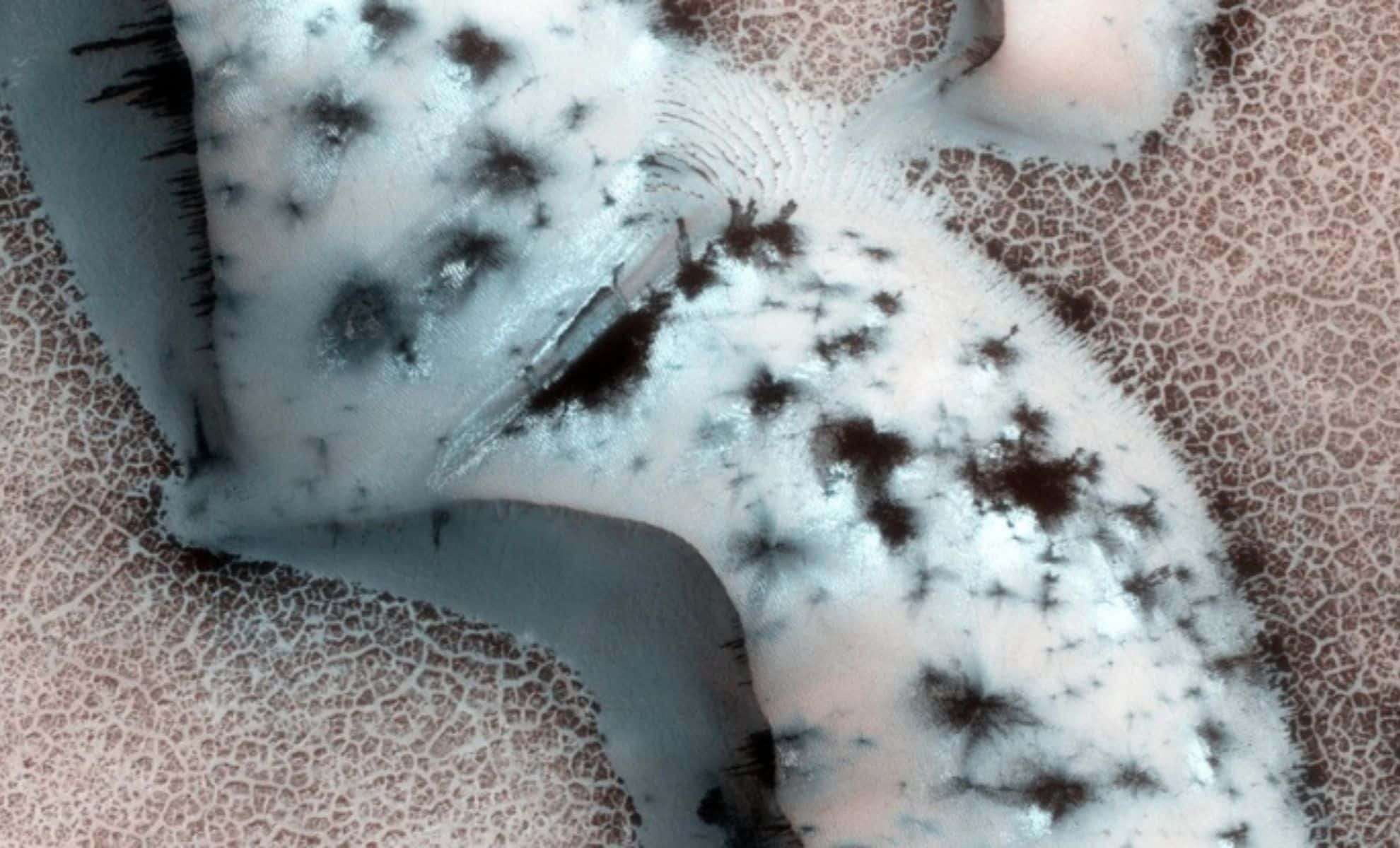
Mars, famous for its vast red deserts, enormous volcanoes, and expansive canyon systems, has revealed an extraordinary new facet of its landscape through detailed images captured by NASA’s Mars Reconnaissance Orbiter. In the planet’s southern polar area, researchers have spotted unusual spider-like structures, large dark streaks, and powerful geysers ejecting material from beneath the ice—phenomena that have no equivalents on Earth’s surface.
These features emerge from a seasonal cycle driven by the sublimation of carbon dioxide (CO2), distinct from Earth’s landscape changes caused by water and wind erosion. With the arrival of spring on Mars, trapped CO2 gas beneath the surface escapes suddenly, chiseling out strange, web-shaped patterns while propelling dark debris across the icy terrain.
After years of investigation, scientists are now decoding the unique mechanisms shaping Mars’ southern polar environment. By exploring these rare formations, they aim to deepen understanding of Martian geology, atmospheric interactions, and the potential for hidden subsurface ecosystems.

Decoding the Unique Characteristics of Mars’ “Spider Terrain”
Among Mars’ most fascinating features is the araneiform terrain, colloquially called Martian spiders, which presents a network of dense, branching channels reminiscent of enormous alien spider webs stretched across the polar ice sheets. In contrast to Earth, where erosion mainly involves water, wind, and tectonic activity, Mars’ spider terrain is sculpted by escaping CO2 gas trapped beneath seasonal ice layers.
Lauren McKeown, a planetary scientist from NASA’s Jet Propulsion Laboratory (JPL), refers to these formations as some of the most remarkable geological features observed beyond Earth. “The spider patterns are unique, intriguing natural formations,” she explained, emphasizing their distinctiveness.
These structures develop when a thick coat of CO2 ice accumulates during Martian winters, sealing gas below the surface. As spring arrives and sunlight penetrates the ice, the underlying ground warms, causing the frozen CO2 to directly transform into gas. This trapped gas pressure builds until it bursts through, shooting up sand and dust in vigorous jets.
CO2-Driven Geysers: Forces Remodel Mars’ Surface
In addition to the spider-like terrain, Mars features seasonal dark spots and geysers that appear during the yearly thaw of the polar ice caps. These CO2-powered eruptions send clouds of dark sediment skyward, leaving behind large, ink-like marks scattered across the frozen landscape.
The Keiffer model, developed in 2006, offers an explanation for these phenomena, depicting how the buildup of pressurized CO2 beneath the ice creates explosive geological activity.
“We suggest that the seasonal ice cap acts as a sealed, translucent slab of CO2 ice that sublimates at the base, creating accumulating high-pressure gas underneath,” stated Keiffer and colleagues in their publication.
This pressure lifts the ice surface before suddenly rupturing it, unleashing high-speed CO2 jets that hurl sand-sized particles into the air, forming extensive dark patches and gradually carving intricate channels into the ground.
“These Martian processes have no parallel on Earth,” the 2006 study’s authors noted, underscoring the alien nature of these dynamic forces.
Summary of Mars’ Peculiar Surface Phenomena
Implications for Future Mars Research and Exploration
Discoveries of the spider terrain and CO2 geysers reveal that Mars exhibits ongoing surface changes rather than being a geologically dormant world. Despite its cold, desolate reputation, the planet supports seasonal processes that actively remodel its landscape.
This challenges the long-held perception of Mars as a dead planet. With CO2 sublimation playing a critical role, the atmosphere’s influence on Martian geology is now seen as far more significant.
Understanding these gas release events will be vital for upcoming missions, helping to inform habitat design, resource extraction methods, and other human exploration strategies.
Additionally, studying CO2 gas movements beneath the surface could help researchers better determine if similar mechanisms ever involved liquid water—an essential factor in the ongoing search for signs of past life on Mars.
Exploring What Lies Ahead
As NASA’s Perseverance Rover, the ExoMars Rover, and planned Mars Sample Return missions embark on their quests, scientists eagerly anticipate new insights into these seasonal phenomena. They question whether these spider-like patterns and geysers existed during Mars’ ancient past, a time when the atmosphere was denser and liquid water more abundant. This raises the possibility that pockets of subsurface gas or liquids might still remain.
Future expeditions may reveal if similar volcanic-like gas eruptions occur in other parts of Mars beyond the south pole, indicating widespread dynamic activity.
For now, the enigmatic and alien terrain of Mars continues to push the boundaries of our planetary knowledge, proving that the Red Planet is far more dynamic and fascinating than ever imagined.
- Categories:
- Astronomy ,
- Nasa







0 comments
Sign in to Comment