
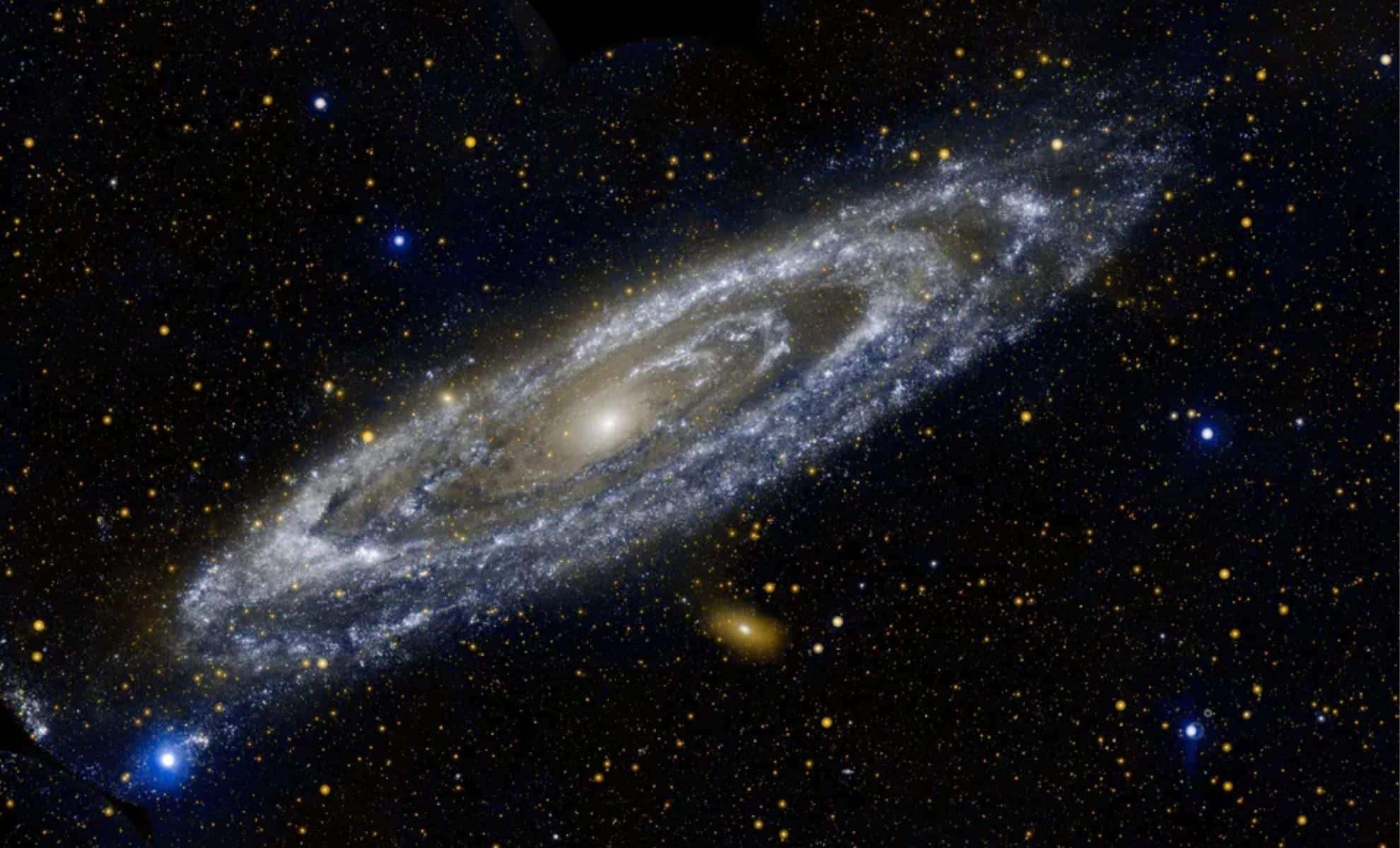
Scientists have made a surprising observation regarding the satellite galaxies orbiting the Andromeda galaxy (M31). A recent paper in Nature Astronomy reveals that nearly all of Andromeda’s 37 satellite galaxies are distinctly oriented toward the Milky Way. This unusual alignment contradicts established galactic formation theories, prompting a reexamination of how such cosmic systems develop.
An Unexpected Pattern in Andromeda’s Satellites
The Andromeda galaxy, the nearest large galaxy to our own, hosts 37 smaller companion galaxies that were once believed to be scattered randomly. Contrary to this expectation, researchers found that most of these satellites are positioned on one side, forming a near-linear alignment aimed directly at the Milky Way. “M31 stands alone as the only known system exhibiting this high degree of lopsidedness,” said lead author Kosuke Jamie Kanehisa from the Leibniz Institute for Astrophysics Potsdam. This satellite arrangement was not predicted by current galaxy formation frameworks.
This distinctive orientation raises fundamental questions about galaxy dynamics and the underlying mechanisms that establish such configurations. The satellites’ coordinated orbits pointing at Earth hint at a recent capture event or interaction. “Observing M31’s satellites in such a precarious setup today — which is quite unusual — likely indicates many of these satellites were only recently gravitationally ensnared,” Kanehisa shared during an interview with Space.com. This suggests the system’s current alignment may be temporary, reflecting recent galactic interactions.

Extremely Rare Phenomenon in Galaxy Formation
To investigate the anomaly, the team compared Andromeda’s satellite layout with galaxy simulations resembling similar structures. Their analysis found that under 0.3% of comparable galaxies feature such an extreme uneven satellite distribution. Kanehisa noted, “While we can’t rule out the existence of equally rare systems elsewhere, Andromeda’s case appears exceptional based on what we've observed.” This implies that the peculiar satellite orientation is not a common occurrence in the universe.
The odds that this satellite alignment arose naturally are astoundingly slim, challenging conventional models proposing that galaxies grow through random mergers of smaller bodies. Typically, satellite galaxies orbiting a dominant galaxy like Andromeda are expected to be more evenly scattered. This finding calls into question the assumption of random satellite distributions and suggests that our understanding of these cosmic systems needs refinement.
Implications for Galaxy Evolution Theory
This discovery has ignited debate over established cosmological models. Classic theories describe galaxy evolution as a chaotic process dominated by mergers, yet the distinct satellite alignment hints at complexity beyond randomness. Kanehisa speculated that this unusual formation may stem from Andromeda’s unique past, possibly tied to a significant merger event about two to three billion years ago that disrupted the galaxy’s structure and influenced its satellites' current configuration. “Possibly related to the major merger thought to have been experienced by Andromeda around two to three billion years ago,” Kanehisa said, hinting at the potential impact of ancient cosmic events on the current satellite arrangement.
Such a rare alignment challenges accepted views on galactic growth and interaction. If Andromeda’s satellite system reflects recent cosmic disturbances, it offers a window into the complex processes driving galaxy mergers and their aftermath. This remarkable case reveals how seemingly improbable outcomes can emerge from the dynamic and turbulent nature of galaxy formation.
- Categories:
- News








0 comments
Sign in to Comment