

NASA has recently unveiled high-resolution radar images of near-Earth asteroids, uncovering new details including a small moon orbiting one of the asteroids.
These remarkable images were obtained thanks to the sophisticated capabilities of NASA’s Goldstone Solar System Radar facility in California.
Close Flyby of Asteroid 2011 UL21
On June 27, 2024, the asteroid 2011 UL21 (also cataloged as 415029) made a flyby at a distance around 4.1 million miles (6.6 million kilometers) from Earth, roughly 17 times farther than the Moon.

Although this asteroid posed no threat, the proximity enabled NASA to capture sharp images of the object, which spans roughly one mile (1.5 kilometers) across. Observations revealed that 2011 UL21 is actually a binary system, featuring a smaller companion, or moonlet, orbiting at about 1.9 miles (3 kilometers) away.
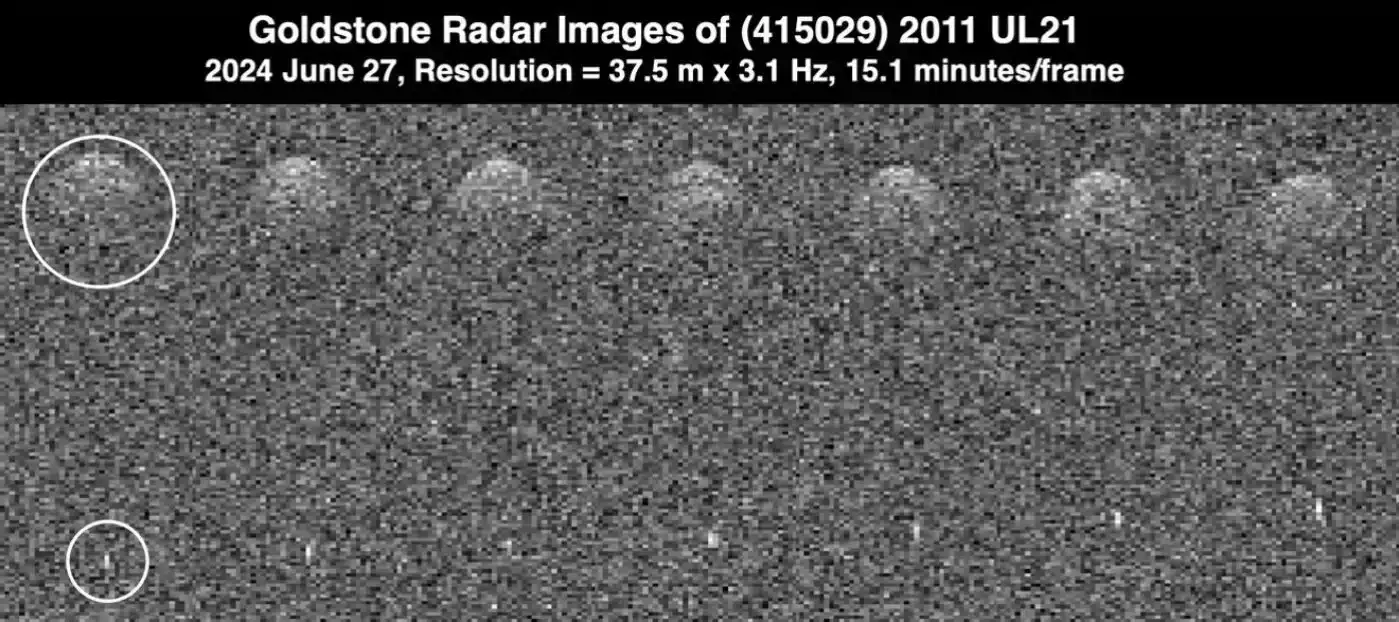
Lance Benner, a lead scientist at NASA’s Jet Propulsion Laboratory, emphasized the significance: “It is thought that about two-thirds of asteroids of this size are binary systems, and their discovery is particularly important because we can use measurements of their relative positions to estimate their mutual orbits, masses, and densities, which provide key information about how they may have formed.”
Radar Imaging Technology Employed
The stunning visuals were created using the 230-foot (70-meter) wide Goldstone Solar System Radar antenna. Part of NASA’s Deep Space Network, this setup transmits radio signals towards asteroids and detects reflected waves to produce detailed images of their shapes and surface features, including any satellites.
These radar observations have provided crucial insight into the asteroid’s physical makeup, enhancing our knowledge of these small solar system bodies.
Asteroid 2024 MK’s Earth Approach
Alongside 2011 UL21, NASA also monitored asteroid 2024 MK as it neared Earth on June 29, 2024. This smaller object, about 500 feet (150 meters) in diameter, passed at a distance of 184,000 miles (295,000 kilometers), within the range of the Moon.
Radar scans from Goldstone revealed intricate surface details on 2024 MK, such as grooves, ridges, and boulders up to 30 feet (10 meters) wide.

Benner remarked, “This was an extraordinary opportunity to investigate the physical properties and obtain detailed images of a near-Earth asteroid,” highlighting the value of these encounters in expanding our understanding of near-Earth objects (NEOs).
Why Tracking Near-Earth Objects Matters
Monitoring these asteroids is essential for gaining insights into their nature and behavior, which is critical for planetary defense strategies. While large asteroids like 2011 UL21 do not currently threaten Earth, smaller bodies still have the potential to cause massive destruction if they collide with our planet.
An asteroid roughly 100 to 170 feet wide could unleash a powerful explosion capable of devastating urban areas. The 2013 Chelyabinsk event serves as a reminder, when a 56-foot (17-meter) asteroid detonated over Russia, causing widespread damage and injuries.
NASA’s ongoing efforts to track and study these space rocks enable better preparedness for any future threats. Data from radar imaging not only deepens scientific knowledge but also supports developing techniques for asteroid deflection and impact mitigation.
The latest observations of 2011 UL21 and 2024 MK underscore the dedication of NASA and the global scientific community to continuously monitor and study the numerous objects that travel near Earth. Through advanced technology and persistent surveillance, we secure critical information vital for planetary safety and future space exploration.
- Categories:
- Astronomy ,
- News ,
- Space ,
- Nasa









0 comments
Sign in to Comment