
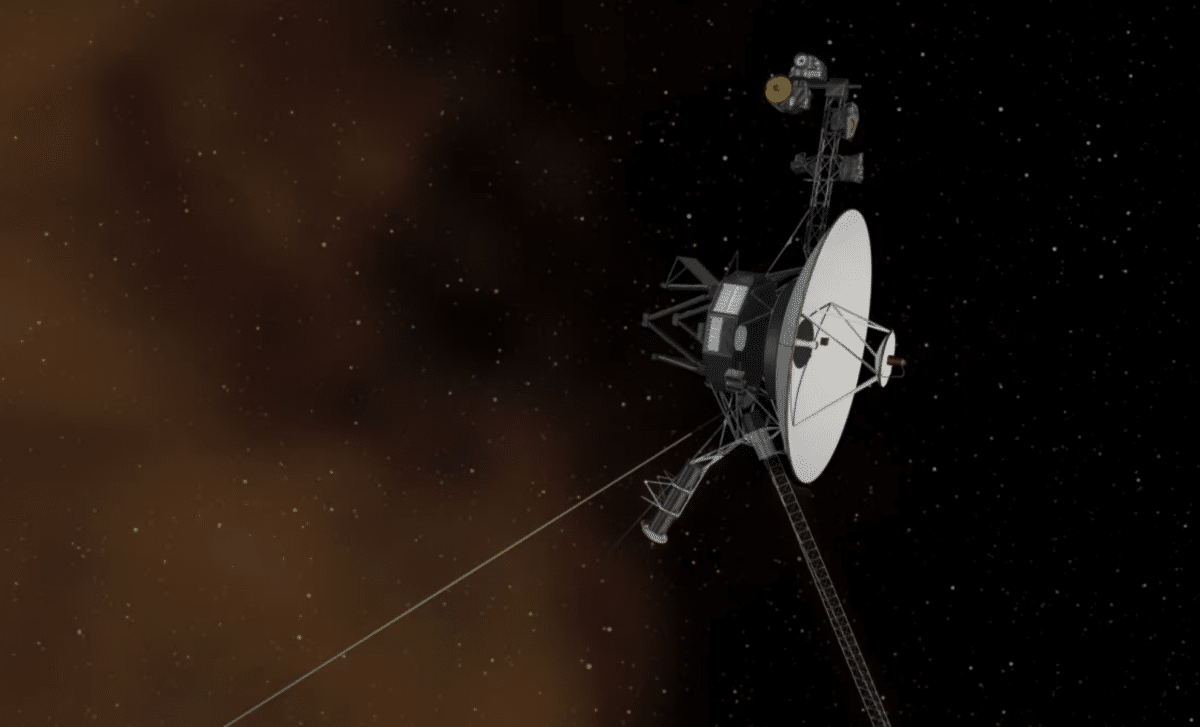
Almost fifty years after embarking on its historic voyage, Voyager 1 is nearing an extraordinary landmark in space exploration. In November 2026, it is expected to become the first artificial object to reach a distance from Earth equivalent to one light-day. This feat highlights not only the mission's unparalleled longevity but also the immense expanse of space beyond our solar system, where Voyager 1 continues to collect valuable data well beyond its original mission to the outer planets.
A Human-Made Cosmic Distance Record
When Voyager 1 crosses the one-light-day threshold, it will be positioned over 25.9 billion kilometers (approximately 15 billion miles) from Earth. At this vast separation, a radio transmission traveling at light speed will take about 24 hours to travel between the spacecraft and our planet. No other human-built craft has ever journeyed so far into the cosmos.
This milestone holds deep significance both scientifically and symbolically. Usually, distances in space are described in massive numbers of kilometers, which can feel abstract. Defining distance by a light-day provides a tangible frame of reference, representing how far light itself travels in a full day. Since its 1977 launch, Voyager 1 has been steadily moving outward, facing extreme conditions and overcoming technical challenges far beyond initial expectations.

What makes this accomplishment even more impressive is that the spacecraft remains functional. Scientists and engineers still receive valuable scientific measurements from a probe created with 1970s technology. Its mission stands as a testament to engineering excellence, greatly surpassing its planned lifespan and continuing to shed light on a largely mysterious region of space.
Voyager 1’s Remarkable Exploration Beyond Our Solar Neighborhood
Launched on September 5, 1977, shortly after its counterpart, Voyager 2, Voyager 1 capitalized on a rare planetary alignment enabling historic flybys of the gas giants. Its observations of Jupiter and Saturn revolutionized our understanding of these planets and their moons.
But its mission extended far beyond those visits. In 2012, Voyager 1 became the first spacecraft to enter interstellar space, passing out of the heliosphere — the magnetic bubble created by the Sun's solar wind. This boundary marks the transition from the Sun’s influence to the broader galactic environment.
Since crossing into interstellar space, Voyager 1 has continued to measure charged particles, magnetic fields, and cosmic radiation, offering scientists unprecedented insights into a scarcely studied region. Each new data transmission enriches our comprehension of the space lying between stars.
As noted by BBC Sky at Night Magazine, the mission has encountered numerous hurdles, including aging hardware, dwindling power levels, and communication difficulties. Engineers have devised innovative strategies to maintain the spacecraft’s functionality, enabling Voyager 1 to continue surpassing prior expectations.
The Timeless Presence of the Golden Record and Voyager’s Enduring Legacy
A defining element of both Voyager spacecraft is the iconic Golden Record, which carries sounds, images, greetings in various languages, and cultural artifacts meant to represent Earth. It serves as an interstellar message, intended for any intelligent life that might encounter the probe in the distant future.
Even after it stops sending data, Voyager 1 will keep drifting silently through the galaxy. Scientists predict that in about 40,000 years, it will pass relatively near the star Gliese 445. Although the likelihood of the spacecraft being found is extremely low, the Golden Record symbolizes humanity’s enduring wish to reach out beyond our own world.
Eventually, Voyager 1’s power supply will be exhausted, ending all communication with Earth. Yet the craft will persist in its journey through interstellar space for millions of years. Its odyssey will outlast countless generations and many milestones of human civilization.
As the probe nears the one-light-day milestone in 2026, it serves as a profound reminder of humanity’s boundless curiosity. Nearly half a century after launch, this small spacecraft continues its voyage deeper into the cosmos, bearing scientific treasures and a message from Earth to the stars.
- Categories:
- News




0 comments
Sign in to Comment