
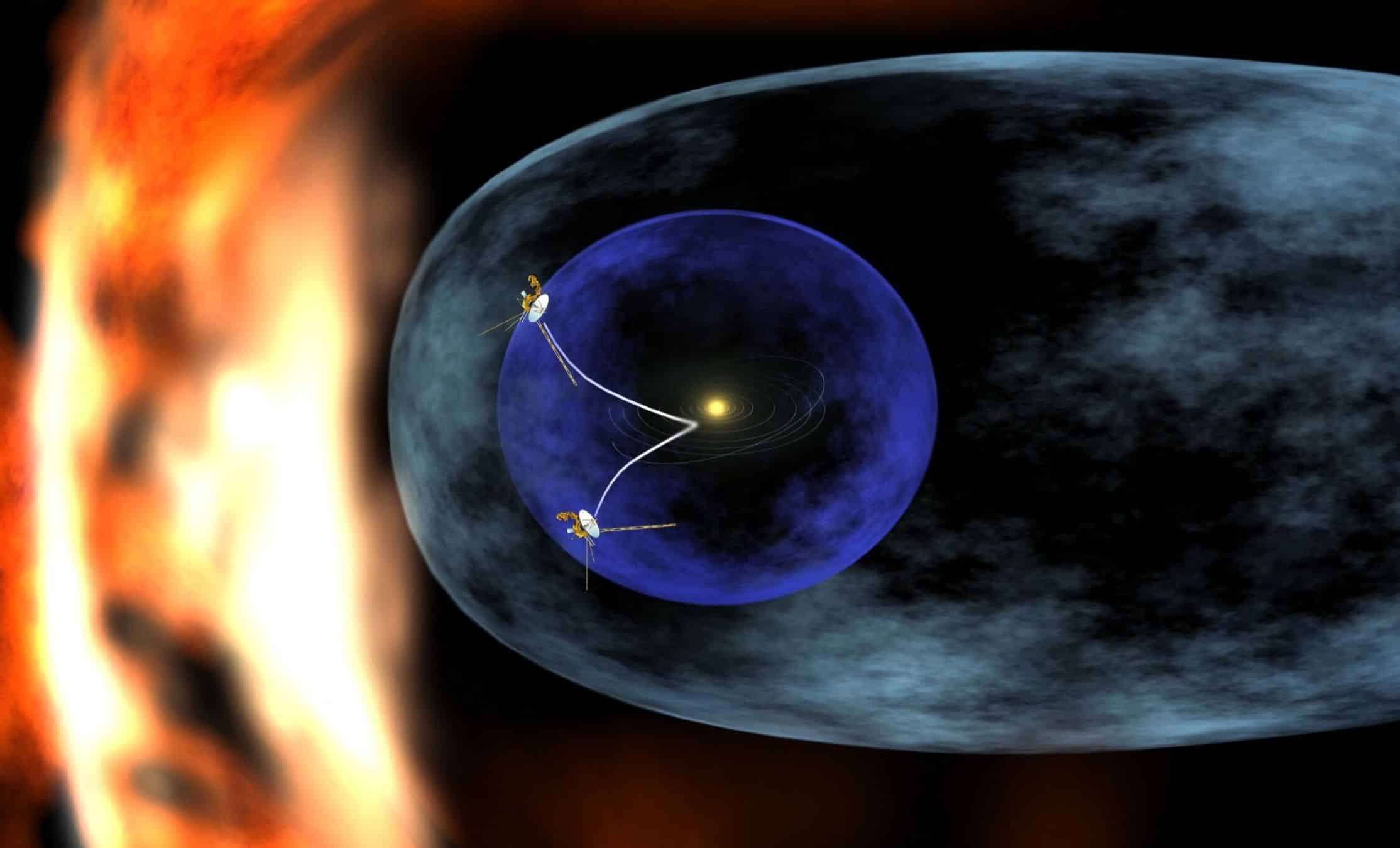
NASA’s Voyager missions have ventured beyond our Solar System, discovering an extraordinary feature: a scorching, high-temperature region known as the “firewall” beyond the solar boundary. Located at the heliopause, this area marks the threshold where the Sun’s domain gives way to interstellar space. According to the NASA Heliophysics program, the heliosphere is a vast bubble generated by the solar wind expanding far beyond Pluto’s orbit, with the heliopause acting as the dividing line between solar and galactic winds. Currently, only Voyager 1 and Voyager 2 have passed this boundary, offering an unprecedented perspective on this remote region.
The Intense Boundary of Our Solar Neighborhood
Launched in 1977, the Voyager spacecraft were tasked with exploring the Solar System’s frontier and the space beyond. After decades of travel, Voyager 1 became the pioneer to traverse the heliosphere boundary in 2012, with Voyager 2 following in 2018. Upon crossing this frontier, the probes detected a dramatic rise in temperature—ranging between 30,000 and 50,000 Kelvin (54,000 to 90,000 °F)—in an area that scientists now call the “firewall.”
This remarkable heat signature appears beyond the heliopause, where the Sun’s solar wind encounters incoming interstellar winds. Although not a tangible wall, the elevated temperature reveals intense interactions between these opposing forces, generating a zone rich in high-energy particles. The Voyagers’ longevity amidst these extreme conditions owes to the sparse particle environment, which limits heat transfer through collisions.

Decoding the Heliosphere’s Edge
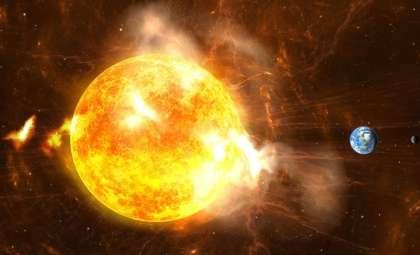
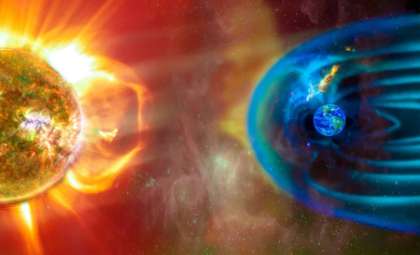
The heliosphere is an enormous enclosure shaped by charged particles streaming from the Sun, known as the solar wind. This bubble stretches well past Pluto, reaching distances triple that from the Sun to the outermost planets. As explained by NASA, “The Sun sends out a constant flow of charged particles called the solar wind, which ultimately travels past all the planets to some three times the distance to Pluto before being impeded by the interstellar medium.” This protective region envelops the Sun and its planets.
The boundary of this bubble, the heliopause, marks where the solar wind ends and interstellar winds begin to dominate. NASA states, “The boundary between solar wind and interstellar wind is the heliopause, where the pressure of the two winds are in balance. This balance in pressure causes the solar wind to turn back and flow down the tail of the heliosphere.” This pressure balance molds the boundary, and as the heliosphere travels through space, it produces a bow shock—similar to the turbulent waves created by a boat moving through water.
Magnetic Field Discoveries Past the Heliosphere
Beyond temperature readings, both Voyager probes have made fascinating magnetic field findings. Notably, Voyager 2’s measurements confirmed Voyager 1’s discovery that the magnetic field just beyond the heliopause aligns closely with the field inside the heliosphere.
NASA detailed this, saying, “An observation by Voyager 2’s magnetic field instrument confirms a surprising result from Voyager 1: The magnetic field in the region just beyond the heliopause is parallel to the magnetic field inside the heliosphere.” Early on, scientists debated whether this alignment was a local anomaly or a widespread characteristic. NASA further explained, “With Voyager 1, scientists had only one sample of these magnetic fields and couldn’t say for sure whether the apparent alignment was characteristic of the entire exterior region or just a coincidence. Voyager 2’s magnetometer observations confirm the Voyager 1 finding and indicate that the two fields align.”
This magnetic alignment sheds new light on the complex nature of interstellar space just outside our Solar System. It revises earlier theories and paves the way for deeper understanding of how the Sun interacts with its galactic environment.
- Categories:
- News



0 comments
Sign in to Comment