

On the evenings of July 23 and 24, sky enthusiasts can enjoy a rare sight of the moon alongside Saturn in the nighttime sky.
This celestial gathering, observable from many global locations, is a perfect occasion to witness two prominent space objects appearing close together.
When and Where to See the Moon-Saturn Close Encounter
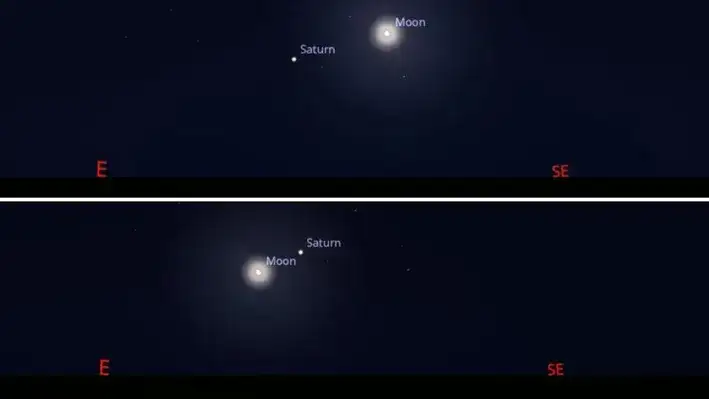
Saturn, the solar system’s sixth planet and the second largest, rises just before midnight throughout July and reaches its highest point in the southern sky before dawn. On the night of July 23, observers in North America should look toward the east near 11:00 PM EDT to spot a 90% illuminated waning gibbous moon positioned slightly above and to the right of Saturn.

Arriving about half an hour prior is ideal for catching the moonrise. On July 24, the moon, now 81% illuminated, will appear closer to the horizon and to the left of Saturn. Because moonrise timing varies by location, checking local schedules is advised. This pairing creates a captivating view, with the bright lunar glow and the yellowish sheen of Saturn set against the Aquarius constellation.
This rare alignment is accessible to amateur stargazers and doesn’t demand advanced telescopes to enjoy.
Tips for Viewing and Gear Recommendations
Both nights offer spectacular views framed by the Aquarius constellation. In North America, the moon and Saturn will be about 10 degrees apart, while observers in some parts of Asia and Africa will witness a moon occultation of Saturn, temporarily obscuring the planet.
This phenomenon can be observed in eastern Africa, southern and eastern India, northwest Indonesia, and areas of southeast Asia, China, and Mongolia. To see Saturn's iconic rings clearly, a telescope with a minimum aperture of 2 inches (50mm) is advisable.
While binoculars or the naked eye will show Saturn as a bright yellowish star-like point, its rings remain out of reach without optical aid. For the best experience, choose a dark location free from city lights with a clear eastern horizon. Arrive early to set up and let your eyes adjust to the darkness for optimal viewing.
Understanding the Celestial Interaction
Although the moon appears near Saturn in the sky, this is a line-of-sight coincidence, as the moon is roughly 238,855 miles (384,400 km) from Earth, compared to Saturn’s distance of about 832 million miles (1.34 billion km) on these dates. The closeness is solely due to the Earth's viewpoint.
Saturn is currently nearing full illumination as it heads toward its opposition on September 8, when it will be largest and brightest in the sky, perfectly positioned opposite the Sun.
This moon-Saturn conjunction offers not only a stunning visual but also a reminder of the ever-changing dance of planets and moons within our solar system.
Tips for Photographing the Event
Astrophotographers can capture this event using cameras with telephoto lenses or small telescopes paired with DSLR cameras for the best shots. A stable tripod and remote shutter or timer settings will reduce blur and enhance photo quality.
Stacking multiple images using specialized software can reveal more intricate details of the moon’s surface and Saturn's rings.
This event is an excellent chance to refine night-sky photography skills and share awe-inspiring images of this cosmic alignment.
- Categories:
- Astronomy ,
- News ,
- Space





0 comments
Sign in to Comment