
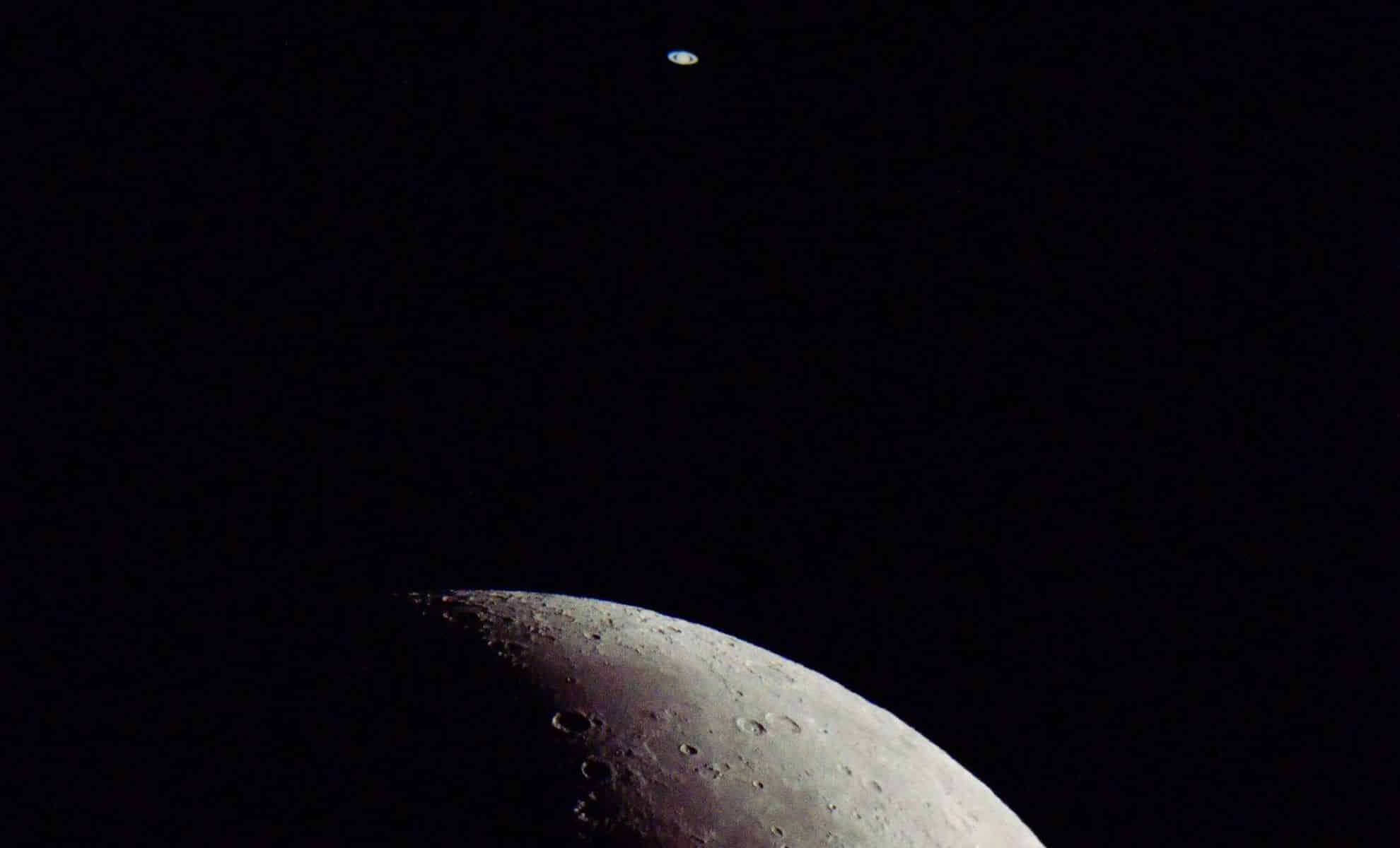
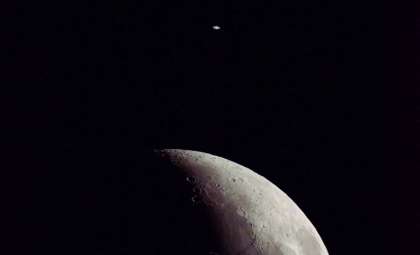
An extraordinary astronomical display is set to unfold on September 8, 2025, featuring Saturn positioned less than 5 degrees away from the nearly full waning gibbous moon shortly after sunset, according to Space.com. This rare close conjunction will provide sky enthusiasts worldwide a stunning visual treat visible to the naked eye—an event made even more remarkable coming just after a total lunar eclipse.
A Captivating Evening Encounter
On the night of September 8, moments following sunset, viewers gazing toward the eastern horizon will spot Saturn shining just to the right of the moon, separated by approximately five degrees—comparable to the span of three fingers held at arm’s length. This pairing will be located within the Pisces constellation, positioned just below the stars that outline the head of the “great western fish.” Saturn’s distinct golden glow will contrast beautifully against the bright silvery face of the moon, which will be illuminated at about 96%, still shining brightly from reflected sunlight.
This close visual arrangement is especially appealing to those without optical aids, allowing residents of both urban and rural areas to appreciate the spectacle. Since this event follows the total lunar eclipse from September 7, the moon may exhibit a subtle reddish hue, a residual effect from its time within Earth’s shadow, creating a dramatic counterpoint to Saturn’s steady golden tint and enhancing the overall scene.

Visual Features and Viewing Tips
As a waning gibbous moon, the lunar surface will reveal detailed features to the naked eye. Although a full moon often obscures nearby objects, Saturn’s brightness along with its prominent position in the eastern sky will make it evident. Those equipped with binoculars or telescopes will gain an enriched experience. Moderate magnification can uncover Saturn’s iconic rings, and telescopes of at least 8 inches (200 mm) aperture may reveal the Cassini Division, the prominent 4,500-kilometer gap in its ring system.
It’s notable that Neptune, while not visible without optical aid, will be situated just three degrees to Saturn’s left. Enthusiasts using high-powered telescopes might glimpse Neptune’s faint bluish disk, adding further interest to the night sky display.
Astrophotographers have an excellent opportunity to capture this event, with twilight’s residual glow providing ideal contrast between the celestial bodies and Earth’s horizon. Utilizing telephoto lenses or wide-angle cameras with long-exposure settings can effectively showcase the closeness of Saturn and the moon amid the starry backdrop.
The Astronomical Mechanisms Behind the Display
Conjunctions like this occur when two celestial objects appear near one another from Earth’s vantage point, despite vast differences in distance—Saturn being over 800 million miles away, while the moon orbits approximately 240,000 miles from us. These visual alignments highlight the intricate and graceful movements within our solar system.
This event’s location within Pisces adds a layer of historical and cultural significance. Ancients often interpreted conjunctions in similar constellations as omens or special occurrences. Today, such events inspire wonder and appreciation for the vastness of the cosmos and our quest to understand it.
Moreover, occurring just after a full moon phase, the reduced shadowed relief on the lunar surface enhances visibility of the lunar maria—large basaltic plains created by ancient volcanic activity. Viewers may recognize familiar dark patterns such as the “man in the moon” or other culturally significant shapes formed by the moon’s uneven terrain.
Viewing Advice: When, Where, and How
This conjunction will be observable across much of the Northern Hemisphere, including areas of North America, Europe, and parts of Asia, weather permitting. Optimal viewing will occur just after sunset, roughly between 7:30 and 8:00 PM local time, varying by location and time zone. Both objects will be visible well above the horizon by nightfall, provided horizons are free of obstruction from buildings, trees, or mountains.
For best results, seek a dark site with minimal light pollution and an unobstructed view of the eastern horizon. Smartphone apps like SkySafari, Stellarium, and Star Walk 2 can assist in locating the precise positions of Saturn and the moon based on your GPS data.
Should weather conditions be unfavorable, some astronomy organizations and observatories may offer livestream coverage of the event, allowing virtual spectators to experience the conjunction through professional telescopes complemented by expert narration and astrophotography.
- Categories:
- News



0 comments
Sign in to Comment